Want to win more jobs with less effort?
Grow your business and send quick quotes with our home service software.

Want to see your potential revenue?
See what businesses like yours earn with Housecall Pro in 1 - 2 minutes.
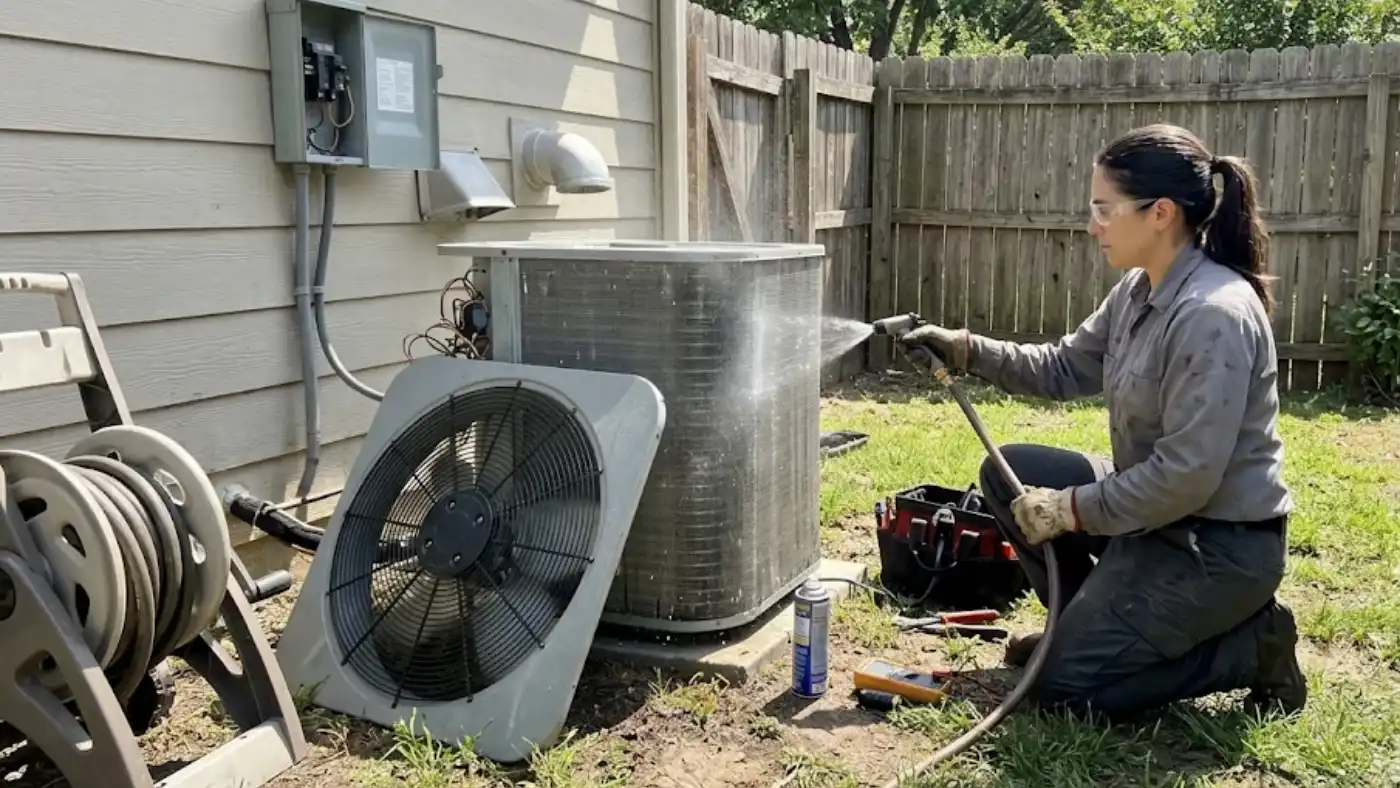
HVAC flat rate pricing gives your customer one price for a defined job before work begins. It works well for common repairs and maintenance visits where you know what’s involved, helping customers understand what they’ll pay and giving your techs a consistent way to quote the work.
To make it work for your business, your prices need to cover labor, parts, overhead, and the profit you want to earn. A repair that looks profitable based on the part and time on site can leave you short once you account for travel, dispatch, insurance, and return trips.
Here’s how to calculate your flat rates, compare them with service benchmarks, and build a price book your team can use in the field.
Quick answer: What is HVAC flat rate pricing and how do you calculate it?
HVAC flat rate pricing means charging one set price for a defined job, such as a capacitor replacement or drain line clearing. The customer approves it before work begins, and it stays the same even if the job takes longer. To calculate yours, divide your total cost (loaded labor, parts, materials, and allocated overhead) by one minus your target profit margin. Then build a price book from your 10–20 most common services.
Table of contents
- How HVAC flat rate pricing works
- HVAC flat rate prices to compare with your own rates
- How to calculate HVAC flat rate pricing
- How to build an HVAC flat rate price book
- HVAC flat rate pricing template: what to include and a sample row
- How to keep your flat rate prices accurate
- How to explain flat rate prices to customers
- How to present good, better, best options for HVAC replacements
- Do you need HVAC flat rate pricing software?
- How Housecall Pro helps you manage flat rate pricing
HVAC flat rate pricing formula:
Flat rate price = Total cost ÷ (1 − Target profit margin)
Total cost includes the full cost of employing your tech, parts, materials, and a share of your business expenses. Enter your target profit margin as a decimal: 10% becomes 0.10.
If you find another problem, explain the extra work and get the customer’s approval on the price before you start.
How HVAC flat rate pricing works
After diagnosing the problem, your tech selects the matching service from your price book and explains what’s included. The customer approves the price before the repair begins.
Say you charge $150 per hour plus $50 in parts for a repair. The customer would pay $200 if it takes one hour or $350 if it takes two, before any other charges.
With a $250 flat rate, the customer pays $250 for that repair either way. You cover the extra labor cost if it takes longer, so base your time estimates on completed jobs.
Flat rate vs. time and materials
Flat rates work well when you know what the job involves. Time and materials can be a better fit when you need to investigate further before you can price the full repair.
| Pricing consideration | Flat rate | Time and materials |
| How you charge | One price for a defined job | Labor time plus materials at agreed rates |
| If the same work takes longer | Your business absorbs the extra cost | The customer’s bill generally increases |
| Best fit | Common repairs, tune-ups, and clearly scoped replacements | Troubleshooting and jobs with uncertain conditions |
| What to explain | Included work, exclusions, and total price | Labor rate, material charges, and any minimums or limits |
You can also use both: Charge a diagnostic fee to find the problem, then quote a flat rate for the repair. Our HVAC pricing guide covers more ways to price your services.
Pros and cons of flat rate pricing
Flat rates can simplify quoting, but they depend on accurate costs and clear service descriptions.
Benefits:
- Techs can easily quote the same price for the same work.
- Customers can compare options before approving the work.
- Finishing a correctly priced job in less time can improve your margin.
Tradeoffs:
- Underestimated labor time reduces your profit.
- Outdated parts costs can leave you charging too little for common repairs.
- Difficult access (such as an attic air handler or a rooftop unit) or unusual equipment may require a separate quote.
ACCA’s 2025 Contractor of the Future study reported average net profits of 7% among contractors using flat rate pricing for service calls, compared with 4% for other methods. The study compares reported results; switching to flat rates alone won’t guarantee higher profits.
HVAC flat rate prices to compare with your own rates
These prices from Housecall Pro customer data can help you check what other businesses charge for common HVAC services. Before comparing your price, check that the service includes similar work.
| Service | Average price range | |
| Residential diagnostic service | $85-$125 | |
| AC tune-up | $89-$159 | |
| Furnace maintenance | $100-$198 | |
| Capacitor replacement | $136-$295 | |
| HVAC contactor replacement | $175-$389 | |
| Blower motor replacement | $341-$978 | |
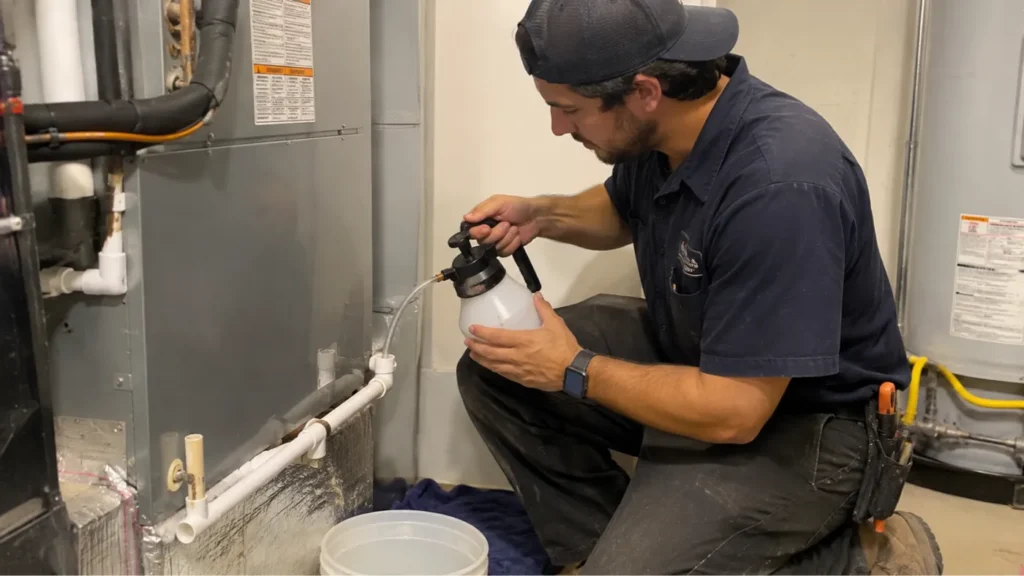
| Condensate drain line clearing and flushing | $125-$249 | |
| Chemical coil cleaning | $149-$475 |
How we sourced HVAC pricing data
These pricing ranges come from real HVAC service entries from Housecall Pro customers over a rolling 12-month period, ending October 2026. The national dataset includes 3,251,175 service entries across 101 HVAC service categories. We group similar services, filter out unusually high and low prices, and give more weight to recent data when calculating national benchmarks.
Ranges reflect individual services and may not include every charge on the final bill. Use them to compare similar work, then set your prices based on your labor, materials, overhead, and profit goals.
How to calculate HVAC flat rate pricing
Start with what the service costs your business, then use your target profit margin to calculate the selling price. We’ll work through an example using hypothetical costs for a one-hour diagnostic visit.
Step 1: Calculate your loaded labor cost
Your full labor cost, also called loaded labor, includes wages, employer payroll taxes, workers’ comp, benefits, and paid time off.
Include paid time you can’t bill to a customer, such as training and meetings. You can build that expense into your labor cost or overhead—just make sure you only count it once.
For this example, assume your full labor cost is $60 per billable hour. A one-hour service costs your business $60 in labor before materials and overhead.
You’ll use that $60 to calculate your selling price. It isn’t the rate you charge customers.
→ See our HVAC salary guide for national and state averages on what to pay your techs.
Step 2: Add materials and overhead
Overhead covers expenses such as dispatch, office payroll, vehicles, rent, and software.
Spread those costs across the hours you realistically expect to bill:
Overhead per billable hour = Annual overhead ÷ Expected annual billable hours
For example, $120,000 in annual overhead divided by 1,200 billable hours equals $100 per billable hour.
Dividing by 2,000 paid hours would produce $60 per hour. If you only bill 1,200 hours and collect $60 toward overhead for each one, you’d recover $72,000 and leave $48,000 uncovered.
Using $100 per hour for overhead, here’s what the diagnostic visit would cost your business:
| Cost component | Example amount |
| One billable hour of loaded labor | $60 |
| Overhead allocated to that hour | $100 |
| Consumables | $5 |
| Total cost | $165 |
Step 3: Add profit using margin
Profit margin is the share of your selling price left after costs. Markup is the percentage you add to your costs to set a price. The difference matters when you’re calculating what to charge.
Using a 10% profit margin as an example:
$165 ÷ (1 − 0.10) = $183.33
That leaves $18.33 above the $165 in estimated costs.
Adding a 10% markup instead would produce a $181.50 price and a margin of about 9.1%.
We’re using 10% to show how the formula works. Choose a target that fits your business, and include all your costs before calculating profit. Any expenses you leave out will reduce what you keep.
Step 4: Compare your price with national and local benchmarks
Compare your calculated price with local providers’ prices and the national data above. Check what each price includes, such as diagnosis, travel, equipment, testing, and warranty coverage.
If your price falls outside the national range, double-check your costs and what’s included before making an adjustment. If a customer questions your quote, walk them through the work, testing, and warranty you provide so they can make a fair comparison. Don’t automatically try to match the cheapest quote; explain your value.
Pro tip: Check the effect of a discount before offering it. On a $250 job costing $225, a $20 discount reduces the amount left after costs from $25 to $5.
How to build an HVAC flat rate price book
An HVAC price book lists your services, what each one includes, and the price your techs should quote.
Start with 10–20 services your team performs most often. Use completed jobs to check your costs and time estimates.
In Housecall Pro, you can enter each service as a price book item with its price and description, so techs pick from one list instead of retyping the same details.
What to include in your price book
Give each entry enough detail for your team to choose the right service:
- Diagnostics:Time included, areas covered, and any credit toward repairs.
- Common repairs: Parts included, expected labor time, testing, and exclusions.
- Tune-ups: Checklist, system type, and number of systems included.
- Replacements: Equipment, installation work, permits, and warranty terms.
- Add-ons: Separate work the customer can approve individually.
- Membership pricing: Eligible discounts and service limits.
- After-hours work: Applicable hours and pricing.
Keep an internal record of the costs, target margin, and last review date for each service.
Membership pricing needs its own math. Whether you sell service agreements or maintenance memberships, decide what members get—priority scheduling, a discounted diagnostic, or a tune-up each year—then confirm the discount still covers your costs. Give after-hours work its own price book entry, so a tech never has to improvise a price at 9 p.m.
Get In Touch: 858-842-5746
Let us earn your trust
On average, Pros increase monthly revenue generated through Housecall Pro by more than 35% after their first year.
See plan options and feature breakdown on our pricing page.
How to price a second repair on the same HVAC visit
When you make two repairs on the same visit, you may only need to charge once for travel, setup, or diagnosis. Create a price for the second repair that accounts for those savings.
Base that lower price on the costs you save. The second repair still needs to cover parts, labor, potential warranty work, and your profit goal.
Be clear about whether you apply the diagnostic fee toward an approved repair. If you do, make sure the total price still covers your costs and planned profit.
HVAC flat rate pricing examples
These examples show how labor time and materials affect your price. All use hypothetical costs to show how the calculation works: $45 per billable hour in loaded labor, $50 per billable hour in overhead, and a 10% profit margin. Account for travel and other paid time in your labor or overhead calculation, without counting it twice. Use your own costs and completed-job times to set your prices.
Calculated price = (Loaded labor cost + Parts or materials + Allocated overhead) ÷ 0.90.
| Example service | Labor hours | Loaded labor cost | Parts or materials | Allocated overhead | Calculated price |
| Standard diagnostic | 1.00 | $45 | $4 | $50 | $110.00 |
| Capacitor replacement | 0.75 | $33.75 | $55 | $37.5 | $140.28 |
| Condenser coil cleaning | 1.25 | $56.25 | $20 | $62.5 | $154.17 |
| Drain line clearing | 1.25 | $56.25 | $5 | $62.5 | $137.50 |
HVAC flat rate pricing template: what to include and a sample row
An HVAC flat rate pricing template is a spreadsheet or price book with one row per service. Each row lists what’s included, what’s excluded, your costs, your target margin, and the calculated price, so every tech quotes the same number for the same work.
Set up these columns, then fill in one row per service from your completed jobs:
| Service | Included work | Exclusions | Labor hours | Loaded labor cost | Parts or materials | Allocated overhead | Target margin | Flat rate price | Last reviewed |
| Capacitor replacement (sample) | Part, installation, and testing | Diagnosis billed separately | 0.75 | $33.75 | $55 | $37.50 | 10% | $140.28 | Add the date |
Sample row uses the hypothetical costs from the examples above. Replace every figure with your own.
To calculate the price in a spreadsheet, use this formula in the Flat rate price column: =(Loaded labor cost + Parts or materials + Allocated overhead) / (1 − Target margin). With the sample row, that is ($33.75 + $55 + $37.50) ÷ 0.90 = $140.28.
Three habits keep the template useful:
- Write the exclusions. A line like “diagnosis billed separately” keeps a tech from quoting a different scope than the one you priced.
- Fill in labor hours from completed jobs, not guesses.
- Add a review date to every row, so you can see which prices are due for a check.
Want a version you don’t have to build yourself? Download our free HVAC price book template for a quick start.
How to keep your flat rate prices accurate
Review your full price book at least once a year and check your most common services quarterly. Update affected entries sooner when labor, parts, refrigerant, or other operating costs change.
Compare estimated labor and materials with completed jobs. Include callbacks and warranty visits when checking whether a service earns what you expected.
If a repair you’ve priced for one hour regularly takes 90 minutes, look at what’s slowing it down. You may need to allow more time, stock different parts on the truck, provide training, or create a separate entry for equipment that’s harder to reach.
Common flat rate pricing mistakes
Watch for these issues during your review:
- Outdated parts costs: Check supplier changes against frequently used entries.
- Missing overhead: Recover office, vehicle, and other operating expenses.
- Confusing markup with margin: Use the formula that matches your goal.
- Ignoring callbacks: Include the cost of return visits.
- Uncontrolled price changes: Set limits on what techs can discount and when they need a manager’s approval.
- Vague service entries: Explain what qualifies for the listed price.
Pro tip: Assign someone to approve updates and record when they take effect. Make sure techs can access the current version.
How to explain flat rate prices to customers
Start with the problem, the work you recommend, and what the price includes. Then give the customer room to ask questions.
Your techs can adapt these examples to the work and pricing you offer.
When presenting a repair:
“The price for this repair is $250. That includes the replacement part, installation, and testing. For the work we’ve discussed, the price stays the same if it takes longer than expected.”
When explaining a diagnostic fee:
“The diagnostic fee covers finding the problem. Once I’ve checked the system, I’ll explain the repair options and their prices before you decide.”
When a customer mentions an online price:
“Let’s compare what’s included. I’ll walk you through the part, work, testing, and warranty covered in this quote.”
Only mention coverage you actually provide. If the scope changes, explain the additional work and price before proceeding.
Raising your rates? Use our price increase letter examples to help explain the change to existing customers.
How to present good, better, best options for HVAC replacements
In Housecall Pro’s 2025 homeowner survey of 1,040 U.S. homeowners, 80% said they want to know what options (“good, better, best”) are available. When quoting a replacement, explain how the options differ in energy efficiency, comfort controls, installation work, and warranty coverage.
Keep shared details together and make the differences easy to spot. Customers should be able to tell what they get for the higher price without rereading the same installation details.
ACCA’s study reported a 10% increase in close rates among contractors who presented four or more options, with premium equipment representing 42% of sales versus 26%. Try offering more options when they give customers a useful choice, such as replacement systems with different efficiency ratings. The right number will depend on the job.
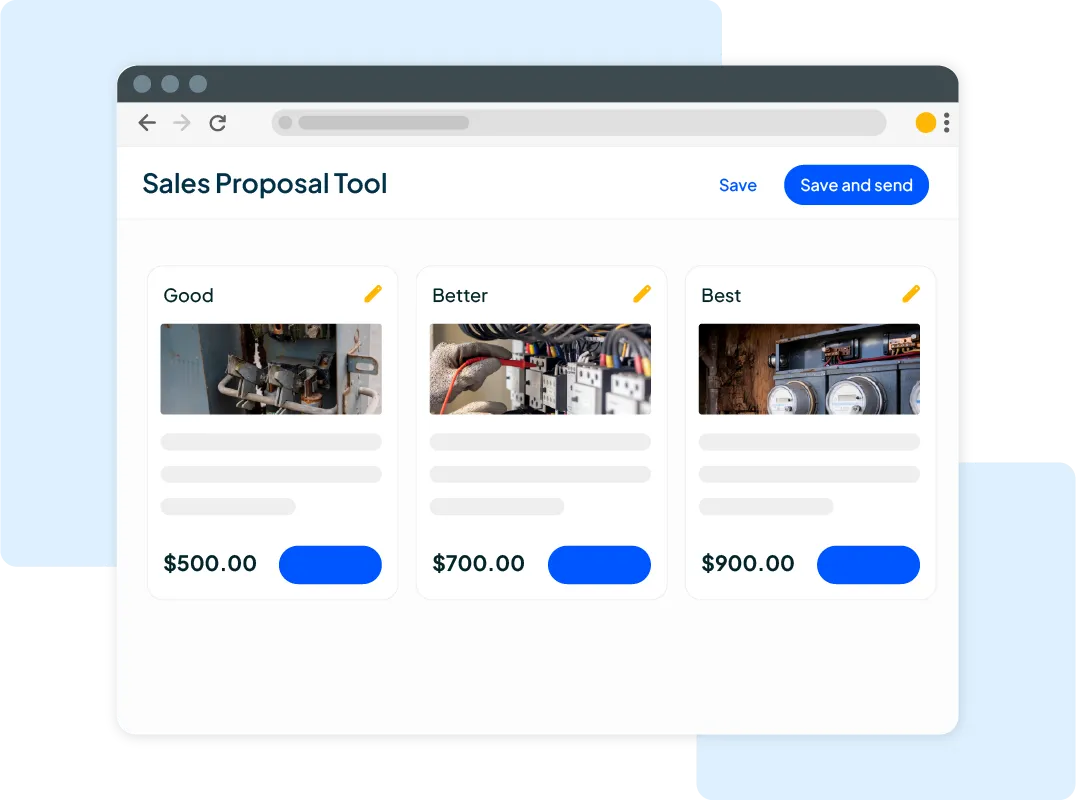
If you quote replacements in Housecall Pro, the Sales Proposal tool lets you present those options to the customer in one proposal.
Do you need HVAC flat rate pricing software?
A spreadsheet can work for a short service list. As your team grows, HVAC flat rate pricing software can make it easier to update prices and get those changes to every tech.
If three techs are working from different copies of your spreadsheet, they could quote three prices for the same repair after a supplier raises costs.
Look for tools that let techs check prices on their phones, see what each service includes, and access your latest updates. You’ll also want a way to compare estimated costs with what completed jobs actually cost.
How Housecall Pro helps you manage flat rate pricing
Once you’ve set your flat rates, your techs need a quick way to use them on the job. Housecall Pro’s HVAC software lets them add price book services to estimates and invoices, so they can spend less time retyping details and more time on the job.
- Keep quotes consistent: Organize services and update prices in your price book.
- Show customers what’s included: Send estimates with clear service details.
- Save time on billing: Add price book items directly to invoices.
- Check your job costs: Review recorded labor, materials, and other expenses with job costing.
- Keep track of recurring maintenance: Manage ongoing agreements with service plans.
Ready to put your price book to work? Sign up for a free 14-day Housecall Pro trial.
HVAC flat rat pricing FAQ
How do you calculate HVAC flat rate prices?
Calculate an HVAC flat rate by dividing total service cost by one minus your target margin. For example, $165 in labor, materials, and allocated overhead divided by 0.90 produces a $183.33 price at an illustrative 10% margin.
Can you use national HVAC prices as your flat rates?
National HVAC prices help you compare similar services, but your flat rates need to cover your own costs and scope. For example, our $85–$125 residential diagnostic range covers the diagnostic service entry only, not the repair or other charges on the final invoice.
Is flat rate pricing better than hourly pricing for HVAC?
Flat rate pricing fits HVAC work you can define before starting, such as a capacitor replacement after diagnosis. Hourly or time-and-materials billing can suit troubleshooting with an uncertain scope, provided you explain the billing terms first. For example, at $150 per hour plus $50 in parts, a repair costs the customer $200 in one hour and $350 in two; a $250 flat rate stays $250 either way.
What’s the difference between markup and margin?
Markup is the amount added as a percentage of cost; margin is the amount left after costs as a percentage of the selling price. A job that costs you $1,000 and sells for $1,250 has a 25% markup and a 20% margin.
How often should you update an HVAC price book?
Review your HVAC price book at least annually, with earlier updates when costs change. For example, if a part rises by $20, maintaining a 10% margin requires a $22.22 price increase, rounded to cents, assuming other costs stay the same.
What should an HVAC flat rate price book include?
An HVAC flat rate price book should include diagnostics, common repairs, maintenance, replacements, add-ons, membership pricing, and after-hours terms. Each entry should define the work, exclusions, and price—for example, whether a capacitor replacement includes diagnosis.