Want to win more jobs with less effort?
Grow your business and send quick quotes with our home service software.

Want to see your potential revenue?
See what businesses like yours earn with Housecall Pro in 1 - 2 minutes.
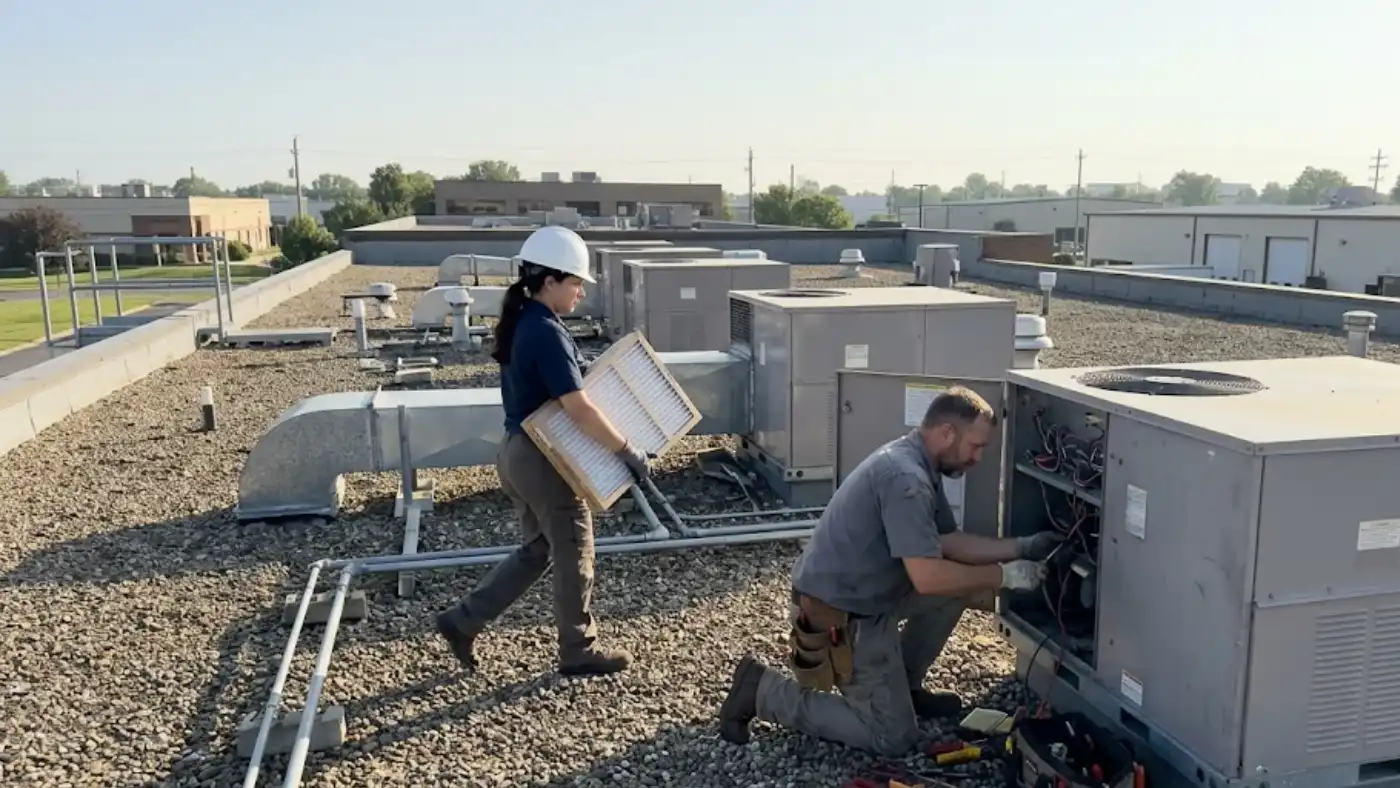
Commercial HVAC maintenance agreements can give your crew steady work and make revenue easier to plan. But if you underestimate the work or leave coverage unclear, even a full schedule can fall short of the profit you need.
This guide walks you through what to include in an agreement, how to price it, and how to explain the value to customers. You’ll also find a checklist and template fields you can adapt to each property.
Download Housecall Pro’s free HVAC service agreement template for a quick start.
Quick answer: How do you write a commercial HVAC service agreement?
To write a commercial HVAC service agreement, first inventory the equipment, define covered tasks, and set the visit frequency. Then, outline the agreement terms, including pricing, payment schedules, response times, exclusions, and renewal conditions. Calculate labor, materials, travel, and overhead costs to set profitable rates. Finally, document payment schedules, renewal notices, and authorized signatures so both sides know their responsibilities.
Table of contents
- What’s a commercial HVAC service agreement?
- Why offer commercial HVAC maintenance agreements?
- What should a commercial HVAC service agreement include?
- What types of commercial HVAC maintenance agreements can you offer?
- How do you price a commercial HVAC service agreement?
- Commercial HVAC service agreement template
- How do you sell commercial HVAC service agreements?
- How do you manage commercial HVAC maintenance agreement visits, billing, and renewals?
- Manage commercial HVAC service agreements in Housecall Pro
What’s a commercial HVAC service agreement?
A commercial heating, ventilation, and air conditioning (HVAC) service agreement is a written contract between your HVAC business and a commercial customer. It explains which equipment you’ll maintain, what work you’ll do, how often you’ll visit, and what the customer will pay.
You may hear these agreements called maintenance agreements or service contracts. Whatever you call them, the written terms determine what’s covered.
A one-time repair authorization covers a specific job, while a service agreement covers ongoing work. A manufacturer’s warranty has its own coverage rules, so make sure customers understand which maintenance and repairs your agreement includes.
How commercial agreements differ from residential plans
Residential memberships often cover one or two systems in a home. Commercial agreements may cover multiple units across offices, restaurants, warehouses, or retail centers, with different maintenance needs at each location.
For commercial properties, you’ll also need to plan for:
- Site access: Record security procedures, roof access, parking, and approved entry times.
- Operating hours: Coordinate maintenance and shutdowns around the customer’s business.
- Equipment inventory: Identify every covered unit at each location.
- Reporting: Name the contact who receives service reports and repair recommendations.
- Approval authority: Identify who can approve the agreement and additional work.
Why offer commercial HVAC maintenance agreements?
Commercial service agreements give you work you can schedule in advance, helping you plan around slower periods. They also give property managers a maintenance schedule, a budget for covered services, and records of the work you’ve completed.
Here’s how those benefits can help you and your customers:
- Repeat work: Scheduled maintenance gives your crew repeat jobs and helps customers keep up with equipment care.
- Better planning: You can reserve technician time while the customer budgets for covered maintenance.
- Regular contact: Service visits give you a chance to explain equipment conditions and discuss next steps.
- Equipment history: Work records help you troubleshoot and help customers plan repairs or replacement.
Make sure your price and staffing can support everything you promise. Every included visit, repair, and after-hours call takes technician time and needs to be part of your estimate.
What should a commercial HVAC service agreement include?
Your agreement should answer three questions: What will you do, what does the customer need to do, and what happens when work falls outside the plan? Clear terms help both sides avoid surprises about coverage, scheduling, and charges.
For additional guidance, the EPA-funded Operation and Maintenance Service Contracts guide discusses service plans, documentation, contractor responsibilities, and contract management for commercial buildings.
Commercial HVAC service agreement checklist
Use this checklist before sending an agreement for review:
- Contractor and customer details: List legal names, service locations, and authorized contacts so everyone knows who can approve work.
- Covered equipment: Record unit identifiers, equipment type, make/model, and condition to prevent coverage disputes.
- Maintenance schedule: Define maintenance tasks, visit frequency, and scheduling procedures so both parties can plan.
- Included coverage: Identify covered labor, parts, consumables, and limits so “maintenance” doesn’t become open-ended repair coverage.
- Exclusions and existing problems: Record pre-existing issues, excluded work, and approval requirements for extra charges.
- Emergency services procedures: State the contact method, service hours, and after-hours charges to set expectations before problems occur.
- Priority service: Explain how priority scheduling works and whether you promise a specific response time.
- Site access requirements: Explain how your crew will enter the building, reach equipment, and arrange shutdowns with the customer.
- Service documentation: List the reports and maintenance records you’ll provide, including equipment conditions and recommended repairs.
- Pricing and payment terms: Include the price, billing schedule, payment deadlines, and charges for work outside the agreement.
- Agreement dates and renewals: List the start and end dates, how renewals and price changes work, and how either party can cancel.
- Acceptance and signatures: Include space for you and an authorized customer representative to sign and date the agreement.
The U.S. Department of Energy also offers equipment operations and maintenance summaries with maintenance checklists and best practices for several types of HVAC equipment.
For guidance on setting inspection and maintenance requirements, refer to ASHRAE/ACCA Standard 180. It provides a reference for commercial HVAC maintenance practices, although it isn’t a universal legal requirement.
Free download: Commercial HVAC maintenance checklist template
What types of commercial HVAC maintenance agreements can you offer?
You can offer preventive maintenance plans only, maintenance with coverage for specific repair labor, or broader coverage that includes both repair labor and parts. The table below compares what each option typically includes, what you’d bill separately, and what to consider when setting your price.
| Agreement type | Preventive maintenance only | Maintenance plus defined repair labor | Broader parts-and-labor coverage |
| Included work | Inspections, cleaning, testing, and routine upkeep | Maintenance and labor for specified repairs | Maintenance, covered repair labor, and parts |
| Separately billed work | Repairs, parts, emergency calls, and other excluded work | Excluded repairs, parts, and labor over coverage limits | Excluded equipment, major replacements, and costs over limits |
| Pricing consideration | Estimate labor, visits, travel, and maintenance supplies | Estimate repair labor using equipment age and service history | Estimate parts and labor costs, including likely repairs |
These are examples of agreement structures. For every option, spell out exclusions, spending limits, and who’s responsible for each part of the work.
If you offer priority service, explain where those customers fall in your schedule, whether you guarantee a response time, and what emergency visits cost.
How do you price a commercial HVAC service agreement?
Start with an on-site assessment and a complete inventory of the customer’s HVAC equipment. Record each unit’s type, age, condition, location, and maintenance needs before calculating your price.
Residential HVAC maintenance agreements often cost $150–$300 annually. However, commercial agreements involve larger equipment, multiple systems, and more demanding maintenance schedules. Charging residential rates or basing prices solely on building square footage can leave you underpaid for the actual work.
Calculate what it’ll cost to service each property, including technician labor, travel, materials, and a share of overhead. Then set a price that covers those costs and leaves room for the profit you want to earn.
Estimate the full cost of delivering the agreement
Start by calculating what it’ll cost your business to complete every scheduled service visit. Account for the following expenses:
- Labor: Technician wages, payroll taxes, benefits, and other labor-related expenses.
- Travel and access: Drive time, fuel, parking, roof access, and time spent entering secured buildings.
- Materials: Filters, belts, cleaning supplies, and other maintenance materials.
- Administrative costs: Scheduling, customer communication, reporting, and invoicing.
- Overhead: Insurance, vehicles, software, and other business operating expenses not already included.
- Additional coverage: Expected repair costs, emergency service, and after-hours obligations.
Adjust your estimate based on equipment age, condition, quantity, operating hours, and maintenance frequency. For example, a 15-year-old rooftop unit with repeat belt failures needs more labor and a bigger repair allowance than a two-year-old unit with a clean service history. If equipment needs repairs or a deep cleaning before regular maintenance can begin, quote that work separately.
Set your price around a target margin
Once you’ve calculated your costs, set a target gross profit margin. According to Relay, commercial HVAC service contracts typically target a 30%–40% gross margin.
Use this formula: Agreement price = Estimated direct agreement costs ÷ (1 − Target gross margin)
Here’s an example for an annual agreement:
- Estimated direct costs: $4,000 for technician labor, materials, and other direct service expenses.
- Target gross margin: 35%
- Calculation: $4,000 ÷ (1 − 0.35) = $6,153.85
- Annual agreement price: $6,153.85
That leaves about $2,154 in gross profit. Remember that this isn’t what you take home. Your overhead, like rent, insurance, office staff, and software, comes out of it first, and whatever remains is your net profit. Before you lock in a price, estimate the overhead this agreement should cover and make sure what’s left meets your profit goal. If it falls short, raise your target margin and run the formula again.
Be careful not to count a cost twice. Technician labor is already in your direct costs, so it doesn’t belong in overhead too.
Check the price against actual service costs
Track technician hours, materials, travel, and extra work for each agreement. Compare actual costs with your estimate so you can spot jobs that are taking more time or money than you planned.
Pay particular attention to:
- Unplanned repairs: Are unexpected service calls reducing your margins?
- Labor hours: Are technicians spending more time on maintenance than estimated?
- Material costs: Have filter, belt, or replacement part expenses increased?
- Service frequency: Does the equipment need more attention than originally planned?
Use what you learn to improve future quotes and renewal prices. For current agreements, follow the written terms for any price changes and required customer approval.
Read more: How to calculate job costing
Commercial HVAC service agreement template
Use this sample as a starting point for your commercial agreements. Fill in the details for each property, attach the equipment list and maintenance schedule, and have an attorney review the terms before using it with customers.
Commercial HVAC maintenance agreement
This agreement is between [Contractor legal name], located at [Contractor address], and [Customer legal name], located at [Customer address], for HVAC services at [Service property address].
Agreement start date: [Date]
Agreement end date: [Date]
Contractor contact: [Name, phone, email]
Customer contact: [Name, title, phone, email]
1. Covered equipment
This agreement covers only the equipment listed below. Equipment added or replaced during the agreement term requires a written coverage update approved by both parties.
| Unit ID | Equipment type | Make/model | Location | Condition |
| [Unit ID] | [Type] | [Make/model] | [Location] | [Condition] |
| [Unit ID] | [Type] | [Make/model] | [Location] | [Condition] |
2. Included maintenance and visit schedule
[Contractor name] will provide [Number] scheduled maintenance visits per [Year/quarter/other period]. Covered work includes [List inspections, cleaning, testing, adjustments, and other tasks for each unit or reference an attached maintenance schedule].
Included filters, belts, and other materials: [Items, quantities, and limits].
Visits will take place during [Service hours] and will be scheduled through [Contact and scheduling process]. After each visit, the contractor will provide [Service report details] to [Customer contact].
3. Exclusions and additional work
The agreement price excludes [List excluded repairs, parts, equipment replacement, existing problems, and other services]. Known equipment issues at the start of this agreement are [List issues or reference an attachment].
Before completing work outside this agreement, the contractor will provide an estimate and obtain approval from [Authorized customer contact] by [Email, signed estimate, or other written method]. Approved additional work will be billed [At the quoted price/according to the attached rate schedule].
4. Emergency and priority service
For emergency service, the customer should contact [Phone number] during [Available hours]. Emergency visits and after-hours work are [Included within these limits/Billed separately at these rates].
Priority scheduling, if included, means [Define scheduling priority and any response-time commitment]. Any response-time commitment refers to [Callback/Arrival on site] and is subject to [Specific conditions].
5. Customer responsibilities and site access
The customer will arrange building and equipment access, including [Entry instructions, roof access, parking, and security procedures]. The customer will coordinate required shutdowns with [Contact] and make equipment available during [Approved service hours].
If a scheduled visit cannot be completed because access is unavailable, [Rescheduling process and any agreed charge].
6. Price and payment
The total agreement price is $X. Payments of $Y are due [Monthly/quarterly/annually] on [Due dates]. Applicable taxes are [Included/Additional].
Payment is due within [Number] days of the invoice date. Approved additional work will be invoiced separately. Late payments will be handled as follows: [Terms reviewed by your attorney].
7. Renewal, price changes, and cancellation
At the end of the term, this agreement will [Expire unless renewed in writing/Renew under the following terms: details]. Required renewal notices will be sent by [Method] at least [Number] days before [Deadline].
Price changes may take effect [When and under what conditions], with [Number] days’ written notice and [Required customer approval].
Either party may cancel under the following conditions: [Grounds, notice period, and notice method]. Upon cancellation, outstanding charges, prepaid amounts, and unfinished services will be handled as follows: [Payment and refund terms].
8. Acceptance
By signing below, both parties agree to the terms above and the attached [Equipment list, maintenance schedule, rate schedule, and any additional terms].
Contractor representative: [Name and title]
Signature: ____________________ Date: __________
Customer representative: [Name and title]
Signature: ____________________ Date: __________
How do you sell commercial HVAC service agreements?
Start with commercial customers who already trust your work, then reach out to other property owners or managers who need regular HVAC maintenance. Explain what you found during inspections and how your proposed service schedule will help them care for their equipment.
Match the offer to the customer’s building
Before recommending an agreement, ask about the property’s equipment, business hours, and current maintenance plan. Find out who handles HVAC service requests and who can approve the agreement.
Use inspection findings and service records to explain your proposed maintenance schedule. For example, a restaurant operating seven days a week may need more frequent filter inspections than an office building with limited operating hours.
Present clear coverage and pricing
Give customers a written proposal that explains scheduled visits, included materials, separately billed repairs, and optional service coverage. Show the annual price and any monthly or quarterly payment options you offer.
For example, a proposal for a small office building with four rooftop HVAC units might include:
- Four scheduled maintenance visits annually.
- Filter replacements and routine inspections.
- Repairs billed separately with customer approval.
- An annual price of $3,600, payable in $300 monthly installments.
Walk the customer through why you’ve included each service, using your inspection notes and the equipment’s maintenance needs.
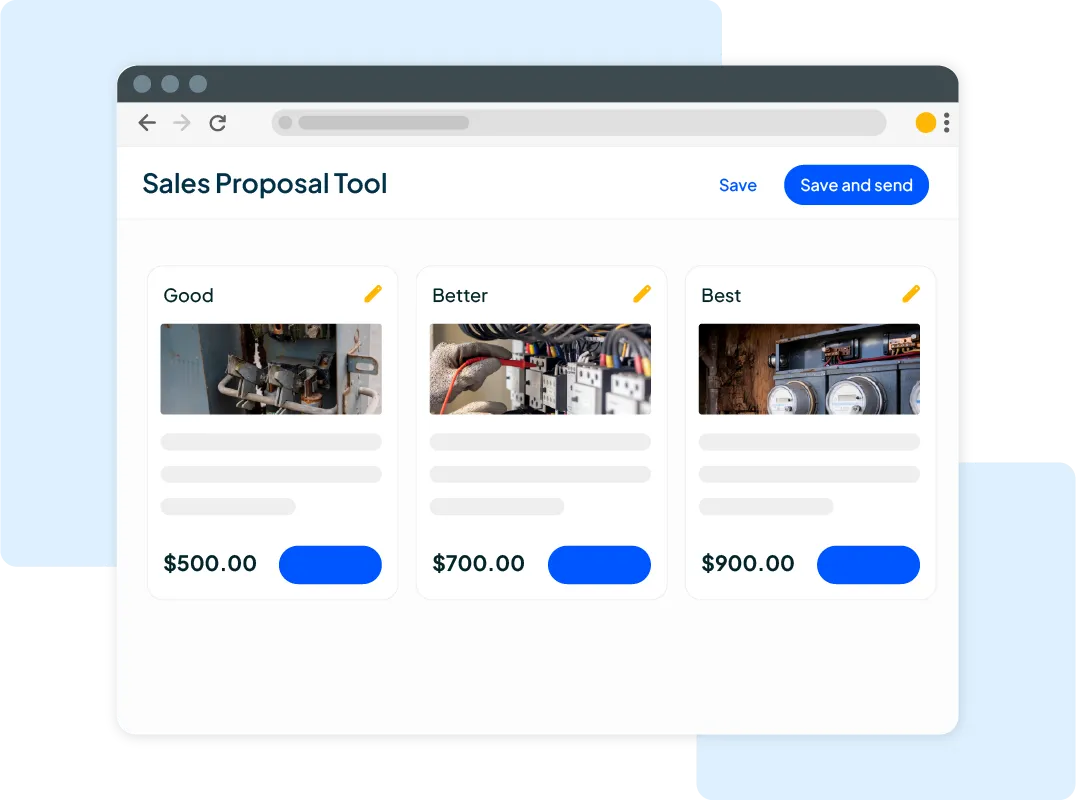
Pro tip: If you’re rebuilding proposals from scratch for every property, Housecall Pro’s sales proposal tool can speed that up. Just save your usual proposal as a template and fill in each property’s details. You can then present your coverage options side by side so the customer can compare them.
Follow up and set expectations before signing
Send the written proposal to the person who can approve it and agree on a date to follow up. Answer questions about repair charges, emergency calls, and exclusions before asking them to sign.
Before the first visit, confirm how your crew will access the property, when they can work, who to call in an emergency, and who approves extra work. Add those details to the job records so technicians arrive prepared.
Get In Touch: 858-842-5746
Let us earn your trust
On average, Pros increase monthly revenue generated through Housecall Pro by more than 35% after their first year.
See plan options and feature breakdown on our pricing page.
How do you manage commercial HVAC maintenance agreement visits, billing, and renewals?
Once the customer signs, add the agreement details to the software you use to manage jobs. Schedule the maintenance visits, assign technicians, and keep notes on completed work, equipment conditions, and recommended repairs.
Send invoices according to the agreement’s payment terms, whether customers pay monthly, quarterly, or annually.
Use this checklist to keep agreements on track:
- Missed visits: Review schedules regularly and reschedule any missed appointments.
- Overdue invoices: Monitor unpaid balances and follow up according to your payment policies.
- Equipment changes: Update equipment records when customers replace, remove, or add HVAC systems.
- Agreement profitability: Compare actual labor, materials, and service costs against the original estimates.
- Upcoming renewals: Review costs and service records, and contact customers before the renewal notice deadline.
Before renewing, review pricing, equipment coverage, and maintenance frequency. Follow each agreement’s renewal terms, whether renewal requires a new signature or occurs automatically under the contract.
Housecall Pro’s service agreement software can handle that tracking for you. Set a renewal reminder and customers get an automatic email or text before their agreement expires. Your Service Plan dashboard shows which agreements are expiring soon, and a renewal stays in “pending renewal” until the customer accepts it. Reminders go out for agreements with an end date, so add one to any agreement you want reminders for.
Manage commercial HVAC service agreements in Housecall Pro
When schedules, agreements, and invoices live in different places, it’s harder to keep track of upcoming visits and payments. Housecall Pro helps you organize service plans, recurring jobs, and billing so your team can stay on top of the work.
Here’s how it can help you manage commercial HVAC work:
- Service plans: Create customized agreements with defined services, pricing, and visit frequencies.
- Recurring jobs: Automatically schedule maintenance visits based on each customer’s service plan.
- Technician assignments: Assign scheduled work based on technician availability, location, or job requirements.
- Billing and Payments: Set up monthly, quarterly, or annual payments and automate recurring billing.
- Customer records: Keep service locations, maintenance history, and customer information organized for future visits.
Pros who used Service Plans grew revenue 2x faster.*
Start your free Housecall Pro trial to keep your maintenance schedule, customer records, and billing organized as your commercial business grows.
*Revenue growth rate during the year after adoption for HVAC, electrical, and plumbing Pros who adopted Service Plans compared to similar Pros who did not.
Commercial HVAC service agreement FAQs
How much does a commercial HVAC service agreement cost?
Commercial HVAC service agreement pricing depends on how many units you maintain, their age and condition, visit frequency, and what the agreement covers. Build the price from your direct costs and a target margin instead of building square footage. For example, a small office building with four rooftop units, four visits a year, and repairs billed separately might be priced at $3,600 annually ($300 a month).
How often should commercial HVAC maintenance be scheduled?
Commercial HVAC maintenance should typically be scheduled quarterly, or four times per year, although the frequency depends on equipment type, age, operating hours, and building conditions. Systems running continuously or serving high-demand facilities may require monthly attention. Follow manufacturer recommendations and refer to ASHRAE/ACCA Standard 180 when developing maintenance schedules.
Does a commercial HVAC service agreement include repairs?
A commercial HVAC service agreement includes repairs only when the written contract specifically provides that coverage. Basic agreements typically cover preventive maintenance, while broader plans may include defined repair labor, replacement parts, or both. Always specify repair exclusions, spending limits, and approval requirements.
Can you use a residential HVAC agreement for commercial customers?
Don’t use residential HVAC agreements for commercial customers without significant modifications. Commercial contracts must address larger equipment, multiple systems, site access requirements, operating hours, and more detailed maintenance schedules. For example, a residential plan usually covers one or two systems at one home, while a commercial agreement may need to cover a dozen rooftop units across several tenant suites, plus roof access and after-hours scheduling.
Can you bill monthly for an annual agreement?
Yes, you can bill monthly for an annual commercial HVAC service agreement by dividing the contract price into 12 payments. For example, a $3,600 annual agreement could be billed at $300 per month, even if maintenance visits occur quarterly. Clearly state the billing schedule and payment terms in the contract.
How long should a commercial HVAC service agreement last?
Annual terms are the simplest to manage because you can review costs, equipment changes, and pricing at each renewal. If you offer multi-year terms, add price-change language so rising labor and parts costs don’t erode your margin, and spell out how either party can cancel.
When should you review an agreement before renewal?
Review a commercial HVAC service agreement before its required renewal notice deadline, ideally 30–60 days in advance, when the contract allows. Compare actual service costs against your estimates, review equipment changes, and determine whether pricing or coverage needs adjustment. Follow the agreement’s renewal and notification requirements.