Want to win more jobs with less effort?
Grow your business and send quick quotes with our home service software.

Want to see your potential revenue?
See what businesses like yours earn with Housecall Pro in 1 - 2 minutes.

Starting an HVAC business means finding customers and building a reputation from scratch. An HVAC franchise can give you a head start with an established name and training, but whether that support is worth it depends on your budget, experience, and long-term plans. Franchises often require a big upfront investment, and it means less control over your business as you grow.
This guide compares leading HVAC franchises by cost, support, and key tradeoffs so you can decide which opportunity, if any, fits your goals.
Quick answer: Is an HVAC franchise worth it?
An HVAC franchise can be worth it if you want training, operating systems, marketing resources, and an established name to help you get started. However, the total investment can range from just under $100,000 to more than $700,000, and you’ll typically pay ongoing royalties while following the franchisor’s rules.
Franchising may be a good fit if you value structure and support over complete independence. Starting your own HVAC company may make more sense if you already have industry experience, want full control over pricing and operations, or prefer to avoid ongoing franchise fees.
Key takeaways
Take these steps before committing to an HVAC franchise:
Compare total costs: Review ongoing fees, not just the initial franchise fee, before making a decision.
Talk to franchisees: Speak with current owners to learn how the business operates post-sale.
Read the FDD carefully: Pay close attention to royalties, territory rights, and operational requirements.
Plan for growth: Choose a franchise with systems that support expansion if you want multiple locations.
Build strong operations: Use software to manage scheduling, payments, reporting, and customer relationships as your business grows.
Table of contents
Should you buy an HVAC franchise?
To decide whether a franchise is right for you, consider how much support you need, how much control you’re willing to give up, and whether the required investment fits your budget. Your experience, existing customer base, and growth plans should also factor into the decision.
An HVAC franchise may be a good fit if you:
- Want an established brand: A recognized name may help you build customer trust and attract leads.
- Need operational support: Many franchises offer training, business coaching, and ongoing guidance.
- Prefer structured systems: Established processes for marketing, hiring, and customer service can reduce the amount you need to build yourself.
- Have enough startup capital: HVAC franchises may require a significant upfront investment plus ongoing royalty and marketing fees.
- Want a model built for expansion: Some franchises offer systems and territory options that support multiple locations.
You may prefer running an independent HVAC business if you:
- Already have a strong reputation: An established customer base may reduce the value of joining a franchise.
- Want control over pricing: Independent owners can set their own prices, discounts, and promotions.
- Prefer to avoid franchise fees: You won’t have to pay ongoing royalties or required marketing fees to a franchisor.
- Want full operational control: You can make your own decisions about branding, services, hiring, and day-to-day operations.
Read more: HVAC marketing strategies to get more leads
What does an HVAC franchise really cost?
The franchise fee is only one part of the cost. You may also need money for vehicles, equipment, inventory, insurance, licensing, software, and day-to-day expenses while the business gets up and running.
Start with Item 7 of each franchise’s Franchise Disclosure Document (FDD), which outlines the estimated initial investment. Then review Item 6 for royalties, marketing contributions, technology charges, and other ongoing fees.
Most HVAC franchise investments fall into three categories:
| Franchise type | Typical total investment* |
| Entry-level service brand | $100,000–$200,000 |
| Full-service HVAC franchise | $200,000–$400,000 |
| Premium or multi-territory brand | $400,000–$700,000+ |
Common HVAC franchise expenses
Before comparing brands, make sure you understand what each estimate includes. Common startup and ongoing expenses include:
- Franchise fee: The upfront cost to join the franchise. Among the brands reviewed, fees range from $43,000 to $59,500.
- Vehicles and upfitting: Service vans, wraps, shelving, and ladder racks. These costs are often included in the total investment rather than listed as a separate fee.
- Equipment and inventory: Tools, recovery machines, gauges, safety equipment, replacement parts, filters, fittings, refrigerant, and installation materials. Requirements vary by franchise and business model.
- Insurance and licensing: Coverage may include general liability, commercial auto, and workers’ compensation. You’ll also need to budget for the contractor licenses, permits, and registrations required in your area.
- Working capital: Cash set aside for payroll, rent, fuel, utilities, and other operating expenses during startup. Some estimates account for six to 12 months of working capital.
- Royalties: Ongoing payments to the franchisor. Among the brands reviewed, royalties range from 1% of gross revenue for MRCOOL to 5%–7% for Aire Serv and up to 6% for One Hour. Minimum monthly payments may also apply.
- Marketing requirements: You may need to contribute to a brand fund, spend a set percentage on local marketing, or do both. Examples include a 0.75% brand fund contribution for MRCOOL, a 2% marketing fee for Aire Serv, and a recommended 8%–12% of gross revenue in local marketing spend for One Hour.
- Technology and software: Find out whether scheduling, dispatching, invoicing, and reporting tools are included or billed separately. For example, MRCOOL lists a $2,000 monthly technology fee.
Sample first-year investment breakdown
The example below shows how startup costs can add up for a new HVAC franchise owner. Actual costs vary by franchise and location. This example uses MRCOOL’s numbers.
| Expense | Estimated cost |
| Franchise fee | $50,000 |
| Vehicle and upfitting | Included in total investment |
| Equipment and tools | Included in total investment |
| Initial inventory | Included in total investment |
| Insurance and licensing | Included in total investment |
| Working capital | Included in total investment |
| Technology fees (12 months at $2,000/month) | $24,000 |
| Estimated total investment | $777,155–$2,456,746 |
Before signing a franchise agreement, compare each brand’s FDD line by line instead of focusing only on the advertised franchise fee. The total investment, ongoing royalties, required marketing contributions, and technology fees will have a much bigger impact on your long-term operating costs than the upfront fee alone.
Read more: HVAC business owner salary
How to compare HVAC franchises
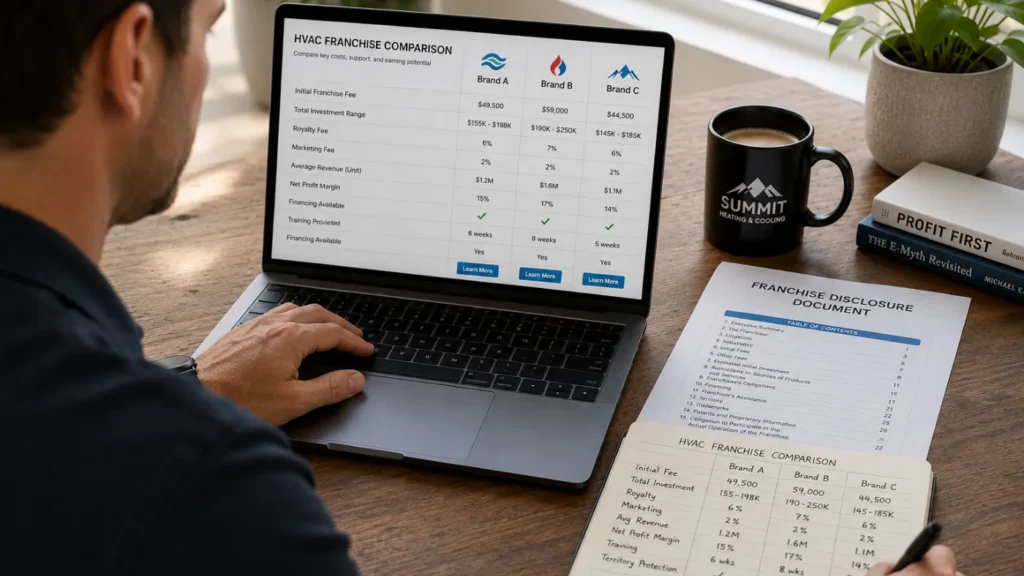
Not every HVAC franchise offers the same level of support, costs, or growth potential. Before signing a franchise agreement, compare several brands side by side and review each FDD carefully. Consider:
- Brand recognition: Find out whether homeowners in your target market know the brand and whether it has a strong local reputation.
- Total initial investment: Include vehicles, equipment, inventory, working capital, and required technology—not only the franchise fee.
- Ongoing fees: Calculate how royalties, advertising contributions, minimum payments, and software charges would affect your monthly cash flow.
- Marketing support: Ask what the franchisor provides, what you must handle locally, and how much local spending is required.
- Owner and technician training: Confirm who receives training, how long it lasts, and whether continuing education is available.
- Territory protection: Check whether your territory is exclusive, how its boundaries are set, and whether the franchisor can add another location nearby.
- Vendor requirements: Ask whether you must use approved suppliers and whether negotiated pricing, rebates, or purchasing support are available.
- Required technology: Find out which platforms you must use, what they cost, and whether they cover the day-to-day work your team needs to manage.
- Ongoing support: Ask current franchisees how useful the operational, recruiting, marketing, and financial guidance is after opening.
- Growth options: If you want to expand, review the terms for additional territories, locations, and development agreements.
Looking beyond the franchise fee will give you a better picture of what you’ll receive and what you’ll be expected to contribute over the long term.
Best HVAC franchise opportunities
The right franchise depends on your budget, HVAC experience, growth plans, and preferred level of support.
The figures below come from brand materials, FDDs, and Entrepreneur’s franchise directory. Costs and terms can change, so request the current FDD and verify every figure before committing.
One Hour Heating & Air Conditioning
One Hour lists a total initial investment of $143,273–$286,702, including a $43,000 franchise fee for a territory with a population of up to 100,000. The ongoing royalty is up to 6% of gross revenue or $1,500 per month, whichever is greater. The brand recommends spending 8%–12% of gross revenue on local marketing each year—it requires a minimum of 8% only if a franchisee misses its performance benchmarks.
Here’s what that could mean: If you make $100,000 in monthly gross revenue, the 6% royalty would equal $6,000 and would generally be collected in two payments during the month. You’d need to pay the brand fund contribution and an annual local advertising fee on top.
Best fit: An existing HVAC company owner who wants to convert an independent business or an entrepreneur prepared to follow a structured service model. One Hour says existing HVAC business owners are typically its strongest candidates, although previous ownership experience isn’t required.
What it offers:
- A national brand focused on heating and air conditioning
- Training and business support for startups and conversions
- Financing assistance for qualified candidates
- Set systems for marketing, customer service, and operations
What to consider: The $1,500 minimum royalty may have a greater effect during slower months, when 6% of revenue would otherwise be lower.
Aire Serv
Aire Serv lists an estimated initial investment of $113,808.50–$271,708.50, with at least $50,000 in liquid capital and a minimum net worth of $250,000. Its licensing fee ranges from 5% to 7% of gross sales.
The FDD also lists a $45,000 initial franchise fee, a 2% marketing, advertising, and promotional fee, and initial advertising spending of $30,000–$60,000.
Here’s what that could mean: Aire Serv calculates and collects its licensing and system marketing fees weekly. At $25,000 in weekly gross sales and a 7% licensing rate, the licensing fee would be $1,750 and the 2% marketing fee would add $500 for that week. Local marketing group contributions may add to that amount.
Best fit: An owner who wants to operate a residential HVAC business within a broader home services organization. It may also work for a first-time owner looking for formal training, marketing resources, and an established operating structure.
What it offers:
- A place within Neighborly’s home services franchise system
- Initial and ongoing operational training
- Established consumer marketing programs
- A model covering repair, maintenance, and replacement work
What to consider: The 5%–7% licensing fee depends on the applicable sales category and franchise terms. Local marketing group charges may add up to 3% of gross sales on top of the 2% system marketing fee. Review Item 6 of the FDD to calculate the combined cost.
MRCOOL
MRCOOL charges a $50,000 single-unit franchise fee. In addition to the upfront investment, franchisees pay ongoing royalties, brand development fees, and local marketing contributions.
Here’s what that could mean: These fees are calculated monthly. At $100,000 in monthly gross revenue during Year 1, the royalty, brand fund contribution, local marketing requirement, and technology fee would total about $5,750 for that month.
Best fit: An entrepreneur with the capital to build a larger HVAC operation who’s comfortable following the brand’s systems and paying recurring minimum fees.
What it offers:
- A 1% percentage-based royalty on the previous month’s gross revenue
- Published formulas for royalties and marketing contributions
- A structured model for building and expanding the business
What to consider: The 1% royalty carries a monthly minimum that increases over the first several years of the agreement.
Varsity Zone HVAC
Varsity Zone lists an initial investment of $204,046–$268,679, a $59,500 franchise fee, and a 5% royalty on gross revenue. According to the brand’s website, candidates should have a minimum net worth of $500,000 and at least $100,000 in liquid assets.
Here’s what that could mean: If you generate $100,000 in gross revenue, the 5% royalty rate would equal $5,000.
Best fit: An owner with business management experience, strong local relationship-building skills, and plans for long-term expansion. Varsity Zone’s website lists a $500,000 net worth requirement and at least $100,000 in liquid assets. Because Franzy reports a different liquidity requirement, confirm the current amount directly with the franchisor.
What it offers:
- Residential and commercial HVAC services
- A central call center, KPI dashboard, and digital sales tools
- Opening and ongoing franchise support
- College sports branding designed to stand out locally
What to consider: Varsity Zone began franchising in 2024, so it has a shorter track record than One Hour or Aire Serv. Talk with current franchisees and review Items 19 and 20 of the FDD closely to understand financial representations and changes in franchise locations. Royalty may be tiered or include a separate advertising fee beyond the flat 5% described above.
HVAC franchises vs. dealer networks
A franchise licenses a full business system, including the brand, operating standards, training, and marketing framework. In return, the owner pays initial and recurring fees and agrees to follow the franchisor’s requirements. Prospective franchisees receive an FDD that explains costs, obligations, territory terms, litigation, and changes in franchise locations.
Bryant, Carrier, and Lennox are often associated with local HVAC companies, but their dealer programs aren’t service franchises. An authorized dealer remains independently owned and branded while selling, installing, or servicing a manufacturer’s equipment under a dealer agreement.
For example, Bryant’s dealer program offers product training, sales tools, lead programs, and manufacturer brand recognition. It doesn’t provide the same full-business licensing model as an HVAC franchise.
Here’s how the two models compare:
| Factor | Franchise | Dealer network |
| Brand | Uses the franchisor’s service brand | Keeps the contractor’s own brand |
| Fees | Pays a fee and ongoing royalties | Pays product or program costs |
| Operations | Follows the franchise system | Keeps more control over processes |
| Agreement | Receives an FDD | Signs a dealer agreement |
| Territory | May include a protected area | Terms vary by manufacturer |
A dealer network may fit an established contractor who wants product access and manufacturer training without changing the company’s identity. A franchise may fit an owner who wants a complete operating model and accepts the added fees and requirements.

HVAC franchise vs. starting your own HVAC business
A franchise provides an established brand and operating structure. An independent business gives you more control but requires you to build your own systems and reputation. Neither path guarantees success, so compare the costs, support, and restrictions against your experience and goals.
| Factor | HVAC franchise | Independent business |
| Startup cost | Often $100,000–$700,000+ | Varies; no franchise fee |
| Brand | Starts with an established name | Builds a name from scratch |
| Marketing | Includes brand resources | Owner builds the strategy |
| Control | Must follow franchise standards | Owner controls decisions |
| Ongoing fees | Royalties and brand fees may apply | No franchise royalties |
| Growth | May offer expansion systems | Owner builds expansion systems |
| Support | Training and coaching may be included | Owner finds outside support |
Read more: How to value a heating and air conditioning business
What to know before buying an HVAC franchise
A franchise sales presentation can show you the opportunity. Your research should show you what owning the business may look like after opening. Focus on these three areas before you sign:
- Recurring costs: Review Item 6 of the FDD for royalties, required marketing contributions, software fees, minimum payments, and other ongoing charges. Calculate what you would owe during both busy and slow months.
- Franchisee experience: Talk with current and former owners listed in the FDD. Ask how long opening took, whether the support met their expectations, which costs surprised them, and what they would do differently.
- Long-term fit: Consider whether the brand’s rules, fees, territory, and growth options match how you want to run the business. The least expensive franchise won’t necessarily offer the best value, and the largest brand won’t be right for every owner.
Running a successful HVAC franchise
Buying a franchise is only the first step. Long-term success comes from running an organized operation that keeps technicians productive, customers informed, and cash flow moving.
If your franchisor allows you to choose your software, Housecall Pro can help you manage scheduling, dispatching, estimates, maintenance plans, payments, and reporting from one place. On average, HVAC Pros increase the number of monthly jobs they complete through Housecall Pro by more than 22% after their first year.
Use Housecall Pro’s HVAC software to:
- Keep the schedule organized: Book jobs, assign technicians, and manage schedule changes from a centralized dispatch board.
- Stay on top of maintenance plans: Track customer benefits, upcoming visits, and renewals so recurring service doesn’t fall through the cracks.
- Give technicians the information they need: Make job history, customer details, estimates, and invoices accessible from the field.
- Make it easier to get paid: Accept payments on site and offer financing options for larger repairs or system replacements.
- Track business performance: Monitor revenue, job profitability, technician productivity, and other results that help you make informed decisions.
If Housecall Pro fits your franchise requirements, start a 14-day free trial to see how it works for your team.
Read more: Franchise management tools: What to look for
Get In Touch: 858-842-5746
Let us earn your trust
On average, Pros increase monthly revenue generated through Housecall Pro by more than 35% after their first year.
See plan options and feature breakdown on our pricing page.
FAQs
Are HVAC franchises profitable?
Yes, HVAC franchises can be profitable, but profitability depends on your location, operating costs, pricing, technician productivity, and ability to generate recurring business. Franchise owners also need to account for ongoing expenses such as royalties, marketing contributions, and technology fees, which reduce margins compared to an independent business. Many owners improve long-term profitability by growing maintenance membership programs, increasing average ticket size, and expanding into additional territories.
How much does an HVAC franchise cost?
An HVAC franchise typically costs between $100,000 and $700,000 or more to start, depending on the brand, territory, and business model. In addition to the initial franchise fee, you’ll need to budget for vehicles, equipment, inventory, insurance, licensing, working capital, and recurring expenses such as royalty and marketing fees. Some premium franchises require significantly more capital. For example, Entrepreneur.com lists a total initial investment of $777,155–$2,456,746 to start an MRCOOL franchise.
Which HVAC franchise is best?
The best HVAC franchise depends on your budget, business experience, and long-term goals. Buyers looking for an established national brand may prefer One Hour Heating & Air Conditioning or Aire Serv, while those seeking a newer franchise may consider Varsity Zone. Higher-investment opportunities like MRCOOL may appeal to experienced operators planning to build a larger organization. Compare each franchise’s investment requirements, royalty structure, training, territory protections, and support before making a decision.
Can you own multiple territories?
Yes, many HVAC franchises allow qualified owners to purchase multiple territories or operate multiple locations. Some franchisors even encourage multi-unit ownership as franchisees gain experience and grow their businesses. Before signing an agreement, ask whether expansion opportunities are available, how additional territories are awarded, and whether discounted franchise fees or development agreements are offered for multi-unit owners.
How much do franchise owners make?
There isn’t a standard salary for HVAC franchise owners because earnings vary widely by franchise, market, and business performance. Revenue and profit are influenced by factors such as the number of technicians, service mix, operating expenses, recurring maintenance customers, and local demand. The gap between average and median figures can be wide: One Hour’s 2026 FDD reports an average gross revenue of about $4.08 million per franchisee, but a median of about $2.22 million—meaning a small number of high-volume, often multi-territory owners pull the average well above what a typical single-territory owner actually earns.
Instead of focusing on average earnings, review the franchisor’s FDD to see whether it includes a Financial Performance Representation in Item 19 and speak with current franchise owners about their experience.
Is franchising better than starting an HVAC business?
Franchising is better for some entrepreneurs, while starting an independent HVAC business is better for others. A franchise provides an established brand, training, operating systems, and ongoing support, but it also means recurring royalty payments and less operational flexibility. An independent business gives you complete control over pricing, branding, and day-to-day decisions, but you’ll be responsible for building every part of the business from the ground up. The better choice depends on whether you value structured support or complete independence.
How do you finance an HVAC franchise?
Most HVAC franchise owners combine a few funding sources rather than paying entirely out of pocket. Common options include SBA loans (particularly the SBA 7(a) program, which many franchisors’ lending partners specialize in), franchisor-provided financing on part of the initial franchise fee, and third-party franchise lenders. Item 10 of the FDD discloses whether the franchisor offers or facilitates financing and under what terms. Several of the brands above, including One Hour and Aire Serv, note financing assistance for qualified candidates. Because financing terms and eligibility change, confirm current options directly with each franchisor and with an SBA-approved lender before budgeting.
How big is a typical HVAC franchise territory?
Territory size is usually defined by population rather than a fixed radius or ZIP code count, and it varies by brand. Among the franchises in this guide, One Hour’s base franchise fee covers a territory of up to 100,000 people (with an added fee per additional 1,000 residents), while Varsity Zone’s territories are built around roughly 200,000 people—about double a typical competitor’s, according to the brand. Ask each franchisor how territory boundaries are set, whether they’re exclusive, and whether the franchisor can add another location nearby before you sign.
How often do HVAC franchises fail?
There’s no single failure rate that applies across HVAC franchises, since it depends heavily on the brand, market, and how well-capitalized the owner is at the start. Rather than looking for an industry-wide number, review Item 20 of each franchisor’s FDD, which discloses the count of terminated, non-renewed, and transferred franchises over the past three years. A pattern of high turnover in a specific system is a more useful warning sign than a general statistic. Talking to current and former franchisees listed in Item 20 is the most direct way to understand real-world outcomes.