

UPDATED 2026 ELECTRICAL LICENSING GUIDE
Washington DC Electrician License Requirements: The 16,000-Hour Master, the NEC Code Class & Virginia-Only Reciprocity (2026)
Table of Contents
Download the Checklist!
If you’re planning to do electrical work in Washington DC, the individual license comes from the Board of Industrial Trades inside the Department of Licensing and Consumer Protection, and the requirements are stiffer than most published guides report. A journeyman license takes 4 years and 8,000 work hours. A master license takes 8 years and 16,000 work hours, not the four or five years you will read elsewhere. Both require an NEC code class certificate taken within the past two years, a requirement almost nobody mentions. Reciprocity exists but is narrow: Virginia only for journeyman, Maryland or Virginia only for master. And every DC electrician license expires November 30 in odd-numbered years regardless of when it was issued. This page covers the license classes, the 49-volt low voltage line, the exam, the documents, and the separate business license you need to contract.
Electrical work is one of the stronger trades in the national job market. Bureau of Labor Statistics figures put the national median wage for electricians at $63,190 a year, or about $30.38 an hour, as of May 2025, with the lowest 10% under $42,640 and the highest 10% above $108,510. The national mean sits higher than the median at $71,490. Employment of electricians is projected to grow 9%, much faster than the average for all occupations, with roughly 72,700 openings a year over the decade.
Washington DC pays electricians far above the national picture and employs comparatively few of them. BLS figures (District of Columbia OEWS, May 2025) count 2,440 electricians at a mean of $42.72 an hour, or $88,860 a year, and a median of $37.97 an hour, or $78,970. That median runs about 25% above the national figure, and the 90th percentile of $60.48 an hour, or $125,790, is well past the national top decile. The location quotient of 0.71 puts electrician employment 29% below the national rate, which is what you would expect in an economy built on government, law, and professional services rather than construction.
Quick answer: do you need an electrical license in Washington DC?
Yes, and depending on what you are doing you may need two separate credentials.
The individual license comes from DLCP’s Board of Industrial Trades, which issues the Electrician License in Low and Regular Voltage across three levels: Apprentice, Journeyman, and Master. It is an occupational and professional license, administered separately from business licensing and searched through a different portal.
The business license comes from DLCP’s business licensing side as a Basic Business License. Electrical contracting requires the electrical endorsement, and trade contractor licensing carries bond requirements set by trade.
Permits come from a third place entirely: the Department of Buildings, which has been a separate agency from DLCP since the old DCRA was split.
What the individual license requires depends on the level. Apprentice needs no experience at all. Journeyman needs 4 years and 8,000 work hours plus tax records, an employment verification letter, and an NEC code class certificate taken within two years. Master needs 8 years and 16,000 work hours plus the same documentation. Both exams are open book.
Key takeaways
Everything you need to know about getting licensed for electrical work in Washington DC:
Three levels, one licence family: DLCP’s Board of Industrial Trades issues the Electrician Licence in Low and Regular Voltage at Apprentice, Journeyman, and Master levels.
Master takes 16,000 hours: Journeyman is 4 years and 8,000 work hours. Master is 8 years and 16,000 hours, roughly double what most published guides report.
An NEC code class is mandatory: Both journeyman and master exam applicants submit an NEC code class certificate taken within the past two years. Almost no guide mentions it.
Low voltage means 49 volts and below: DLCP defines low voltage work as any work done at 49 volts and below, a lower threshold than most states use.
Reciprocity is narrow: Journeyman reciprocity is Virginia only. Master reciprocity is Maryland or Virginia only, and the licence must have been obtained by exam.
One fixed expiry for everyone: All DC electrician licences expire November 30 in odd-numbered years, regardless of when they were obtained.
The three license levels and what each takes
DLCP publishes the requirements in a single chart, and it is the most useful document in this whole process because it sets out routes as well as thresholds.
| Level | Route | Experience required |
| Apprentice | Application | None |
| Journeyman | Exam | 4 years, 8,000 work hours |
| Journeyman | Waiver | Nationally certified apprenticeship |
| Journeyman | Reciprocity | Valid active state licence, Virginia only |
| Master | Exam | 8 years, 16,000 work hours |
| Master | Reciprocity | Active licence, Maryland or Virginia only |
Three things in that table are worth pausing on.
The master requirement is 16,000 hours. Published guides commonly describe DC’s master requirement as four or five years, or as four years post-journeyman. DLCP’s own instruction sheet says 8 years / 16,000 work hours. That is one of the longest master paths in the country and it materially changes career planning.
There is no master waiver route. The apprenticeship waiver applies to the journeyman exam only. A nationally certified apprenticeship gets you past the journeyman test, not the master test.
Apprentice requires no experience. You register with an employment verification or school enrollment document, which is how you legally start accumulating the hours the other two levels require.
The statute adds a route the chart does not show. Under D.C. Code § 47-2853.92, a journeyman applicant may alternatively have graduated from an accredited college or university with a degree in electrical engineering and have at least two years of practical experience in electrical work, certified by a licensed master electrician. For an EE graduate, that is a dramatically shorter path than 8,000 hours.
The low voltage master, and why it is the shortcut
That same statutory section names a class that low voltage specialists should read twice.
D.C. Code § 47-2853.92(b) sets its eligibility requirements for “a journeyman electrician or a master electrician limited (low voltage)” in the same breath. Both are governed by the same standard: 8,000 hours over at least 4 years as an apprentice electrician, or the electrical engineering degree route, plus the code class within two years.
So the master electrician limited (low voltage) credential requires 4 years and 8,000 hours, not the 16,000 hours the full master licence demands. For a contractor working exclusively in data, security, controls, fire alarm signalling, and other systems at or below 49 volts, that halves the experience requirement while still delivering a master-level credential.
Two caveats. The scope is genuinely restricted to low voltage, so any line-voltage element sits outside it. And confirm with the Board how the class is administered and examined, because DLCP’s published chart lists Apprentice, Journeyman, and Master without breaking out the limited class. For anyone whose work is truly all low voltage, this is the most valuable provision on the page.
The NEC code class nobody tells you about
This is the requirement most likely to send an otherwise complete application back, and it appears in almost no third-party guide.
Both journeyman and master exam applicants must submit an NEC Code Class Certificate taken within two years of the application, alongside tax records and an employment verification letter.
The statute describes the same requirement in its own terms: an applicant must establish that they have satisfactorily completed a class on Title 12C of the District of Columbia Municipal Regulations, or equivalent code, within 2 years prior to submittal of the application. Title 12C is the DC Electrical Code.
Three practical consequences.
Recency is the point. A class you took four years ago does not count, so if you took it early you may need to retake it.
“Or equivalent code” gives you room. The statute allows an equivalent code class rather than a DC-specific one, so a current NEC code-update class from a recognised provider may satisfy it.
Get it near the end, not the start. Because the two-year clock runs backward from your application date, the sensible sequence is to accumulate your hours first, then take the code class, then apply. Doing it in the other order wastes the certificate.
On course length. Neither DLCP’s sheet nor the statute states how long the class must be. Circulating guides claim 16 hours in one place and 18 in another, both attributed to administrative rules, neither verifiable against an official source. Ask the Board what length and which providers it accepts before you enrol.
Low voltage is 49 volts in DC
Worth being precise about, because every jurisdiction draws this line differently and DC draws it low.
DLCP’s instruction sheet states plainly that low voltage work is any work done at 49 volts and below. For comparison, West Virginia’s statutory threshold is 80 volts or less, and other jurisdictions use 50 or 91 volts.
The licence itself is issued as an Electrician License (Low and Regular Voltage), so the same licence family covers both, with the voltage definition determining what falls into the low voltage category. The statute separately provides for a master electrician limited (low voltage) class with journeyman-level eligibility requirements.
For a contractor doing structured cabling, security, fire alarm, or controls work in DC, the practical question is whether any part of your scope operates above 49 volts. A great deal of nominally low voltage work includes a line-voltage element: a dedicated circuit for a rack, a receptacle for a camera power supply, a transformer primary. That element sits outside a low voltage credential.
The exam
DC’s electrician exam is open book, which changes how you prepare.
DLCP’s published FAQ names the study references as the National Electrical Code and Ugly’s Electrical Reference, and confirms the exam is open book. The published sheet cites the 2011 edition of the NEC. DC’s adopted construction codes have moved on since that edition, and third-party sources claim more recent editions are now tested, so confirm the current code edition with the Board or the exam vendor before you buy a code book. An open-book exam on the wrong edition is worse than a closed-book one, because your tabs and article references will not line up.
To sit for the exam you must first show the appropriate experience. DLCP asks for an employment verification letter signed off by the master, detailing the length of time employed and the experience gained. If you already hold a master licence in another state, you submit a copy of that licence.
Being open book does not make it easy. Open-book electrical exams reward navigation speed: knowing that grounding and bonding sits in Article 250, overcurrent protection in Article 240, and where the ampacity tables live matters more than memorisation. Candidates who fail open-book exams usually fail on time, not on knowledge.
There is a corollary worth acting on. Tab your code book before the exam, not during it. An untabbed NEC in an open-book exam is close to useless under time pressure, and the tabs have to match the edition being tested, which is another reason to confirm the current edition with the Board rather than assuming.
Reciprocity: Virginia, and Maryland for masters only
DC’s reciprocity is real but much narrower than the regional picture suggests, and this is the single biggest correction to the published guidance.
| Level | Reciprocity available from |
| Journeyman | Virginia only |
| Master | Maryland or Virginia only |
That is DLCP’s own chart. Not “surrounding states,” not “states with substantially similar requirements,” and not the broad multi-state arrangements some guides imply.
Two conditions attach.
You need a letter of good standing from your state of origin, meaning the state where you took your test, and that letter must explicitly state that you obtained your licence by examination. A licence obtained by grandfathering, waiver, or its own reciprocity route will not carry across.
The licence must be valid and active, not lapsed or on inactive status.
For the Washington metro area this produces a specific asymmetry. A Virginia journeyman can reciprocate into DC. A Maryland journeyman cannot, though a Maryland master can. If you are a Maryland-licensed journeyman planning to work in the District, the realistic path is the DC exam, which means 8,000 documented hours plus the code class.
What you need before you apply
DLCP publishes a checklist, and having these ready turns a multi-week application into a same-day submission.
- One 2 by 2 inch passport-style photo in .jpeg format
- A government-issued identification card, such as a driver’s licence
- A debit or credit card to pay application, exam, or licence fees
- Employment verification letters, apprenticeship school enrollment, or a letter of good standing
- A valid state-issued electrician licence, if applying by reciprocity
- Tax records and the NEC code class certificate, for exam applicants
New applicants begin online through DLCP’s OPLA new licence portal. There is no paper-first route.
One warning on fees. Under D.C. Code § 47-2853.10, application fees for initial licensing, certification, registration, renewal, and reinstatement are not refundable, even if you withdraw the application. Submit when your documentation is complete rather than to start a clock.
Fees and renewal
DC publishes fees through DLCP rather than in the instruction sheet, and the figures in circulation vary, so treat these as orders of magnitude and confirm before paying.
| Item | Commonly cited |
| Application fee | Around $65 |
| Journeyman licence fee | Around $110 |
| Master licence fee | Around $120 |
| Electrical contractor licence fee | Around $120 |
| Exam fee | Around $52 |
| Renewal, per two-year cycle | Around $110 to $180 |
DLCP’s Board of Industrial Trades page also cites a licence fee of $260.00 under D.C. Official Code § 47-2853.99 for a class of licence, which is well above the figures above, so the schedule is not uniform across classes. Ask DLCP which fee applies to the licence you are seeking.
Renewal is the part to calendar. DLCP states that, regardless of when they were obtained, all electrician licences expire November 30 on odd-numbered years. That is a fixed date on a two-year cycle, not an anniversary.
Sit with what that means. A licence issued in October of an odd year expires the following month, and you pay a full renewal to carry it into the next cycle. One issued in December of an odd year runs almost two years. Same fee, up to 23 months of difference, decided by when your application happened to clear.
You cannot control Board processing time, but do not treat a newly issued licence as good for two years without checking the date.
For context, DLCP runs different dates for each trade:
| Trade | Expiration | Renewal year |
| Electrician | November 30 | Odd |
| Elevator Maintenance | November 30 | Odd |
| Asbestos Worker | July 31 | Odd |
| Plumbers and Gasfitters | March 31 | Even |
| Refrigeration and Air Conditioning | September 30 | Even |
| Steam and Other Operating Engineers | September 30 | Even |
A firm holding several trade licences is therefore tracking several different dates, none of which align.
Documenting 8,000 or 16,000 hours
The hours are the hard part of DC licensure, and the documentation standard is specific enough that it rewards preparation years in advance.
DLCP’s chart lists three document types for the exam route at both journeyman and master level: tax records, an employment verification letter, and the NEC code class certificate. The instruction sheet adds that verification letters must be signed off by the master and should detail the length of time employed and the experience gained.
Read those together and the standard is clear. DC is not asking you to assert hours, it wants two independent corroborations: a tax record showing you were paid by that employer over that period, and a letter from a licensed master describing what you did.
Three consequences.
Tax records tie hours to employers. W-2s and 1099s covering your qualifying years are the spine of the application. Cash work, or an employer no longer reachable, is hard to prove regardless of what you actually did.
The letter must come from a master. Not a foreman, not an office manager. If your supervising master has moved on, tracking them down later is harder than asking when you leave.
Sixteen thousand hours is a long paper trail. A master applicant documents eight years across possibly several employers, so collect verification letters as you change jobs rather than assembling them at the end.
The statutory alternative is worth remembering here. Under § 47-2853.92, an electrical engineering degree from an accredited college or university plus two years of practical experience certified by a licensed master substitutes for the 8,000 hours at journeyman level. For an EE graduate that turns a four-year documentation exercise into a two-year one.
The business license you also need to contract
Your Board of Industrial Trades licence authorises you to perform electrical work. It does not authorise a business to contract for it.
Contracting in DC requires a Basic Business License from DLCP’s business licensing side. For electrical work that means the electrical trade endorsement, and DLCP publishes trade contractor licensing requirements including bond amounts by trade.
The standard BBL items apply on top:
- Tax registration and a Clean Hands certificate. DLCP cannot issue or renew where more than $100 is owed to the District in fees, fines, taxes, or penalties, or where a required DC tax return is unfiled.
- A Certificate of Occupancy for a commercial location, or a Home Occupation Permit if you run the business from a DC residence.
- Corporate registration through CorpOnline, with a DC registered agent for out-of-jurisdiction entities.
- A certificate of liability insurance naming DLCP as certificate holder.
- Workers’ compensation coverage. DC requires it under D.C. Code § 32-1503 for employers with one or more employees, with no small-employer exemption to weigh. It is a separate obligation from your licence but it is checked in practice, and going without exposes the business directly.
So an electrician going into business for themselves in DC is looking at three separate processes: the trade licence from the Board of Industrial Trades, the Basic Business License from business licensing, and permits from the Department of Buildings.
Coming in from Maryland or Virginia
The Washington metro area spans three licensing regimes and none of them fully recognises the others, so map your own position before you plan.
If you hold a Virginia licence. Best position of anyone. Virginia journeymen and masters can both reciprocate, provided the licence is valid and active and you obtained it by examination. Get the letter of good standing stating that explicitly.
If you hold a Maryland licence. Masters can reciprocate. Journeymen cannot. That asymmetry is the most consequential fact on this page for Maryland electricians: a Maryland journeyman working in the District needs 8,000 documented hours, a code class, and the DC exam, the same as someone starting from scratch.
If you hold a licence anywhere else. There is no reciprocity route. DLCP’s chart lists Virginia for journeyman and Maryland or Virginia for master, and nothing else.
If your licence came by reciprocity or waiver elsewhere. It will not carry into DC. The letter of good standing must state you obtained the licence by examination, which excludes credentials from grandfathering, waiver, or another state’s reciprocity.
For a contractor running crews across all three, individual electricians need credentials wherever they work and the business needs a licence in each. A DC Basic Business License, a Maryland licence, and a Virginia DPOR licence with its own class system and net worth test are three processes on three cycles.
Two portals, and which one to search
DC runs licence verification in two places, and mixing them up is the most common verification mistake.
The OPLA licence search at govservices.dcra.dc.gov covers electricians, plumbers, refrigeration mechanics, steam engineers, and other occupational licensees. This is where you confirm an individual electrician’s licence and level.
A caution on sources. At least one published guide says DC electricians are licensed by the Department of Buildings, Office of the Surveyor, and that master licences renew November 30 of even years. DLCP says otherwise on both: the Board of Industrial Trades issues the licence, and every licence expires November 30 in odd years. A source wrong on those two deserves the same scepticism on its fees and CE figures.
SCOUT, DLCP’s business licence search, covers Basic Business Licenses including trade contractor endorsements. This is where you confirm the company.
Four things to check before you hire an electrician or take one on as a sub:
- The individual’s level, since journeyman and master authorise different responsibilities
- The licence is current for this cycle, remembering the November 30 odd-year expiry
- The business holds a BBL with the electrical endorsement, if they are contracting
- Clean Hands status, because a lapse there can suspend the ability to renew
That second item matters more in DC than in states with rolling anniversaries. Because every electrician licence expires on the same date, a check run in December of an odd year reveals non-renewals that a check in October would not.
Apprenticeship, and the route most DC electricians actually take
The apprentice licence requires no experience, which makes it the entry point rather than an achievement, and DLCP’s own resource list tells you where the training happens.
The instruction sheet names four organisations: Associated Builders and Contractors, the DC Department of Employment Services apprenticeship programme, Independent Electrical Contractors Chesapeake, and the International Brotherhood of Electrical Workers Local 26.
That list matters for a practical reason beyond training. Completing a nationally certified apprenticeship programme waives the journeyman exam entirely. So an apprentice who goes through a recognised programme reaches journeyman without sitting a test, while someone who accumulates hours informally has to document 8,000 of them and then pass an open-book exam.
For anyone at the start of this, the arithmetic favours a formal apprenticeship heavily. Same four years of work, no exam at the end, and a certificate of completion that satisfies the Board on its own rather than requiring tax records and master-signed letters from every employer along the way. The waiver route replaces a documentation problem with a single document.
Note the limit, though. The waiver covers the journeyman exam only. Everyone sits the master exam, and the master route has no waiver and no shortcut beyond reciprocity from Maryland or Virginia. So the apprenticeship saves you one exam, not two, and the 16,000-hour master requirement still sits ahead of you with its own documentation burden.
What the licence does not cover
Two boundaries worth being precise about, because both send DC electricians to other agencies.
Fire alarm and life safety. DC’s construction codes carry their own requirements for fire alarm and detection systems, and permits for them run through the Department of Buildings. An electrician licence authorises electrical work; it does not resolve every fire alarm approval on a commercial job.
Elevator work. DLCP licenses Elevator Maintenance separately through the same board, on the same November 30 odd-year cycle.
The other trades under that board are plumbing and gasfitting, refrigeration and air conditioning, steam and other operating engineers, and asbestos, all on different renewal dates: plumbing March 31 in even years, refrigeration September 30 in even years.
The federal overlay applies regardless. The EPA’s Renovation, Repair and Painting rule requires firm certification and a certified renovator whenever you disturb painted surfaces in pre-1978 housing, which covers a large share of work in DC’s older rowhouses.
How to get licensed, step by step
Step 1: Register as an apprentice
No experience required. An employment verification letter or school enrollment document is enough, and it starts the clock on hours that count.
Step 2: Choose apprenticeship or informal hours
A nationally certified apprenticeship waives the journeyman exam. Informal hours do not, and you will need to document 8,000 of them with tax records and employment verification letters signed by a master.
Step 3: Check reciprocity before you plan an exam
Virginia journeymen and Maryland or Virginia masters may reciprocate. The letter of good standing must state that you obtained your licence by examination.
Step 4: Accumulate and document hours as you go
4 years and 8,000 hours for journeyman, 8 years and 16,000 for master. Keep tax records and employer letters contemporaneously rather than reconstructing them later.
Step 5: Take the NEC code class last
The certificate must be within two years of your application, so take it after the hours are banked rather than before.
Step 6: Apply online through the OPLA portal
Passport photo, government ID, payment card, and your documentation. Remember that application fees are non-refundable even on withdrawal.
Step 7: Sit the open-book exam
Study navigation as much as content, and confirm the current NEC edition with the Board before buying a code book.
Step 8: Add the business licence if you will contract
A Basic Business License with the electrical endorsement, plus Clean Hands, a Certificate of Occupancy or Home Occupation Permit, corporate registration, insurance naming DLCP, and any trade bond.
At a glance
| Requirement | Detail |
| Individual authority | DLCP Board of Industrial Trades |
| Licence name | Electrician Licence, Low and Regular Voltage |
| Levels | Apprentice, Journeyman, Master |
| Statute | D.C. Code § 47-2853.92 and following |
| Low voltage | 49 volts and below |
| Journeyman experience | 4 years, 8,000 work hours |
| Master experience | 8 years, 16,000 work hours |
| Code class | NEC or Title 12C class within 2 years |
| Journeyman exam waiver | Nationally certified apprenticeship |
| Journeyman reciprocity | Virginia only |
| Master reciprocity | Maryland or Virginia only |
| Exam format | Open book |
| Expiration | November 30, odd-numbered years |
| Application fees | Non-refundable under § 47-2853.10 |
| Apply | OPLA new licence portal |
| Business licence | Basic Business License, electrical endorsement |
Where DC electricians get tripped up
Planning around a four-year master. DC’s master requirement is 8 years and 16,000 hours per DLCP’s own chart.
Missing the NEC code class. Both exam routes require a certificate taken within the past two years.
Taking the code class too early. The two-year window runs backward from your application date.
Assuming regional reciprocity. Journeyman reciprocity is Virginia only. Maryland journeymen do not reciprocate.
Holding a licence obtained by waiver elsewhere. Reciprocity requires that your original licence was obtained by examination.
Using 50 volts as the low voltage line. DC says 49 volts and below.
Buying the wrong code book. The published sheet cites the 2011 NEC and the exam is open book, so confirm the current edition first.
Submitting an incomplete application to start the clock. Fees are non-refundable even if you withdraw.
Treating the trade licence as permission to contract. Contracting needs a Basic Business License with the electrical endorsement.
Forgetting November 30. Every DC electrician licence expires on that date in odd years, whenever it was issued.
Assuming a new licence lasts two years. One issued in October of an odd year expires the following month.
Bringing an untabbed code book to an open-book exam. Tab it in advance, in the edition actually being tested.
What electricians earn in Washington DC
| District of Columbia electricians, May 2025 | Hourly | Annual |
| Mean | $42.72 | $88,860 |
| Median | $37.97 | $78,970 |
| 10th percentile | $24.97 | $51,950 |
| 25th percentile | $29.44 | $61,240 |
| 75th percentile | $58.68 | $122,050 |
| 90th percentile | $60.48 | $125,790 |
Three things stand out, and the third is the interesting one.
Pay beats the national picture at every level. The DC median of $37.97 runs about 25% above the national $30.38, and the 90th percentile of $60.48, or $125,790, sits well past the national top decile of roughly $52 and $108,510.
The market is small in relative terms. A location quotient of 0.71 means employment runs 29% below the national rate. In a government and professional-services economy, 2,440 electricians is what you get.
The distribution is bimodal, and the top is capped. Look at the spread between the 75th and 90th percentiles: $58.68 and $60.48, just $1.80 apart. Then look at the gap from median to 75th: $37.97 to $58.68, a jump of 55%. That is not a smooth curve. It is two clusters with a short bridge between them and almost nothing above the upper one.
That pattern is the signature of a scale-driven market rather than a negotiated one. DLCP’s own resource list names IBEW Local 26, and the District is a heavily organised construction market. The practical read for an electrician here: the money is in getting from the lower cluster to the upper one, and the thing that moves you is the licence level and the classification you work under, not incremental negotiation. It also means the ceiling is real. Past the upper cluster, additional earnings come from contracting rather than from wages, which is why the business licence side of this page matters as much as the trade licence. For how electrical pay compares with other construction roles across jurisdictions, see our contractor and construction manager salary breakdown.
Three agencies, one set of records
DC asks a lot of an electrician’s paperwork. Eight thousand hours documented with tax records and employer letters, a code class dated within two years, an open-book exam, a fixed November 30 expiry that ignores when you were licensed, a business licence from a different division if you contract, and permits from a different agency again. None of it is difficult. All of it is easy to lose track of when you are the electrician, the estimator, and the office.
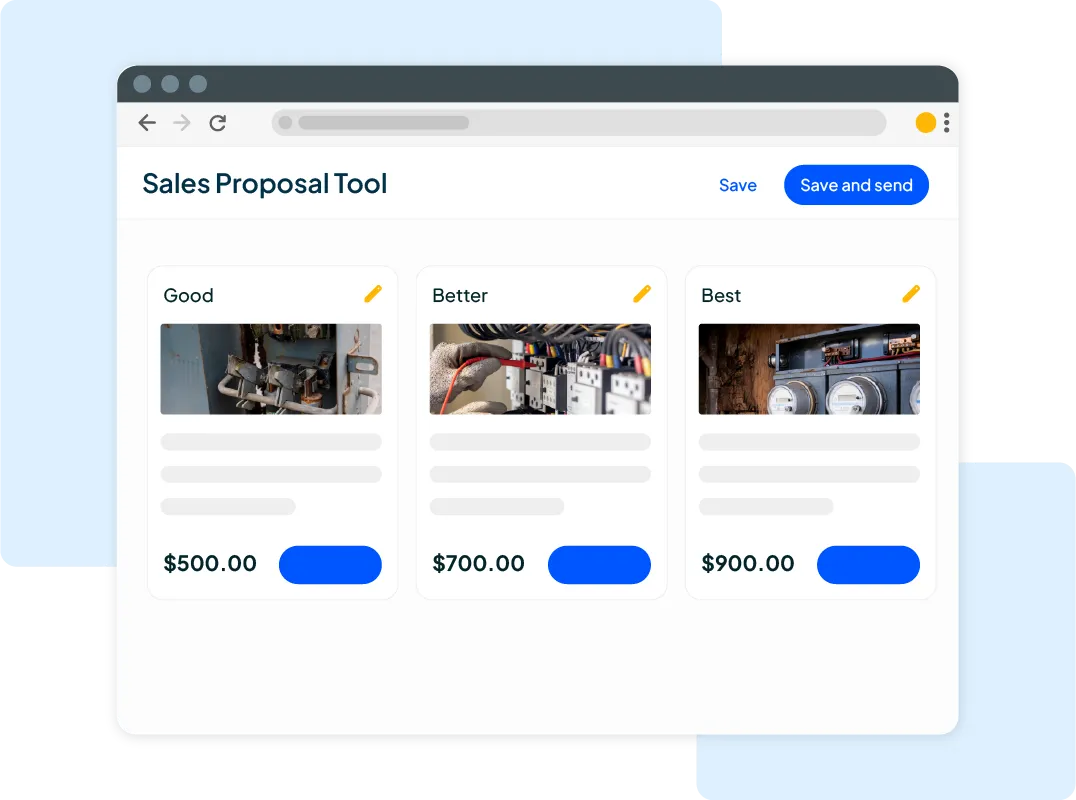
Housecall Pro’s electrical contractor software connects scheduling, dispatch, job management, and invoicing in one place, so your licence details, pricing, and customer history follow the job instead of living in three systems. Build quotes fast with electrical estimating software, offer good, better, best options, and collect approval on the spot, then bill and chase payment with Invoicing while automated reminders handle the follow-up. Keep every lead, job, and conversation together in the electrician CRM, and sync the books through the QuickBooks integration so the records behind your Clean Hands status and your business filings are ones you can actually produce. Want tools for the truck as well as the office? See our roundup of the best electrician apps. Try Housecall Pro free for 14 days.
General information, not legal advice. Fees, code editions, experience standards, and reciprocity arrangements change. Verify with the DC Board of Industrial Trades and the Department of Buildings before applying or pulling a permit.
Washington DC electrician licensing FAQs
Who licenses electricians in Washington DC?
The Board of Industrial Trades, inside the Department of Licensing and Consumer Protection. It issues the Electrician Licence in Low and Regular Voltage at Apprentice, Journeyman, and Master levels.
How much experience do I need for a journeyman licence?
4 years and 8,000 work hours, documented with tax records and an employment verification letter signed by a master, plus an NEC code class certificate taken within two years. The statute also allows an electrical engineering degree plus two years of practical experience certified by a licensed master.
How much experience do I need for a master licence?
8 years and 16,000 work hours per DLCP’s published chart, with the same documentation. Guides describing a four or five year master path do not match DLCP’s own instruction sheet.
Do I need to take a code class?
Yes, for both journeyman and master exam applicants. DLCP requires an NEC code class certificate taken within two years, and the statute describes it as a class on Title 12C of the DCMR or equivalent code completed within two years before submittal.
Can I skip the journeyman exam?
Yes, with proof of completion of a nationally certified apprenticeship programme. That waiver applies to the journeyman exam only, not the master exam.
What counts as low voltage in DC?
Any work done at 49 volts and below, per DLCP’s instruction sheet. The statute also provides for a master electrician limited (low voltage) class with journeyman-level eligibility.
Does DC have electrician reciprocity?
Yes but narrowly. Journeyman reciprocity is available from Virginia only. Master reciprocity is available from Maryland or Virginia only. Your letter of good standing must state that you obtained your licence by examination.
Is the exam open book?
Yes. DLCP names the National Electrical Code and Ugly’s Electrical Reference as study references and confirms the exam is open book. The published sheet cites the 2011 NEC, so confirm the current edition before buying a code book.
When does my licence expire?
November 30 in odd-numbered years, regardless of when it was obtained. It is a fixed date on a two-year cycle rather than an anniversary.
What does it cost?
Commonly cited figures are around $65 to apply, $110 for a journeyman licence, $120 for master, and around $52 for the exam, with renewals in the $110 to $180 range. DLCP’s board page also cites a $260 licence fee under § 47-2853.99 for a class of licence, so confirm which applies to you.
Are fees refundable?
No. Under D.C. Code § 47-2853.10, application fees for initial licensing, certification, registration, renewal, and reinstatement are non-refundable even if you withdraw the application.
Do I need a business licence too?
If you contract rather than work for someone else, yes. A Basic Business License with the electrical endorsement, plus Clean Hands, premises documentation, corporate registration, insurance naming DLCP, and any trade bond.
Is there a low voltage master licence?
The statute provides for a master electrician limited (low voltage) class, which shares the journeyman-level eligibility requirements rather than the 16,000-hour master standard. Ask the Board whether it fits your scope.
Where do I get permits?
From the Department of Buildings, a separate agency from DLCP since the old DCRA was split. DLCP licenses you, DOB permits and inspects the work.
How much do electricians earn in Washington DC?
The mean is $42.72 an hour or $88,860 a year, and the median is $37.97 or $78,970, per BLS data for May 2025. The bottom 10% earn $24.97 an hour and the top 10% earn $60.48, or $125,790.
LEARN FROM THE PROS
Helpful content for the trades
Explore our collection of helpful articles written by top experts in their field to seasoned pros in the field. Strengthen your field service knowledge and stay current on the latest industry topics and trends.
How to get junk removal leads: 15 proven strategies
Junk removal ads to win more customers (ideas, costs, and examples)
10 junk removal marketing strategies to grow your business
How to create a Google Business Profile: Step-by-step guide
TradeWire #49: A blade built for nails, an Amana recall, and the most unforgettable name in the trades
How to set up payment processing for recurring service agreements
How to write a junk removal business plan (+free template)
How to write a pressure washing contract (+free template)
Is a handyman franchise worth it? Costs and best brands
How to collect payments for electrical jobs
How to collect payments for plumbing jobs and keep cash flowing
How commercial service contractors manage agreements, dispatch, and invoicing
Get $50 gift card
Talk to an expert and see how Housecall Pro can fit your needs.
Prefer to explore on your own?


