

UPDATED 2026 ELECTRICAL LICENSING GUIDE
Nevada Electrician License Requirements: The C-2 Contractor License, the Local Journeyman Card & Four Years in Fifteen (2026)
Table of Contents
Download the Checklist!
If you’re planning to do electrical work in Nevada, the credential you need depends on whether you are running the business or working on the tools, and the two come from completely different places. The Nevada State Contractors Board issues the C-2 Electrical contractor license to the business, and that license is what lets a company bid, contract, and pull permits. Nevada does not issue individual journeyman or master electrician licenses at state level. Those come from local jurisdictions, and in Clark County, the City of Las Vegas, and the City of Reno they are administered as Electrical Qualifications Cards through Electrical Safety Professionals. So most electrical businesses here need both: a state C-2 license and carded people on the job site. This page covers the C-2 requirements, the experience rule almost every guide reports incorrectly, the exams, the financial statement tiers, and the local cards.
Electrical work is one of the stronger trades in the national job market. Bureau of Labor Statistics figures put the national median wage for electricians at $63,190 a year, or about $30.38 an hour, as of May 2025, with the lowest 10% under $42,640 and the highest 10% above $108,510. The mean sits higher than the median at $71,490, which tells you the distribution is stretched upward by experienced and specialty work. Employment of electricians is projected to grow 9%, much faster than the average for all occupations, with roughly 72,700 openings a year over the decade, most of them from workers retiring or moving into other work.
Nevada pays above that national picture and employs electricians at above-average concentration. BLS state figures (Nevada OEWS, May 2025) count 8,350 electricians in the state at a mean of $36.40 an hour, or $75,710 a year, with a median of $35.37 an hour and $73,570 annually. That median runs roughly $5 an hour above the national median. The top 10% reach $58.27 an hour, or $121,200, well past the national 90th percentile. Nevada’s location quotient of 1.11 puts electrician employment 11% above the national rate, which is what a construction-heavy Las Vegas and Reno market looks like.
Quick answer: do you need an electrical license in Nevada?
Yes, and you may need two different credentials.
To operate an electrical business, you need a C-2 Electrical contractor license from the Nevada State Contractors Board (NSCB). Under NRS 624, all contractors must be licensed before contracting, and the Board defines contracting to include bidding, offering to engage, and negotiating a price. The license belongs to the business, not to the person who qualified it.
To work on a job site as the qualified individual supervising installations, you need a local Electrical Qualifications Card. Nevada does not regulate job-site supervision or the installation of electrical systems at state level. That requirement comes from the administrative codes of Clark County, the City of Las Vegas, and the City of Reno, and the cards are administered through Electrical Safety Professionals.
That split is the single most important thing to understand about electrical licensing here. A contractor holding a valid C-2 license still cannot put uncarded people in charge of installations in Clark County, and a carded journeyman cannot contract for work without a licensed employer.
What the C-2 requires: four years of qualifying experience within the past fifteen, a passing score on both the PSI trade exam and the Nevada Business and Law exam, a financial statement matched to your requested monetary limit, a bank verification form, and a surety bond the Board sizes after approval.
Key takeaways
Everything you need to know about getting licensed for electrical work in Nevada:
Two credentials, two authorities: NSCB licenses the business as C-2. Clark County, Las Vegas, and Reno card the individuals. Neither substitutes for the other.
Four years within fifteen, not ten: NSCB requires four full years as a journeyman, supervising employee, or contractor within the fifteen years before you apply.
No education requirement at all: NSCB states you do not have to meet any education requirement. Schooling can substitute for up to three of the four years.
Two exams, three attempts each: The PSI trade exam plus the Nevada Business and Law (CMS) exam. Fail either three times and your application becomes void.
Your financials set your monetary limit: A financial statement is required regardless of limit size, and the CPA involvement scales up as the limit rises.
Do not buy the bond early: The Board sets your bond between $1,000 and $500,000 after approving the application. Buying before the letter wastes money.
Two credentials, two authorities
Most states either license individual electricians at state level or leave it entirely local. Nevada does neither cleanly, which confuses contractors arriving from California or Arizona.
| C-2 Electrical contractor license | Electrical Qualifications Card | |
| Issued by | Nevada State Contractors Board | Local jurisdictions via ESP |
| Held by | The business entity | An individual person |
| Authorizes | Bidding, contracting, pulling permits | Supervising installations on site |
| Legal basis | NRS 624 | Local administrative codes |
| Experience | 4 years in the past 15 | 6,000 or 8,000 hours by card type |
| Exam provider | PSI | International Code Council |
| Term | Biennial renewal | Three years from issue |
| Continuing education | None required by the state | Required, 15 to 30 hours by card |
The clearest statement of why both exist comes from the body administering the cards: the State of Nevada does not regulate supervision on the job site or the installation of an electrical system, and the requirement for a qualified individual on site comes from Clark County, City of Las Vegas, and City of Reno administrative codes.
Your state license makes the company legal. The cards make the crew legal.
The experience rule that almost every guide gets wrong
This changes who is eligible, so it is worth stating directly.
NSCB’s own License Requirements page states, twice, that the trade qualifying individual must have had, within the fifteen years immediately before the filing of the application, at least four full years of experience as a journeyman, supervising employee, or contractor in the specific classification requested.
You will read “within the last ten years” in many places, including exam prep providers and licensing aggregators. That is not what the Board’s current page says, and the distinction matters for a real category of applicant: someone with four years in the trade who left for a decade and is coming back. Under ten years they are ineligible. Under fifteen they may qualify. Confirm with NSCB, but do not disqualify yourself on a third-party guide.
How you document it
The Board accepts three routes:
- Four Certification of Work Experience Forms per trade qualifier, from people with firsthand knowledge of your work
- A current masters certification from a governmental agency in a substantially similar discipline
- Proof of transferable military experience and training
Each qualifier also completes a Resume of Experience, and self-employment requires a customer list with full addresses and phone numbers.
Two provisions most applicants miss. Accredited training can satisfy up to, but no more than, three years of the requirement, documented with transcripts or apprenticeship certificates. And there is no education requirement at all.
The certificates are waived entirely if the qualifier served as a qualified employee in the same classification on another Nevada license within the last five years, or qualifies for waiver by endorsement.
That five-year provision is worth flagging. If you qualified a Nevada electrical license at a previous employer within the last five years, you skip the work experience certificates entirely, which removes the slowest part of most applications: chasing four former supervisors for signed forms.
Who can be the qualifying individual
Under NRS 624.260 the qualifier can be an owner, officer, member, manager, or employee, and must be a bona fide member or employee actively engaged in the contracting business, not a name on paper.
The consequence: the license belongs to the business, not the qualifying party. If your qualifier leaves, the license has a problem, and renewal requires confirming they are still actively associated. For a firm whose C-2 rests on one employee’s exam results, the cheapest hedge is qualifying a second person.
The exams: PSI, the CMS, and the three-strike rule
Every C-2 applicant’s qualifying individual passes two exams unless they meet the requirements for waiver:
- The trade examination specific to the classification requested
- The Business and Law (CMS) examination, which is Nevada-specific
NSCB contracts testing to PSI. The sequencing matters: you cannot schedule an exam until after the application is submitted and you have received an Examination Eligibility form with a Candidate ID number. Applicants who try to test first and apply later hit a wall.
| Exam logistics | Detail |
| Provider | PSI Licensure |
| Nevada test centers | Las Vegas, Reno, Elko |
| Out-of-state testing | Available at PSI-owned sites, confirm with PSI |
| Attempts allowed | Three per exam |
| Wait between attempts | Two weeks |
| After three failures | Application becomes void, NAC 624.600(3) |
| Reapplying after void | New application and fee, 30 days after last exam |
| Prerequisite | Submitted application plus Exam Eligibility form |
That three-strike rule deserves attention. Failing three times does not just mean retesting. Your application becomes void, and you start over with a new application and fee after a 30-day wait. With the two-week gap between attempts, a poorly prepared applicant can lose a quarter of a year.
The C-2 trade exam covers general electrical knowledge, services, feeders and branch circuits, grounding and bonding, conductors and cables, raceways and boxes, special occupancies, electrical power, motors, low voltage, lighting, illuminated signs, fire detection, safety, transmission lines, and overcurrent protection. It is semi-open-book, so knowing your way around the tabbed references matters as much as recall.
Financial statements and the monetary limit
Nevada ties your maximum contract size to your balance sheet, and the documentation required scales with the number you ask for.
The monetary limit is the maximum contract you may undertake on one or more contracts on a single construction site or subdivision for a single client, set with reference to NRS 624.260 through 624.265.
A financial statement is required regardless of the limit you request. There is no threshold below which you skip it.
| Requested monetary limit | Financial statement required |
| $25,000 or less | CPA statement, Board form, or software balance sheet |
| $25,000 or less | Self-prepared must be current within 6 months |
| Over $25,000 to under $500,000 | CPA-compiled within 6 months |
| Over $25,000 to under $500,000 | Or reviewed or audited within one year |
| $500,000 to under $1,000,000 | CPA-compiled with full disclosures, 6 months |
| $500,000 to under $1,000,000 | Or reviewed or audited within one year |
| $1,000,000 or more | Reviewed or audited by an independent CPA, one year |
Other requirements apply across all tiers. Statements must be for the applying entity, in US dollars, with a classified balance sheet for business statements. Sole proprietors and each general partner submit personal statements, and a CPA-prepared personal statement needs a supplemental schedule disclosing working capital and net worth.
A Bank Verification Form completed by your bank goes in alongside the financial statement.
There is also an indemnification option worth knowing about. It lets the Board consider the financial strength of another individual or entity in addition to the applicant. It is not required, but it gives a path to an applicant who would not otherwise qualify. The agreement goes on a Board-prescribed form with its own financial statement and bank verification form meeting the same criteria.
The bond: do not buy it before the letter arrives
Nevada’s bond rules catch people who try to get ahead of the process.
The Board determines the amount at the time of license approval, ranging from $1,000 to $500,000 based on license type, monetary limit, past, present or future financial responsibility, experience, and character. You receive notification of the required amount after approval and before issuance.
So: wait for the letter. Buying early does not speed anything up and may waste the premium.
Once you know the number, you can post a surety bond from a company authorized in Nevada rated “A” or better, or a cash deposit by cashier’s check for the full amount. Two details on the cash route: a $200 biennial administrative fee applies, and after license termination NSCB must hold the deposit an additional two years because of the claims statute of limitations.
Bonds must be continuous. A surety may cancel on 60 days notice, and failing to maintain the bond is cause to deny, revoke, suspend, or refuse renewal.
C-2 subclassifications and picking the right scope
NSCB licenses by classification and subclassification, and the C-2 family splits electrical work into narrower scopes rather than treating it as one credential. The governing regulation is NAC 624.200, not NAC 624.140, which is General Engineering. Guides citing 624.140 for electrical have the wrong section.
A full classification C-2 license authorizes installing any electrical wires, fixtures, appliances, apparatuses, raceways and conduits, plus installing and maintaining wind energy systems for residential and commercial use not scaled solely for commercial production and sale of electricity, plus all subclassification work.
| Subclassification | Scope under NAC 624.200 |
| C-2a Electrical Wiring | Wires, fixtures, appliances, apparatuses, existing structures |
| C-2b Integrated Ceilings | Modular illuminated ceiling systems and their wiring |
| C-2c Fire Detection | Heat and smoke sensors, alarms, related wiring |
| C-2d Low Voltage Systems | Fiber optics, or systems not exceeding 91 volts |
| C-2e | Lines to transmit electricity |
| C-2g Photovoltaics | Solar cells, batteries, inverters, not past the panel |
Three details earn their place. C-2b is Integrated Ceilings, not “integrated headers,” which appears in some guides. C-2d turns on a hard number: fiber optics or systems not exceeding 91 volts. And C-2g stops at the service panel, authorizing photovoltaic work but not wires beyond the panel.
One housekeeping note: a regulatory amendment deemed holders of the former C-2f to hold C-2e, so the list has consolidated over time. Confirm current designations with the Board.
The point of the subclassifications is that your trade exam and your authorized scope both follow the designation you applied for. NSCB’s own guidance tells applicants to email its classification determination team if they are unsure which designation covers their work, and that email is free where an exam fee is not.
Two consequences.
Apply for the scope you actually sell. A contractor licensed for a narrow subclassification who takes work outside it is operating outside the license, which is a disciplinary matter rather than a technicality.
Adding scope later is a process. Broadening a classification means meeting the experience and exam requirements for the new designation, so if you expect to expand from low voltage into full power distribution it is cheaper to qualify once for the broader designation.
Read NAC 624.200 against your actual scope before you pay a processing fee, because the classification you request determines which trade exam you sit and therefore which four years you must document.
Licensure by endorsement and limited reciprocity
Nevada offers a path for established out-of-state electrical contractors, with conditions.
Licensure by endorsement requires the trade qualified individual to have been actively licensed in the endorsing state for four years with no discipline, suspensions, or sanctions, plus a Request for Verification of Licensure completed by that state. NSCB publishes a State Equivalency Chart of states with substantially equivalent requirements.
The limit: if your endorsing state has no equivalent trade examination, you sit Nevada’s anyway. Endorsement never removes the Nevada-specific Business and Law exam.
On the electrical trade specifically, NSCB maintains limited arrangements with Arizona, California, and Utah that apply to trade examinations only. Confirm the current scope with the Board rather than assuming, because these agreements are renegotiated.
The local card: Journeyman, Master, and the ESP system
Here is the half of Nevada electrical licensing that has nothing to do with NSCB.
Clark County, Las Vegas, and Reno require a qualified individual on site to supervise electrical work, administered as an Electrical Qualifications Card through Electrical Safety Professionals. Card types include Electrical Journeyman, Residential, Sign, Low Voltage Technician, and Master.
| Card type | Typical experience to sit the exam |
| Residential Journeyman | 6,000 hours, about three years |
| General Journeyman | 8,000 hours, about four years |
| Master Electrician | Time as a journeyman, per local rule |
Exams run through the International Code Council on the current edition of the NEC. The general journeyman exam covers residential, commercial, industrial, and construction wiring; the residential card is limited to residential work. Applications require employment verification letters on company letterhead plus a description of the work performed.
Cards expire three years from issue or from the exam date, and newer cards carry the holder’s photograph, a change made to stop people using credentials they had not earned.
Continuing education for the card
The state requires no continuing education for the C-2 license. The local cards do, and the requirement has structure. Renewal every three years requires CE related to electrical code and safety, with minimums inside the total:
- At least 0.8 CEU, or 8 hours, on a code-change class highlighting changes to the current or future enforced edition of the NEC
- At least 0.4 CEU, or 4 hours, on electrical safety based on the current edition of NFPA 70E
- Journeyman, Residential, Sign, and Low Voltage Technician cards require roughly 15 to 18 hours in total depending on the current schedule
- Master cards require 3.0 CEU, or 30 hours
Only CEUs from approved organizations count, and the provider list sits with ESP. Sources disagree on whether the journeyman total is currently 15 or 18 hours, so confirm with ESP before buying a course package.
One more Nevada-wide item that applies on job sites regardless of licensing: Nevada requires OSHA construction safety training for construction workers, commonly OSHA 10 for workers and OSHA 30 for supervisory employees. Budget for it as part of onboarding rather than treating it as optional, and confirm the current rule and deadline with Nevada OSHA, because the requirement attaches shortly after hire rather than at some later point.
Why the card and the license renew on different clocks
Your C-2 license renews every two years with no state continuing education. Your crew’s Electrical Qualifications Cards renew every three years with 15 to 30 hours of CE each. Those cycles never align, because the cards date from when each individual passed their exam.
For a one-person shop that is two dates. For a firm with eight carded electricians it is nine, each with its own CE requirement, on top of license renewal and bond continuity. Track it centrally, because an expired card on a supervising electrician is a company compliance problem, not a personal lapse.
How to get your C-2 license, step by step
Step 1: Confirm your qualifier’s experience fits
Four full years as a journeyman, supervising employee, or contractor in electrical, within the fifteen years before filing. Decide whether you are using work certificates, a governmental masters certification, or military experience.
Step 2: Decide your monetary limit before anything else
It drives the financial statement tier, which drives whether you need a CPA and how current the statement must be. Asking for more than you need adds cost and scrutiny.
Step 3: Prepare the financial package
The right statement for your tier, in the applying entity’s name, with a classified balance sheet for business statements, plus the Bank Verification Form from your bank. Consider indemnification if your own numbers fall short.
Step 4: Submit the application and pay the processing fee
Through NSCB’s online system or on paper to the Reno or Las Vegas office. Applications are commonly cited at a $300 processing fee, with the biennial license fee due at issuance. Confirm current amounts with the Board.
Step 5: Wait for your Examination Eligibility form
You cannot book a PSI exam until the application is in and the form with your Candidate ID has arrived.
Step 6: Pass the trade exam and the Business and Law exam
Three attempts each, two weeks between, and the application voids after three failures on either. Prepare properly the first time.
Step 7: Wait for the bond letter, then buy the bond
NSCB tells you the amount after approval. Then choose a surety bond from an A-rated carrier or a cash deposit, remembering the $200 biennial fee and the two-year hold on cash.
Step 8: Card your people and register locally
Get Electrical Qualifications Cards for the individuals who will supervise installations in Clark County, Las Vegas, or Reno, and check local business licensing in each jurisdiction where you work.
Nevada electrical licensing at a glance
| Requirement | Detail |
| State authority | Nevada State Contractors Board |
| Classification | C-2 Electrical |
| Legal basis | NRS 624 |
| Experience | 4 full years within the past 15 |
| Education | None required |
| Education substitution | Up to 3 years from accredited training |
| Exams | PSI trade exam plus Business and Law (CMS) |
| Attempts | Three per exam, application voids after |
| Financial statement | Required at every monetary limit |
| Bank verification | Required |
| Bond | $1,000 to $500,000, set after approval |
| Cash bond admin fee | $200 biennially |
| Renewal | Every two years |
| State continuing education | None |
| Local card | Required in Clark County, Las Vegas, Reno |
| Reno office | 5390 Kietzke Lane, Ste 102, (775) 688-1141 |
| Las Vegas office | 8400 West Sunset Road, Ste 150, (702) 486-1100 |
Verifying an electrical contractor in Nevada
Nevada gives you three public lookups, and using only one leaves gaps.
NSCB License Search confirms the C-2 license, status, classification, and monetary limit. That last field matters: a contractor whose limit is $50,000 cannot legally take your $200,000 project.
NSCB Public Disciplinary Actions Search is separate. A contractor can hold a current license and still carry an enforcement history.
The local card check confirms the individuals supervising installations hold current cards. Newer cards carry a photograph, so a card you can see beats a number you are told.
Four things to confirm before hiring or subcontracting:
- C-2 status is active, and the classification matches the scope
- The monetary limit covers the contract value you are giving them
- No open or recent discipline in the Board’s enforcement search
- The people on site are carded, not just the company licensed
The monetary limit check is the one most general contractors skip. Because Nevada sizes the limit to the contractor’s financials, handing a small-limit C-2 holder a large scope puts them outside their license, and the problem lands on your project.
Working without a license in Nevada
NSCB treats this as a criminal matter and publishes a page titled “Contracting Without A License Is A Crime.”
The rule to internalize is timing. All contractors must be licensed prior to contracting, and NSCB defines contracting as bidding, offering to engage, or negotiating a price. The violation happens when you quote, not when you pull wire.
The Board also enforces advertising requirements with separate guidance on unlawful advertising, so your license number belongs in your ads from day one.
Two more exposures worth knowing. NSCB maintains a public disciplinary actions search alongside its license search, which means an enforcement record follows you in front of every customer who checks. And the Board operates a Residential Recovery Fund, covered below, which carries its own obligations.
There is a quieter risk in the timing rule. Because contracting includes bidding and negotiating a price, a company that quotes Nevada work while its application is pending has already violated the statute even if it never performs the job. Wait for the license.
The Residential Recovery Fund, and what it actually costs
If your C-2 work touches owner-occupied single-family homes, you are in this system, and the amounts circulating online are wrong in both directions.
What it is. Limited compensation to single-family homeowners harmed by a licensed contractor’s failure to perform, once other recovery is exhausted. NRS 624.440 defines qualified services as construction, remodeling, repair or improvement on a single family residence occupied by the owner.
The statutory caps. NRS 624.470 sets maximums, not fixed amounts, on a three-tier scale:
| Monetary limit | Statutory cap per biennium |
| Not more than $1,000,000 | $200 |
| More than $1,000,000 but limited | $500 |
| Unlimited | $1,000 |
What the Board actually charges. Subsection 3 requires the Board to reduce assessments when the account balance reaches 150% of its largest recent balance, and it has done so. NSCB’s own Recovery Fund affidavit states the current assessment as $80 for limits of $1,000,000 or less, $200 for more than $1,000,000 but not unlimited, and $400 for unlimited.
So a five-tier scale running $100, $250, $500, $700 and $1,000 against thresholds like $80,000 and $250,000 is neither the statute nor the Board’s schedule. Three tiers, caps of $200, $500 and $1,000, and the amounts currently collected are lower.
You can exempt out, carefully. A licensee who will not provide qualified services may file a notarized Certificate of Exemption. NSCB warns that false certification may cost you the license and bring criminal prosecution, so do not sign it to save $80 if you intend to take owner-occupied residential work.
There is a disclosure duty attached. Under NRS 624.520 a contractor must notify the owner of their rights related to the Fund by written statement, with an administrative fine for noncompliance. A line item in your residential contract, not a courtesy.
Claim windows run long. Homeowners may apply within four years after completion, or two years after a Nevada court judgment. Committee decisions are final and, under NRS 624.510(4), not subject to judicial review.
Industrial insurance: the requirement before activation
Nevada calls workers’ compensation industrial insurance, and compliance is checked as part of licensing rather than treated as a separate employer matter.
An approved C-2 license is not activated until the business satisfies the Board on industrial insurance, which means one of two things:
- With employees, proof of active Nevada industrial insurance from a licensed carrier
- With no employees, an affidavit on the Board’s form documenting that you are not required to carry it
The second route is the one sole proprietors and single-member entities miss. No employees does not remove the requirement, it changes what you file. Confirm the current form and standard with NSCB, since both are set administratively.
Note that this is a continuing condition rather than a one-time filing: hiring your first employee moves you from the affidavit track to the coverage track.
What it costs to get licensed
| Cost item | Typical amount |
| NSCB application processing fee | Commonly cited at $300 |
| Biennial license fee | Set by the Board, confirm current amount |
| PSI exams, trade plus Business and Law | Paid to PSI per attempt |
| CPA financial statement | Varies by tier and firm |
| Surety bond | Premium on $1,000 to $500,000 face amount |
| Cash bond administrative fee | $200 biennially, if used |
| Residential Recovery Fund assessment | Applies to residential work |
| Local Electrical Qualifications Card | Application fee per individual |
| ICC journeyman or master exam | Paid to the exam provider |
| Local CE, each three-year cycle | 15 to 30 hours per card type |
| OSHA 10 or OSHA 30 training | Varies by provider |
Confirm every figure with NSCB, PSI, or ESP before budgeting. Fee schedules change and the Board’s own site notes that its published information may not reflect recent updates.
Where Nevada electrical applicants get tripped up
Using the ten-year experience window. NSCB’s page says fifteen years. The narrower figure circulates widely and wrongly.
Booking a PSI exam too early. You cannot schedule until the application is submitted and the Examination Eligibility form arrives.
Treating three failures as just retesting. The application becomes void under NAC 624.600(3), and you reapply with a new fee after 30 days.
Buying a bond before approval. The Board sets the amount after reviewing your application and tells you in a letter.
Skipping the financial statement on a small limit. It is required regardless of the limit requested.
Submitting a stale statement. Self-prepared and compiled statements must be current within six months; reviewed and audited within a year.
Assuming a C-2 covers the crew. Job-site supervision is a local requirement, met by Electrical Qualifications Cards.
Forgetting the qualifier is a single point of failure. The license belongs to the business, and renewal confirms the qualifier is still actively associated.
Expecting full reciprocity. Arrangements with Arizona, California, and Utah cover trade examinations only, and the Business and Law exam is never waived.
Marketing before the license issues. Contracting includes bidding and negotiating a price, so quoting Nevada work during the application period is already a violation.
What electricians earn in Nevada
| Nevada electricians, May 2025 | Hourly | Annual |
| Mean | $36.40 | $75,710 |
| Median | $35.37 | $73,570 |
| 10th percentile | $22.17 | $46,110 |
| 25th percentile | $23.52 | $48,920 |
| 75th percentile | $46.42 | $96,550 |
| 90th percentile | $58.27 | $121,200 |
Source: U.S. Bureau of Labor Statistics, Occupational Employment and Wage Statistics, Nevada, May 2025, with 8,350 electricians employed statewide.
The shape of that distribution is the story, and it maps directly onto the licensing structure described above.
Look at the bottom two rows. The 10th percentile is $22.17 and the 25th is $23.52, barely a dollar apart. Then the median jumps to $35.37, roughly 50% above the 25th percentile. That is not a gradient. It is two clusters: apprentices, helpers, and uncarded workers compressed near the bottom, and carded journeymen well above them.
So the single largest pay event in a Nevada electrical career is crossing between them, and what moves you across is documented hours plus a journeyman card. At the top, $58.27 an hour or $121,200 exceeds the national 90th percentile of roughly $52, and that tier is where master-carded supervisors and C-2 holders live. Nevada’s location quotient of 1.11 confirms demand above the national rate. For how electrical pay compares with other construction roles across states, see our contractor and construction manager salary breakdown.
Run the business side while you chase the cards
Nevada asks a lot of an electrical contractor’s paperwork: a financial statement matched to a monetary limit, a bond you cannot buy until the Board tells you the number, exams you cannot schedule until the application lands, a qualifier who has to stay actively associated, and cards for your crew that renew on a different clock than your license. All of it sits on top of actually running the jobs.
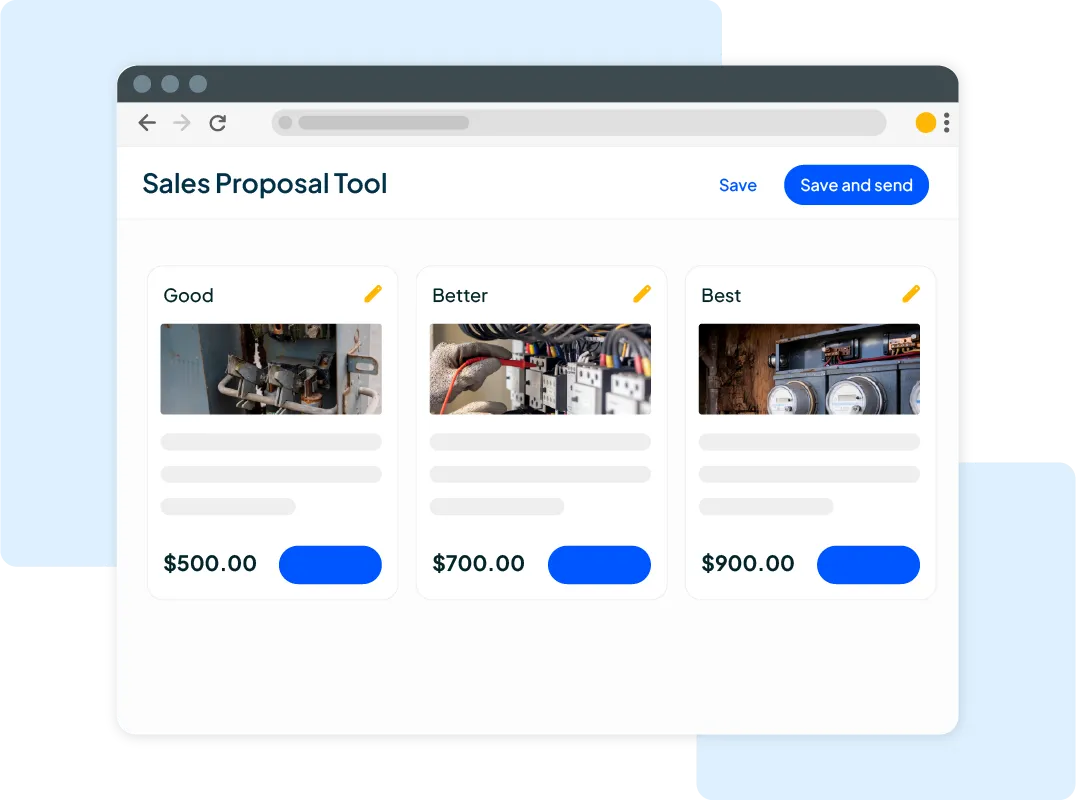
Housecall Pro’s electrical contractor software connects scheduling, dispatch, job management, and invoicing in one place, so the license number, pricing, and customer history follow the job instead of living in three systems. Build quotes fast with electrical estimating software, offer good, better, best options, and collect approval on the spot, then bill and chase payment with Invoicing while automated reminders do the follow-up. Keep every lead, job, and conversation in one place with the electrician CRM, and sync the books through the QuickBooks integration so the financial statement behind your monetary limit is built on records you can actually produce. Want tools for the truck as well as the office? See our roundup of the best electrician apps. Try Housecall Pro free for 14 days.
General information, not legal advice. Fees, bond ranges, exam rules, and local card requirements change. Verify with the Nevada State Contractors Board, PSI, and Electrical Safety Professionals, plus the building department in every jurisdiction where you work.
Nevada electrician licensing FAQs
Do I need a license to do electrical work in Nevada?
Yes. An electrical business needs a C-2 Electrical contractor license from the Nevada State Contractors Board. Individuals supervising installations in Clark County, Las Vegas, or Reno also need a local Electrical Qualifications Card.
Does Nevada issue journeyman electrician licenses?
Not at state level. Nevada does not regulate job-site supervision or installation. Journeyman and master credentials come from local administrative codes and are administered through Electrical Safety Professionals.
How much experience do I need for a C-2 license?
Four full years as a journeyman, supervising employee, or contractor in electrical, within the fifteen years immediately before filing. Many guides say ten years, which does not match NSCB’s current page.
Can schooling count toward the four years?
Yes, up to but no more than three years, from an accredited college, university, or equivalent program accepted by the Board, documented with transcripts or apprenticeship certificates. There is no education requirement.
What exams does Nevada require?
The PSI trade exam for the C-2 classification plus the Nevada Business and Law (CMS) exam. You get three attempts at each, with two weeks between attempts.
What happens if I fail an exam three times?
Your application becomes void under NAC 624.600(3). You may reapply with a new application and fee 30 days after the last examination.
How much is the bond?
Anywhere from $1,000 to $500,000. The Board sets the amount at license approval based on license type, monetary limit, financial responsibility, experience, and character, then notifies you before issuance. Do not buy it beforehand.
Can I post cash instead of a surety bond?
Yes, by cashier’s check payable to the State Contractors Board for the full amount. A $200 biennial administrative fee applies, and NSCB holds the deposit for two years after license termination.
Do I need a financial statement for a small license?
Yes. NSCB requires a financial statement regardless of the monetary limit requested, along with a Bank Verification Form. The level of CPA involvement rises with the limit.
What is the monetary limit?
The maximum contract you may undertake on one or more contracts on a single construction site or subdivision for a single client. It is set with reference to NRS 624.260 through 624.265.
Does Nevada have electrical reciprocity?
Limited. NSCB maintains arrangements with Arizona, California, and Utah that apply to trade examinations only, and licensure by endorsement requires four years of active licensure in an equivalent state. The Business and Law exam is never waived.
Does Nevada require continuing education?
Not for the state contractor license. Local Electrical Qualifications Cards require continuing education every three years, roughly 15 to 18 hours for journeyman-class cards and 30 hours for masters, including a code-change class and NFPA 70E safety hours.
Do the license and the crew cards renew together?
No. The C-2 renews every two years with no state CE. Electrical Qualifications Cards renew every three years from each individual’s exam date and carry their own CE. Track them centrally.
Who can qualify the license?
An owner, officer, member, manager, or employee under NRS 624.260, who must be a bona fide member or employee actively engaged in the business. The license belongs to the business, not the qualifier.
How much do electricians earn in Nevada?
The mean is $36.40 an hour or $75,710 a year, and the median is $35.37 or $73,570, per BLS data for May 2025. The bottom 10% earn $22.17 an hour and the top 10% earn $58.27, or $121,200 a year.
LEARN FROM THE PROS
Helpful content for the trades
Explore our collection of helpful articles written by top experts in their field to seasoned pros in the field. Strengthen your field service knowledge and stay current on the latest industry topics and trends.
How contractors track job status without calling every technician
How to market your home service business and keep customers coming back
How HVAC companies with 10+ technicians manage GPS tracking and dispatch
How to price and scale a recurring lawn care route
How to evaluate field service apps: 8 things to check before you choose
How to compare payment processing options for home service contractors
Thumbtack vs. Angi: Which is better for your business?
TradeWire #50: Home Depot’s tool sweater, Milwaukee’s $200M trades pledge, and Trades Thursday
General contractor pricing guide: How to price jobs in 2026
Housecall Pro’s inaugural Trades Thursday draws thousands of pros nationwide
How to choose the right HVAC scheduling app
How to get junk removal leads: 15 proven strategies
Get $50 gift card
Talk to an expert and see how Housecall Pro can fit your needs.
Prefer to explore on your own?


