Want to win more jobs with less effort?
Grow your business and send quick quotes with our home service software.

Want to see your potential revenue?
See what businesses like yours earn with Housecall Pro in 1 - 2 minutes.

When homeowners discover termites, ants, rodents, or other pests, their first move is usually a Google search. If your business doesn’t appear near the top of those search results, they’re likely calling a competitor instead.
That’s where pest control SEO (search engine optimization) comes in. SEO helps your business show up when local customers search for services like termite inspections, bed bug treatments, or rodent removal in your area. Unlike paid ads, which stop generating leads when you stop spending, SEO can help you attract a steady stream of homeowners actively looking for pest control services.
In this guide, you’ll learn how pest control SEO works, why it matters for local service businesses, and the practical steps you can take to improve your rankings, generate more leads, and book more jobs.

Website SEO Grader
See how your website stacks up on SEO that help customers find you.
Quick answer: What is pest control SEO and how does it work?
Pest control SEO is the process of optimizing your website and online presence so your business appears in Google search results when homeowners look for pest control services in your area. It includes four main components:
- Local SEO: Optimizing your Google Business Profile and building consistent citations so you appear in map results
- On-page SEO: Using location- and service-specific keywords across your website pages
- Off-page SEO: Earning reviews and backlinks that signal credibility to search engines
- Technical SEO: Ensuring your site loads fast, works on mobile, and can be crawled by Google
Most pest control searches are local and urgent. A homeowner searching “ant exterminator in Phoenix” is ready to book, not researching. Businesses that appear in the top local results capture the majority of those calls. SEO is how you get there without paying for every click.
Key takeaways
In pest control SEO, the goal is to focus on what drives visibility and booked jobs:
SEO takes time: Most businesses need several months of consistent effort before seeing meaningful ranking improvements.
Dedicated pages perform better: Create separate pages for key services and service areas instead of relying on one generic page.
Seasonality creates opportunities: Publish and update content before peak pest seasons to capture demand when searches spike.
Reviews support growth: Consistent customer reviews can improve local visibility and help homeowners choose your business.
Leads matter most: Measure success by calls, form submissions, and booked jobs—not rankings alone.
Table of contents
- Pest control SEO services: Should you hire an expert?
- Local SEO for pest control
- On-page SEO for pest control
- Off-page SEO for pest control
- Technical SEO for pest control
- How to adjust your pest control SEO strategy by season
- How to know if your pest control SEO is actually working
- How to turn SEO traffic into booked jobs
Pest control SEO services: Should you hire an expert?
Whether you should hire an SEO agency depends on two things: your time and goals.
If you’re expanding into multiple service areas or competing in a crowded market, an SEO agency can help you get results faster and free up your schedule. If you primarily serve one local area, you might be able to handle the basics yourself.
The right choice comes down to how aggressively you want to grow and how much time you can realistically commit to marketing your pest control business.
Before you decide one way or the other, consider the pros and cons:
| Pros | Cons |
| Pros handle keywords, content, and technical SEO | Monthly retainer or ongoing service fees |
| Faster results from proven SEO strategies | Quality varies by agency experience |
| Tracks rankings, traffic, and conversions | Less control over site changes |
Table: Trade-offs of hiring a pest control SEO agency vs. managing it yourself, for single-location and multi-location businesses.
What does pest control SEO actually cost?
If you hire an agency, expect to pay $1,000–$2,500/month for a small business retainer (Backlinko, 2025). Competitive metro markets or multi-location businesses can push that higher.
DIY isn’t free, though—it costs time and tools. A basic DIY setup typically runs $100–$200/month: Google Search Console and Google Analytics are free, but a keyword research tool like SEMrush or Ahrefs starts around $100–$130/month.
The real cost is time. Expect to spend 5–10 hours per month on keyword research, content updates, and maintaining your Google Business Profile if you’re doing it yourself. That’s manageable for one service area. Once you’re juggling multiple locations or competing in a crowded market, the time cost usually tips the decision toward hiring out.
Local SEO for pest control
Most pest control searches are local and urgent. Homeowners want fast help from a company nearby. That means showing up in local search results (especially Google’s map pack) matters more than broad website traffic.
Optimize your Google Business Profile
Your Google Business Profile is one of the most important tools for local visibility. It’s often the first thing homeowners see when they search for pest control services.
If you haven’t already, create or claim your profile and fine-tune it:
- Choose the right primary category. “Pest control service” is typically the best option. Add secondary categories that fit your services, such as “termite control service” or “wildlife removal service.”
- Set accurate service areas. List the cities and ZIP codes you actively serve. Avoid claiming areas you don’t cover.
- Add real photos: Upload pictures of your trucks, techs in uniform, equipment, and before-and-after treatment results. Fresh photos show you’re active and build trust.
- Keep hours updated. Revisit these as your hours change. Include holiday hours and emergency availability if you offer them.
- List specific services: Add detailed service descriptions, such as “bed bug heat treatment” or “termite inspection.”
Once fully optimized, your Google Business Profile improves your chances of appearing in local map pack results and capturing high-intent calls.
Use location-specific keywords
Pest control is a local service. That means your website should clearly tell Google where you work and what you do.
Start by combining your core services with your service area. Instead of targeting overly broad phrases like “pest control” or “exterminator,” focus on location-based terms such as:
- “Termite inspection in Orlando”
- “Bed bug treatment Denver”
- “Ant exterminator in Phoenix”
- “Rodent control service in Seattle”
Use these phrases naturally throughout your site in:
- Page titles
- Meta descriptions (summarize the page’s content in 155 characters or fewer)
- H2 and H3 headers
- Service page content
- Image alt text (descriptions added to images on your site)
If you serve 3+ cities, build a dedicated page for each. One combined ‘service areas’ page won’t rank for city-specific searches. Each one should include unique content about that area. Think about common pest issues in the state, seasonal trends, or neighborhoods you serve. Avoid copying the same page and just swapping city names. If each location page says the same thing, save for the city name, search engines may ignore or consolidate them.
Clear, location-focused pages make it easier for search engines (and homeowners) to see that you serve a specific area.
Pro tip: Don’t create one generic “Pest Control” page and expect it to rank for every service and city. Build dedicated pages for key services and major service areas to improve visibility.
Build local citations
Local citations are online listings that include your business name, address, and phone number (often called NAP information). Search engines use these listings to confirm that your business is legitimate and consistently represented across the web.
Start by making sure your NAP details are the same everywhere. Even tiny differences, like “Street” vs. “St.” or a missing suite number, can create confusion.
Common citation sources for pest control companies include:
- Yelp
- Angi
- HomeAdvisor
- Better Business Bureau
- Local chamber of commerce websites
- Industry-specific directories, such as your state’s pest control association directory (if applicable)
The goal isn’t to list your business on dozens of random sites. Focus on reputable, relevant directories and keep your information consistent. That consistency helps search engines trust your business location and improves your chances of ranking in local results.
On-page SEO for pest control
Local visibility helps homeowners find you. On-page SEO helps convince both Google and your customers that your website is the right choice.
Do keyword research
Keyword research helps you understand exactly what homeowners are typing into Google. Instead of guessing, use tools like Google Keyword Planner or SEMrush to find search terms with steady demand.
For pest control, focus on high-intent keywords (searches from people who are actively looking for a service and are more likely to book) rather than general information searches. Target a mix of:
- Service and pest type: “termite inspection,” “bed bug treatment,” “roach exterminator.”
- Service and location: “pest control in Raleigh,” “rodent removal Chicago.”
- Cost-related searches: “termite inspection cost,” “how much does pest control cost.”
Focus on the services you already offer to start. Then, look for variations that people actually search. Build your main service pages around those core terms rather than trying to rank one page for everything.
Clear keyword targeting makes it easier for search engines to understand what each page is about. Using an on page SEO checker can also help identify optimization gaps and ensure each service page is fully aligned with SEO best practices. It also helps your content match real searches.
Write blog content that captures homeowners before they’re ready to book
Service pages target people who are ready to book. Blog content helps you reach homeowners earlier in their search.
Think about the questions your customers might ask before they realize they need your help:
- “How do I know if I have termites?”
- “Are bed bug treatments safe for pets?”
- “Why are ants worse in the summer?”
These topics let you answer common questions while naturally weaving in local keywords. For example, a post on “Signs of termite damage in Florida homes” can attract seasonal traffic and build authority.
Blog content works best when it’s specific, helpful, and written in plain language. Avoid stuffing keywords or using industry words the reader might not recognize. Focus on answering real questions clearly.
Optimize page titles and meta descriptions
Your page title and meta description—the short summary that appears below your page title in Google search results—are often the first impression homeowners have during their search. While they don’t directly improve rankings on their own, they can increase the chances that someone clicks your listing instead of a competitor’s.
Keep titles clear and location-focused, when applicable (think service pages). For example:
- “Termite Inspection in Tampa | Licensed Pest Control Experts”
Meta descriptions should summarize your service and encourage action:
- Need a termite inspection in Tampa? At Florida Pest Pros, we provide fast, thorough inspections and treatment options. Call today for a free estimate.
Clear, keyword-rich titles improve visibility. Strong descriptions improve click-through rates.
Use clear headers and page structure
Search engines scan your pages, looking at things like headings and internal links (links that connect pages within your own website) to understand what your content covers. A clearly laid-out page helps both search engines and homeowners find the answers they need quickly.
Organize each service page with logical headers:
- H1: Main service + location (“Rodent control in Columbus”)
- H2s: Subtopics (“Signs of a rodent problem,” “Our treatment process,” and “Why choose us?”)
- H3s: Supporting details when needed
Opt for short paragraphs, bullet points, and clear sections to improve readability. That’ll also help search engines connect your page to relevant searches.
If someone lands on your site, they should be able to scan it in seconds and know they’re in the right place.
Optimize images
Images make your site look professional and help search engines understand what your pages cover. Each image should have a descriptive file name like “termite-inspection-tampa.jpg” instead of “IMG_1234.jpg.” It also should have alt text—a short description that helps search engines and screen readers understand what’s shown in an image. Clearly describe the image, such as “technician performing termite inspection in Tampa home.” Keep it natural and relevant.
Image size matters, too. Large files can slow down your website, especially on mobile. Compress photos before uploading them to keep pages loading quickly and visitors engaged.
Well-optimized images help your site load faster and work better for homeowners.
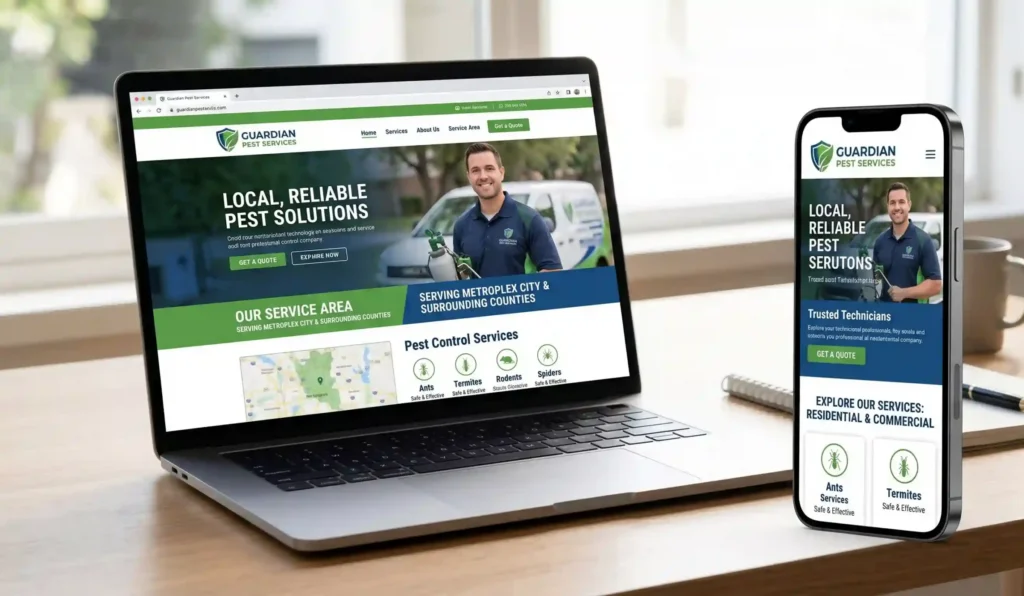
Improve website speed and mobile experience
Over 60% of online searches occur on mobile devices. If your site loads slowly or looks broken on mobile, visitors are likely to leave as quickly as they came—and Google will notice.
So, improve mobile experiences with:
- Fast load times
- Easy-to-tap buttons
- Clear phone number placement
- Simple navigation
- Visible calls to action
You can use tools like Google PageSpeed Insights to check performance. If anything comes back with issues, adjust accordingly.
A fast, mobile-friendly website keeps visitors engaged and increases the chances they’ll call or book.
Off-page SEO for pest control
Your website tells search engines what you do. Off-page SEO shows them that other sites trust and recommend your business. The stronger your reputation across the web, the easier it is to rank (especially in competitive local markets).
Build quality backlinks
Backlinks are links from other websites to yours. When reputable local or industry sites link to your business, search engines treat it as a signal of credibility.
Focus on earning links from:
- Local news sites (for sponsorships or community events)
- Chamber of commerce websites
- Industry associations
- Local home service blogs
- Partner businesses, like real estate agents or property managers
For example, you could sponsor a youth baseball team or a community event, such as a local 5K. That can sometimes lead to a mention on the website and a backlink. Those local signals carry weight because they reinforce your presence in the area you serve.
It’s best to avoid paying for bulk links or listing your business on low-quality directories.Think of backlinks as referrals from other websites. The more trusted the referring site is, the more valuable the link tends to be.
Get and manage customer reviews
Reviews influence both rankings and homeowner decisions. A steady stream of recent, positive reviews strengthens your local visibility and builds trust.
Make review requests part of your standard process. After completing a service, send a short follow-up asking for feedback. The easier you make it, the more likely customers are to respond.
Once the reviews start coming in, respond to every one—positive or negative. Thank happy customers, and address concerns professionally. Active engagement shows homeowners and search engines that you’re legitimate and responsive.
Pro tip: Make review requests part of your technician’s closing routine so they happen consistently, not just when someone remembers.
Partner with local businesses
Partnering with other local businesses helps expand your reach and establish you as a credible local pest control business. Consider collaborating with:
- Real estate agents
- Property managers
- Home inspectors
- Landscaping companies
You might exchange referrals, co-host educational workshops, or even create shared content. These relationships can open the door to more brand mentions and backlinks while strengthening your local presence.
Technical SEO for pest control
Technical SEO means making sure search engines can find, read, and trust your website. In simple terms, it’s the behind-the-scenes work that helps your site perform well and makes it easier for search engines to understand your content.
Focus on these technical SEO essentials:
- Ensure search engines can access your site. Submit your sitemap through Google Search Console so your pages can be indexed correctly. Indexing means Google can store and display your pages in search results. Check for broken links, crawl errors, and outdated redirects. Dead ends weaken both user experience and search visibility.
- Add structured data (schema markup). Schema markup is extra code that gives search engines more context about your business, services, reviews, and service areas. You can mark up services like termite inspection, service areas, business hours, and review ratings. That’ll improve clarity and can enhance how your listing appears in search results.
- Use HTTPS for security. HTTPS protects visitor data and prevents “Not Secure” browser warnings. Homeowners are less likely to submit a contact form if your site looks unsafe. It’s now a basic expectation for professional websites.
- Keep a clear site structure and internal links. Organize pages by service, sub-services, locations, and blog content. Link related pages together so search engines know how your content connects. A simple structure also makes it easier for homeowners to navigate your site.
- Address performance issues. If you find them, take care of them. Slow load times and poor mobile usability can hurt rankings. Run periodic checks using tools like Google PageSpeed Insights.
- Schedule regular technical checkups. Websites need maintenance. As you add pages or update content, small issues can appear. Plan to audit your page routinely to protect your rankings over time.
For a more in-depth breakdown of this side of SEO, check out our technical SEO guide.
Get In Touch: 858-842-5746
Let us earn your trust
On average, Pros increase monthly revenue generated through Housecall Pro by more than 35% after their first year.
See plan options and feature breakdown on our pricing page.
How to adjust your pest control SEO strategy by season
Pest control demand isn’t flat year-round—it spikes and shifts by season and region. Your SEO should follow the same pattern.
Here’s how to align your strategy with seasonal demand:
Publish content before the season hits, not during it. New content takes time to rank. If you want to show up for “mosquito control in [city]” in May, publish and optimize that page in February or March. Think of it as planting before the growing season.
Update your Google Business Profile for seasonal services. Use the Posts feature to highlight seasonal treatments: termite swarm inspections in spring, mosquito yard treatments heading into summer, rodent exclusion in fall. Posts appear in your GBP listing and signal to searchers that you’re active and current.
Target seasonal keywords with dedicated pages or blog content. Common seasonal queries include:
- “Termite swarm season [state]” (spring)
- “Mosquito control for backyard” (late spring/summer)
- “Ant infestation in kitchen” (summer)
- “Mice getting into house” (fall/winter)
Check Google Trends to see when these searches peak in your region—timing varies by climate. A pest control company in Florida deals with year-round mosquito pressure; one in Minnesota doesn’t.
Refresh high-traffic pages before peak season. If you have a termite page that ranked well last spring, update it in February. Add current pricing references, freshen the intro, add a new FAQ. Google tends to favor recently updated content for time-sensitive queries.
How to know if your pest control SEO is actually working
SEO should drive calls, form submissions, and booked jobs. Higher rankings are helpful, but the real goal is generating revenue for your business.
Pay attention to key metrics
Focus on metrics that connect directly to growth:
- Website traffic (total and organic): This shows how many people are visiting your site and how many are coming from search engines. If organic traffic grows steadily, your SEO efforts are working.
- Local search rankings: Monitor where you appear for terms like “termite inspection in Austin” or “rodent control near me.” Higher visibility in local results increases your chances of getting the call.
- Bounce rate and time on page: If visitors leave quickly, your content may not match their search intent. The strongest pages keep homeowners engaged and reading.
- Conversion metrics: Track contact form submissions, phone calls, and online booking requests. Traffic only matters if it leads to real inquiries.
Think of it this way: traffic is foot traffic to your storefront. Conversions are the customers who walk in and buy.
Use SEO analytics tools
Free tools like Google Analytics and Google Search Console provide most of the data you need. Google Analytics shows how visitors behave on your site, while Search Console shows which search terms (keywords) are helping people find you.
Set up basic conversion tracking to measure form submissions and booking requests. That makes it easier to see which pages are actually generating leads.
Interpret data and adjust strategies
Look for patterns. Which pages bring in the most traffic? Which keywords lead to inquiries? Hone in on what’s working by expanding high-performing pages or adding related content.
If certain services aren’t getting traction, revisit your keyword targeting, content clarity, or internal links. SEO works best as an ongoing process, not a one-time setup.
How to turn SEO traffic into booked jobs
SEO gets homeowners to your website. What happens next determines whether they book or bounce.
Housecall Pro is software built for pest control businesses that handles the follow-through so your SEO investment actually converts. With it, you can:
- Get more reviews without asking manually: Most customers don’t leave reviews unless you make it effortless. Housecall Pro’s automated review requests send after every completed job, so you build a steady review stream without your techs having to remember to ask.
- Capture leads after hours: Homeowners who find you at 10 p.m. won’t wait until morning. Online Booking lets them schedule directly from your website so the job is booked before they move on to a competitor.
- Connect marketing spend to actual revenue: Track campaigns, monitor lead sources, and measure results in one place, so you can see which SEO efforts are generating jobs, not just traffic.
- Keep your schedule full between jobs: Automated follow-ups send seasonal reminders, re-treatment notices, and promotions without manual effort. Repeat business from existing customers costs less to generate than new leads from search.
- Personalize outreach with full job history: Integrated customer records give you service notes, treatment details, and contact info in one system — so follow-up feels relevant, not generic.
As Richard V., owner of Verikill Pest Control, puts it: “Housecall Pro improves the quality of your life by making things easier. It facilitates a lot of stuff that really ties people in small businesses down.”
Try Housecall Pro free for 14 days.
Pest control SEO FAQ
How much does it cost to pay someone to do SEO?
The cost of hiring someone to do SEO usually ranges from $500–$2,500 per month for ongoing services (Backlinko.com). If you’re doing larger campaigns in a competitive metro area, you may pay even more per month.
What are the four pillars of SEO?
The four main pillars of SEO are technical SEO, on-page SEO, off-page SEO, and local SEO. Technical SEO ensures search engines can access and understand your website. On-page SEO focuses on optimizing content, keywords, and structure. Off-page SEO builds authority through backlinks and reviews, while local SEO improves visibility in map results and location-based searches.
Can SEO help me advertise my pest control business?
Yes, but it works on a different timeline than paid ads. With Google Ads, you pay per click and stop appearing when the budget runs out. With SEO, you earn organic placement over time. Once you rank, traffic is essentially free. For pest control, SEO is best used to capture steady search volume for recurring services (termite inspections, annual treatments), while paid ads can fill gaps during slow seasons or when you’re entering a new service area.
How long does it take for pest control SEO to start working?
Most local SEO efforts take 3–6 months to produce measurable ranking changes, though the timeline depends on how competitive your market is and how much work your site needs upfront. Google Business Profile optimizations tend to move faster—you may see improvements in local map pack visibility within a few weeks of fully optimizing your profile and getting a steady flow of reviews.
New content pages and service area pages typically take longer, often 4–6 months before they gain enough authority to rank consistently. If your site has technical issues (slow load times, broken pages, missing location data) those need to be resolved first, which can add time before growth kicks in. SEO is a long-term investment: businesses that stay consistent for 12+ months typically see compounding results as their content and reviews accumulate.