Want to win more jobs with less effort?
Grow your business and send quick quotes with our home service software.

Want to see your potential revenue?
See what businesses like yours earn with Housecall Pro in 1 - 2 minutes.
Even the best pest control companies can struggle to grow without a strong marketing strategy. Customers have more options than ever, and most will compare multiple businesses online before making a decision. If your company doesn’t appear credible, visible, and easy to contact, potential customers will move on quickly.
This guide walks through pest control marketing strategies to help you reach more homeowners, build customer trust, and create a steady pipeline of new business. We’ll also show how tools like Housecall Pro can support your growth behind the scenes.

Score your online presence
See how visible and trustworthy your business looks online.
Quick answer: How do you market a pest control business?
Market your pest control business by making it easy for homeowners to find and trust you online. Start with the essentials: a complete Google Business Profile, a professional website with online booking, and a system for collecting customer reviews. From there, you can add local SEO to improve visibility in search results, paid ads like Google PPC or Local Services Ads to generate faster leads, and social media to stay connected with your community as your business grows.
Key takeaways
Keep these core principles in mind as you market your pest control business:
Be easy to find: Show up where homeowners search—online and in your neighborhood—so your business is easy to find.
Focus on a few channels: Pick two or three marketing channels to master before adding more to your plate.
Build trust early: A strong review profile and professional website help customers choose you with confidence.
Stay consistent: Steady, ongoing effort outperforms one-off campaigns or frequent strategy changes.
Make booking easy: Clear action steps and fast follow-ups turn interest into scheduled work before leads go elsewhere
Table of contents
- 1. Build a strong pest control brand
- 2. Create a professional pest control website
- 3. Optimize your pest control website for SEO
- 4. Run targeted pest control ads
- 5. List your pest control business on online directories
- 6. Use direct mail marketing to reach homeowners in your target neighborhoods
- 7. Generate pest control leads with reviews and referrals
- 8. Use social media for pest control marketing
- 9. Use email and text to turn one-time customers into repeat business
- 10. Promote your pest control business with vehicle wraps and signage
- 11. Get pest control referrals from property managers and contractors
- How to build your pest control marketing plan (step-by-step)
- How to market your pest control business without doing it all manually
1. Build a strong pest control brand
Your brand is the combination of your name, logo, colors, and tone. It shapes how homeowners see your pest control business before they even pick up the phone.
Start with the basics:
- A clear, memorable business name: Pick a pest control company name that sounds professional, is easy to search for online, and helps customers quickly understand what you do.
- A professional logo: Use a simple design that looks good on everything from your business card to a truck wrap.
- Consistent colors and fonts: Use the same visual style across your website, uniforms, and marketing materials so you’re easy to identify.
- A customer-focused slogan: Keep it short and focus on what the customer wants—safety, reliability, or fast response.
Carry your branding into day-to-day operations. Clean, clearly marked vehicles. Branded shirts or uniforms for techs. A professional voicemail greeting and email address. These details add up—they help homeowners feel comfortable inviting you onto their property and recommending you to others.
Pro tip: If you’re working with a tight budget, sites like Fiverr or 99designs can help you find freelancers who specialize in service business logos for as little as $50–$150.
2. Create a professional pest control website
According to Housecall Pro’s 2025 Customer Service Report, 96% of homeowners say a professional, user-friendly website matters when hiring a service provider. Your website is your chance to show potential customers whether you’re trustworthy and easy to work with. A site that’s hard to navigate or slow to load can send that lead to your competitor.
At minimum, your pest control website should include:
- A clear homepage that explains who you serve, the problems you solve, and how to contact you.
- Dedicated service pages for common treatments like ants, rodents, termites, or mosquitoes.
- A service area page listing the cities or neighborhoods you cover.
- An “About Us” page with real photos and a short background on your business.
- A contact page with your phone number, hours, and an easy way to request service.
Speed and usability matter as much as content. Your site should load quickly, look clean on mobile, and make it obvious what to do next, like requesting a quote or booking service. If customers have to dig for what they need, they’ll move on.
If you’re just starting out, a one-page site that clearly lists your services and contact info is enough. Expand it as your business grows.
Pro tip: 80% of homeowners surveyed for our Customer Service Report said online booking influences who they hire. You can use tools like Housecall Pro to add this directly to your website and give people an easy way to request service anytime, even after business hours.
3. Optimize your pest control website for SEO
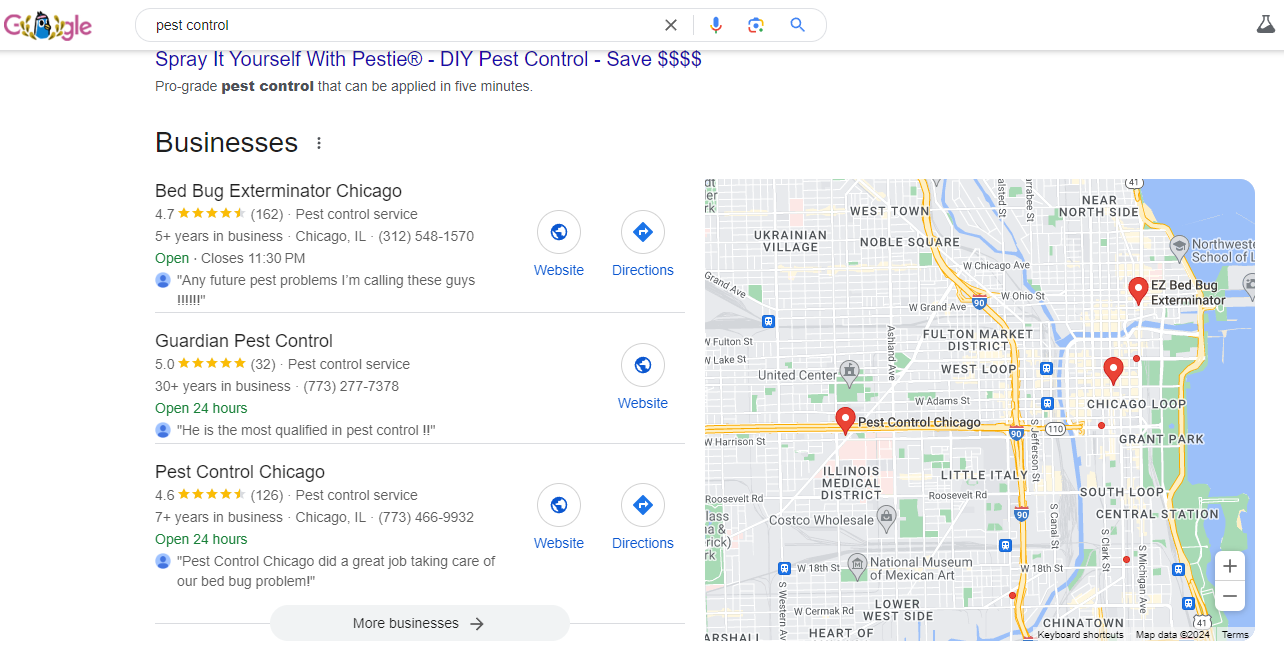
Search engine optimization (SEO) means making your website show up when local homeowners search for pest control services online. It’s about helping the right people find you, understand what you offer, and feel confident enough to reach out.
Local SEO
Local SEO is one of the most effective marketing strategies for pest control companies because it helps your business appear when homeowners are actively searching for help nearby. It improves your visibility in local search results, especially in Google Maps and the “near me” listings people use to compare local service providers.
Start by claiming and optimizing your Google Business Profile.
To keep it working for you:
- Verify that your business name, address, and phone number (NAP) match exactly across all online platforms.
- Add real photos of your team, branded vehicles, and completed jobs.
- Keep your service area and hours accurate and current.
- Ask for reviews after every job and respond to each one—positive and negative.
On-page SEO
On-page SEO focuses on your website’s content and structure so search engines understand what you do. Clear, helpful content that answers real customer questions is more effective than repeating the same keywords over and over to try to “game” the system.
Improve on-page SEO by:
- Creating individual pages for each core service you offer (termite control, rodent removal, mosquito treatment, etc.)
- Adding location-specific pages for each major service area (e.g., “Pest Control in [City]”)
- Including short FAQ sections that answer common pest questions
- Writing seasonal blog posts about pest prevention tips
Pro tip: Search your primary service plus city name, then look at the top three results. Use their website structure and content as a baseline, then make your pages clearer and more useful.
4. Run targeted pest control ads
Paid advertising generates leads quickly, especially during peak seasons or when you need to fill gaps in your schedule. Instead of trying every platform, focus on high-intent channels where homeowners are already looking for help.
| Ad Type | Cost Model | Avg. Lead Cost | Best Use Case | Time to First Lead |
|---|---|---|---|---|
| PPC (Google Ads) | Pay-per-click | $40–$120, depending on search intent | Searchers actively looking to book now | Same day |
| Local Service Ads (LSAs) | Pay-per-lead | $20–$70 | High-intent local leads | Same day–1 week |
| Paid Social (Facebook/Instagram) | Pay per click (CPC) or impressions (CPM) | $50–$80 | Seasonal awareness, retargeting past website visitors | 1–2 weeks |
Average lead costs for U.S. residential pest control campaigns, 2025–2026. Ranges vary by market competitiveness, service type, and ad quality score. Sources: Cube Creative Design Pest Control Advertising Cost Guide (2026); NPMA & PCO Bookkeepers 2025 Pest Control Industry Cost Study.
Pay-per-click ads (PPC)
PPC ads appear at the top of search results when someone searches for terms like “pest control near me.” You pay only when someone clicks, making it a direct way to reach people with immediate needs.
To keep costs manageable:
- Focus on service-specific searches, not broad terms.
- Target only the cities or ZIP codes you actually serve.
- Use call extensions so customers can tap to call directly from the ad.
- Start with a small daily budget ($10–$20) and adjust based on results.
PPC ads work best when they point to clear service pages that make it simple to call or book immediately.
Google Local Service Ads (LSAs)
LSAs sit above PPC results at the very top of Google search. Instead of paying per click, you pay per lead. They include a “Google Verified” badge showing you’ve passed background and insurance checks, which builds trust immediately with homeowners vetting their options.
To get the most from LSAs:
- Respond to calls and messages quickly—response time directly affects your ranking.
- Consistently collect reviews; review count and rating influence your visibility.
- If LSAs are competitive in your market, test them alongside PPC rather than replacing it.
Paid social ads (Facebook, Instagram, TikTok)
Social ads reach homeowners who aren’t actively searching yet. They’re useful for seasonal reminders like mosquito control in the spring or retargeting people who’ve already visited your site.
Tips that help:
- Target by location and ZIP code so you’re not wasting budget outside your service area.
- Promote time-sensitive offers: “Spring mosquito treatment—book by May 31.”
- Use retargeting to re-engage people who visited your site but didn’t book.
Paid social isn’t usually an immediate call generator, but it keeps your business visible when pest problems come up.
5. List your pest control business on online directories
Directories like Yelp, Angi, Thumbtack, and HomeAdvisor put your business in front of homeowners who are already comparing service providers. They’re not a replacement for your own website or Google presence, but skipping them means missing customers who start their search on these platforms instead of Google.
Start by claiming your free listings on Yelp, Angi, and Thumbtack. Fill out every field—photos, services, service area, and hours—so your profile looks complete next to competitors. Make sure your business name, address, and phone number should match exactly across every directory and your Google Business Profile.
Paid placement is optional. Angi and Thumbtack both offer sponsored visibility, but results vary widely by market. If you’re already getting consistent leads from LSAs or PPC, paid directory placement is hard to justify. Test it with a small budget in your slow season before committing.
Read more: Best lead generation websites for contractors
6. Use direct mail marketing to reach homeowners in your target neighborhoods
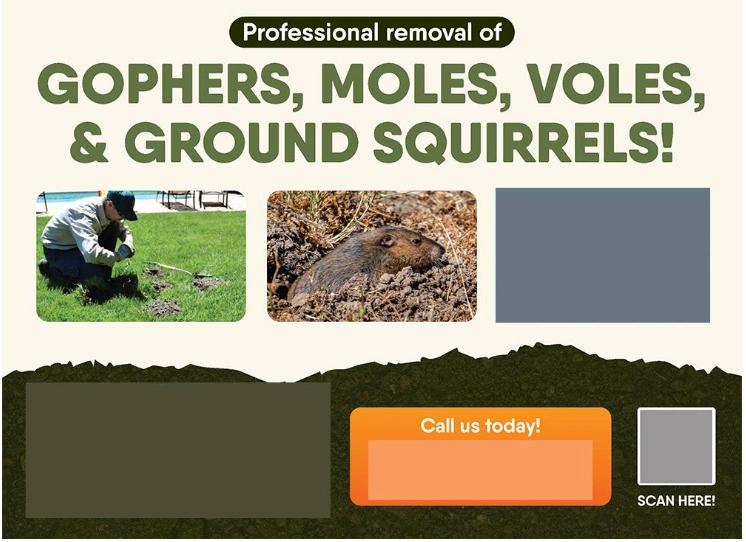
Direct mail is a powerful tool for pest control businesses that want to dominate specific neighborhoods. A postcard or door hanger puts your name directly into the hands of homeowners who might need service this season.
Keep it simple and effective:
- Focus on one seasonal problem—ants in spring, rodents in fall—so the message is clear.
- Make your phone number or booking link easy to find at a glance.
- Send mailers to areas where you already have customers and want to expand.
- Use a dedicated phone number or unique promo code to track which mailers are actually turning into jobs.
Pro tip: Fridge magnets with your contact info and emergency number are a low-cost way to stay visible long after a postcard gets tossed.
Read more: Direct mail marketing strategies for home service businesses
7. Generate pest control leads with reviews and referrals
Reviews matter for two reasons: they help you rank higher in local search results, and they reassure customers that you’re worth trusting with their home. Your star rating and recent feedback are often the deciding factor when someone is choosing between two similar businesses. According to BrightLocal’s 2026 Local Consumer Review Survey, 97% of consumers read reviews before choosing a local business, and 41% say they always check reviews when browsing. Nearly half (47%) won’t even consider a business with fewer than 20 reviews.
Ask for reviews right after the job, when the experience is fresh. If remembering to follow manually feels like too much, you can use tools like Housecall Pro to send automated review requests for you. If a negative review comes in, respond publicly and professionally within 24–48 hours.
Referrals are another powerful way to generate leads because people tend to trust recommendations from friends, neighbors, and family members more than ads. The numbers back it up: in our 2025 Customer Service Report, 73% of homeowners say they’d refer a service provider to others after an excellent experience.
Create a simple referral program and make the benefit clear for both sides. Incentives that work well:
- A dollar amount off a future service (e.g., “$25 off your next visit”)
- A free add-on or upgrade during the next visit
- A credit toward a recurring treatment plan
Mention the referral program at the end of every job and include it in follow-up messages so customers don’t forget. To make it easy to track, give customers a simple way to refer—a unique code they share with friends, a dedicated referral link, or just asking them to have their contact mention their name when they call.
8. Use social media for pest control marketing
Social media keeps you visible in your community so homeowners remember you when they eventually need service. You don’t need to post every day—you just need to show you’re active and professional.
A few content ideas to get started:
- Before-and-after photos from recent jobs
- Quick seasonal pest prevention tips
- Branded vehicle or team photos out in the field
- Short videos showing common signs of pest activity
| Platform | Best Content Type | Best Audience | Posting Frequency |
|---|---|---|---|
| Before/after photos, seasonal promos, community posts | Homeowners 30–65, local groups | 3–4x/week | |
| Before/after photos, short video, branded team content | Homeowners 25–50 | 3–4x/week | |
| Nextdoor | Neighborhood intros, service offers, seasonal tips | Local homeowners by ZIP code | 1–2x/week |
| TikTok | Behind-the-scenes, pest ID videos, quick prevention tips | Younger homeowners 18–40 | 3–5x/week |
| YouTube | How-to videos, pest prevention guides | Homeowners researching before booking | 1–2x/month |
General guidance based on platform audiences and home service industry trends. Posting frequencies are meant to help you stay active consistently, not maximize output.
Facebook is where pest control businesses typically get the most local traction. Use it for community groups and collecting reviews. Nextdoor is underrated for neighborhood-level visibility. Pick one or two platforms and stay consistent rather than trying to manage all five at once.
9. Use email and text to turn one-time customers into repeat business
Email and text messaging help you stay connected after the initial job. For pest control, that matters—repeat and seasonal treatments are a big part of long-term revenue, and staying in touch keeps you top of mind when the next pest problem comes up.
A few consistent messages go a long way:
- Appointment reminders: Send confirmations so customers know exactly when to expect you.
- Thank-you notes: Follow up after a service to make sure the customer is happy.
- Seasonal reminders: Alert customers when it’s time for mosquito treatment, rodent prevention, or other recurring services.
- Special offers: Send occasional promotions to reward repeat customers.
Use SMS for quick updates and email for more detailed seasonal advice. If you’re overwhelmed, start with quarterly emails—that alone puts you ahead of most competitors who never follow up at all.
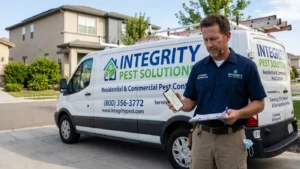
10. Promote your pest control business with vehicle wraps and signage
Your service vehicle is one of your most visible marketing tools. Whether you’re driving to a job or parked in a customer’s driveway, a branded truck introduces your business to everyone in the neighborhood.
Any wrap or decal should be simple and readable at a glance. Your business name, phone number, and core service should be clear. Avoid clutter or small text that’s hard to read from the street.
Beyond vehicles, consider:
- Yard signs placed at job sites (with permission) to signal activity in the neighborhood.
- Door hangers to let nearby homeowners know you were just down the street.
- QR codes on any signage that link directly to your booking page or Google reviews.
Pro tip: You don’t need a full wrap to look professional. A partial wrap or high-quality decal can be just as effective at building brand recognition—and costs significantly less.
11. Get pest control referrals from property managers and contractors
Local relationships are a steady, low-cost source of referrals, especially when you build them with people who regularly work with homeowners. It takes time, but a handful of strong partnerships can open the door to repeat work and long-term growth.
Start with connections that make sense for pest control:
- Property managers who need reliable pest control for multiple units.
- Real estate agents who need inspections or treatments before a sale closes.
- Home service contractors (HVAC, plumbers, roofers) who often notice pest issues during their work.
- Local organizations like chambers of commerce or neighborhood associations that keep you visible in the community.
Actionable first step: Introduce yourself to five local property managers or real estate agents this month. Drop off a card, offer a referral discount, and follow up in two weeks.
Get In Touch: 858-842-5746
Let us earn your trust
On average, Pros increase monthly revenue generated through Housecall Pro by more than 35% after their first year.
See plan options and feature breakdown on our pricing page.
How to build your pest control marketing plan (step-by-step)
A clear plan helps you spend your budget wisely and focus on what actually brings in work. Start here.
Step 1: Define your marketing goals
Pick one specific goal to start—more inbound calls, more repeat customers, or a target monthly revenue number. The more specific you are, the easier it is to choose the right channels and measure whether they’re working.
Step 2: Identify your target customers
Think about who you want more of and what problems they’re trying to solve when they search for help.
For residential homeowners, think beyond “anyone with a pest problem.” New homeowners often discover issues during or after closing, families with young children or pets prioritize low-chemical treatments, and homeowners near wooded areas or water deal with recurring seasonal problems. Each group searches differently and responds to different messaging.
If you want to grow into commercial accounts, treat them as a separate audience from residential homeowners—they have different concerns, buying processes, and points of contact. Commercial targets worth prioritizing for pest control:
- Property managers and landlords: Need fast, reliable service across multiple units; often want a standing agreement
- Restaurants and food service businesses: Face strict health code requirements and need regular inspections.
- Real estate agents: Need pre-sale inspections and fast turnarounds.
- Office buildings and retail: Prioritize minimal disruption and discreet service.
Commercial accounts tend to require longer sales cycles but produce more predictable recurring revenue than residential. If you’re targeting them, reach out directly—email or a phone call to the property manager or office manager works better than social media.
Step 3: Choose your marketing channels
Start with two or three channels aligned to your goal. A solid starting combination: Google Business Profile (visibility), a website with online booking (conversion), and a review request process (credibility). Add paid ads or social media once those fundamentals are working.
Step 4: Set your budget and timeline
Decide how much you can commit each month. Industry benchmarks suggest 6%–10% of revenue for growing pest control businesses, and 10%–15% for businesses actively scaling. Give each channel at least 60–90 days before judging results—most marketing takes time to gain traction.
Step 5: Track performance and adjust
Track what leads to booked jobs, not just clicks or impressions. Ask every new customer how they found you. Use your Google Business Profile insights, ad dashboards, and Housecall Pro’s reporting to see what’s driving calls. Keep what converts, adjust what doesn’t.
How to market your pest control business without doing it all manually
Most pest control business owners don’t have time to manage marketing on top of running jobs. When marketing is handled by hand, the first things to slip are follow-ups, review requests, and customer communications—exactly the things that drive repeat business.
Housecall Pro’s pest control software keeps those things running in the background to prevent:
- Missed follow-ups: Automated email and SMS campaigns go out after jobs and on seasonal schedules so past customers hear from you even when you’re heads-down on work.
- Review gaps: Automated review requests send after every completed job, prompting satisfied customers at the right moment and building your rating consistently over time.
- Lost after-hours leads: Online Booking lets homeowners schedule directly through your website at any hour, so you capture jobs while you sleep.
- Slow payment collection: Online Payments make it easy for customers to pay right after the job, improving cash flow without awkward follow-up calls.
- No visibility into what’s working: Reporting shows exactly where jobs are coming from so you can focus time and budget on what’s actually driving growth.
Ready to simplify your marketing and booking process? Try Housecall Pro free for 14 days.
Pest control marketing FAQ
-
What's the most effective marketing strategy for a pest control business?
-
A Google Business Profile combined with a consistent review request process is the highest-ROI starting point for most pest control companies. Together, they improve your local search visibility and build the credibility that turns searchers into booked jobs—with minimal ongoing cost.
-
How much should a pest control business spend on marketing?
-
Growing pest control businesses typically allocate 5–10% of revenue to marketing; businesses actively scaling may spend 10–15%. If you’re starting out, focus on free, high-impact channels first—Google Business Profile, a basic website, and review requests—before committing budget to paid ads.
-
How do I market my pest control business with no money?
-
Start with three free channels: claim and optimize your Google Business Profile, ask every satisfied customer for a review, and introduce your services in local Facebook groups and Nextdoor. These cost nothing but time and consistently produce leads for businesses that stick with them.
-
What's the best way to get more pest control customers?
-
The fastest way to get more customers is to respond to leads quickly and ask for reviews consistently. The most successful home service companies follow up with new leads in five minutes or less. A steady stream of recent, positive reviews then does the heavy lifting when homeowners are comparison shopping.
-
How long does it take for pest control marketing to start working?
-
Paid ads (PPC and LSAs) can generate leads the same day you launch. SEO and Google Business Profile improvements typically take 3–6 months to show meaningful results. Reviews and referrals compound over time—often 12 months or more.
-
Do pest control businesses need a website to get customers?
-
Yes—even if most of your current jobs come from referrals, homeowners almost always search online before booking. Without a website, you have no destination for Google Ads, no place to collect reviews, and no way to take online bookings, which means every other marketing channel you invest in has nowhere to send leads.
-
Should I use Google Ads or Local Service Ads for my pest control business?
-
Start with LSAs if they’re available in your market. The pay-per-lead model is more budget-friendly than pay-per-click, and the Google Verified badge helps earn trust quickly. Once LSAs are producing consistent leads, add PPC to capture additional searchers or reach more specific services and areas.
-
What time of year should pest control companies advertise the most?
-
Ramp up advertising 4–6 weeks before pest activity peaks in your region, not when calls are already coming in. A general U.S. breakdown by pest type:
- Ants and termites: February–March (termite swarm season hits hard in April–May)
- Mosquitoes: March–April ahead of warm weather
- Wasps and stinging insects: May–June
- Rodents: September–October as temperatures drop and mice start moving indoors
- General pest prevention: Year-round, but heaviest push in spring and early fall
Allocate more budget to Q2 (April–June) when search volume is highest and cost-per-lead tends to be lowest. Pull back in Q4 and shift spend toward email campaigns to existing customers.