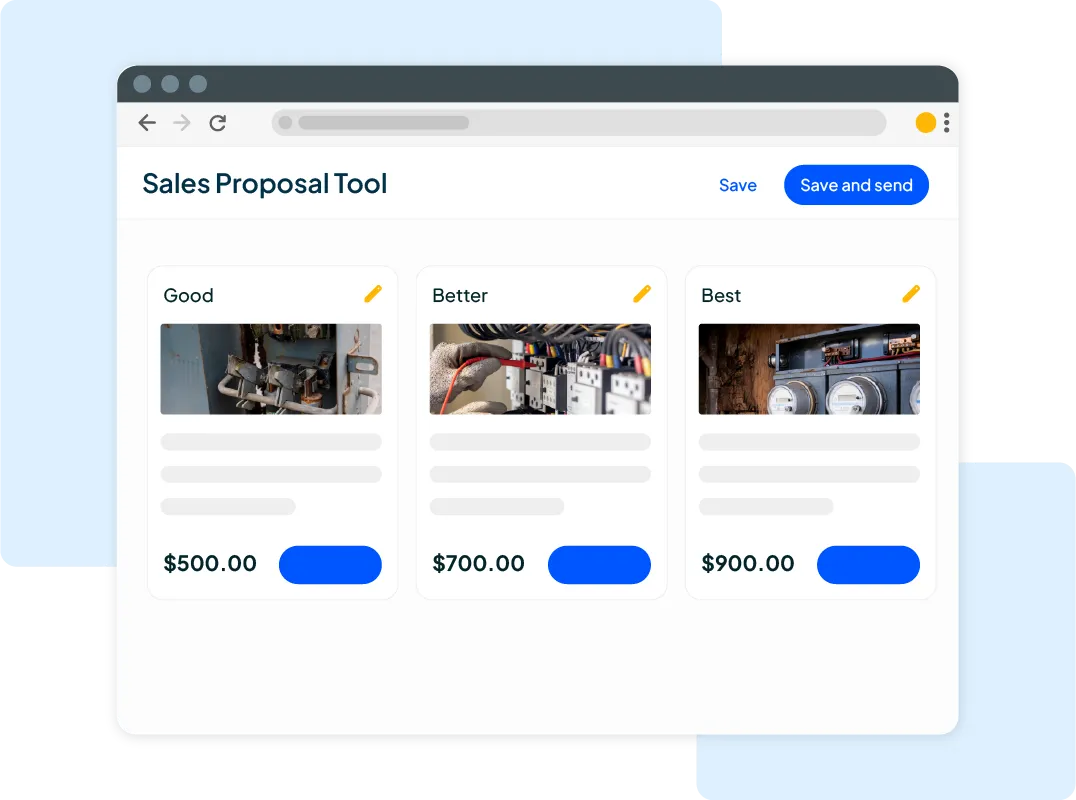
Want to win more jobs with less effort?
Grow your business and send quick quotes with our home service software.

Want to see your potential revenue?
See what businesses like yours earn with Housecall Pro in 1 - 2 minutes.

Every appliance repair starts with a question you can’t fully answer until you diagnose the problem: What is this job actually going to cost to complete? Parts prices, repair time, appliance type, and job complexity can vary widely, making it easy to underquote work if your pricing doesn’t account for each one.
A reliable pricing system gives you a repeatable way to turn those variables into a profitable quote while still giving customers a clear price.
This guide covers how to price appliance repair jobs using diagnostic fees, labor, parts, overhead, and profit goals, along with when to use flat-rate or hourly pricing.
Quick answer: How do you price appliance repair jobs?
Price appliance repair jobs by adding your diagnostic fee, labor, parts, travel costs, and overhead, then applying your target profit margin. Adjust the final price based on the appliance type, brand, repair complexity, and time required.
Avoid using one flat repair fee for every job. A simple dryer repair and a refrigerator compressor replacement have very different labor, parts, and skill requirements, so your pricing should reflect the actual cost of completing each repair.
Key takeaways
Know your appliance repair costs before setting prices:
Start with break-even: Calculate labor, overhead, and parts costs before adding your target profit margin.
Use consistent pricing: Pair diagnostic fees with flat-rate pricing for common repairs and hourly pricing for complex jobs.
Weigh repairs vs. replacements: Compare repair cost to replacement value before recommending major work (see the 50% rule below).
Price every variable: Account for appliance type, gas vs. electric, brand tier, and parts availability on every estimate.
Review rates regularly: Update pricing when parts costs rise by more than 10%, or sourcing becomes more expensive.
Table of contents
- How we sourced appliance repair pricing data
- Average appliance repair prices in 2026
- Residential vs. commercial pricing
- Popular add-ons and upsells
- Appliance repair price list for common jobs
- Common pricing models for appliance repair
- What factors affect appliance repair pricing?
- How to set your appliance repair prices
- Example appliance repair price calculations
- How to improve your appliance repair business profits
- How to explain appliance repair pricing to customers
- How to quote appliance repair jobs consistently
How we sourced appliance repair pricing data
The price ranges in this guide are based on 2026 consumer pricing data published by Angi, TaskRabbit, HomeAdvisor, and Thumbtack. These reflect what homeowners commonly pay across the U.S.—use them as a benchmark, not your price list.
Actual repair prices vary based on factors such as:
- Local labor rates and cost of living
- Appliance type and brand tier (standard vs. luxury or built-in)
- Gas vs. electric appliances, since gas repairs often cost more because of higher-priced parts and additional safety requirements
- Part availability and the age of the appliance, as older or discontinued models often require more expensive or harder-to-source components
- Diagnostic fee structure and whether the diagnostic charge is credited toward the repair
- Warranty status and whether the repair is billed directly to the customer or through a home warranty contract
Compare these benchmarks against your own pricing, then account for your labor costs, overhead, and desired profit margin.
Average appliance repair prices in 2026
Most appliance repair jobs cost $107–$249, with a national average around $178. Labor averages about $54 per hour, but the final price depends on the appliance, the repair required, replacement parts, and local labor rates.
A standard appliance repair usually includes the service call, diagnosing the problem, labor, and any common replacement parts needed to complete the repair. A minor adjustment or a simple part replacement will typically cost less than a major repair involving internal components, electrical systems, or sealed units.
Use national averages as a reference point, not a pricing formula. Your final price should reflect the technician’s labor time, overhead expenses, travel, parts costs, job complexity, and the profit margin your business needs on every repair (see step-by-step guide below).
Residential vs. commercial pricing
Residential appliance repair is usually priced around a single service call. You can combine a diagnostic fee, labor, and replacement parts into one quote because the scope is typically limited to one appliance in one home.
Commercial pricing usually needs more flexibility because the scope can be larger and the stakes are higher. You may be servicing multiple machines, working around business hours, or responding quickly when equipment downtime affects revenue.
Instead of relying on a standard service-call price, you can charge by equipment type, labor rate, service frequency, or a recurring maintenance agreement. You may also build in higher rates for priority response, added complexity, and greater liability.
Residential appliance repair prices
Most residential appliance repair companies price jobs using three main charges: a diagnostic fee, labor, and replacement parts. Together, those costs make up the total price of the repair.
Labor can be priced as an hourly rate or a flat rate for common repairs. Flat-rate pricing gives customers a more predictable total, while hourly pricing can work better for unusual or time-intensive jobs.
Be clear about how your diagnostic fee works before the appointment, including whether you’ll apply it toward the repair if the customer approves the estimate. List replacement parts separately so customers can see what they’re paying for.
Use these national repair ranges as a benchmark, then adjust your prices based on your labor costs, parts, overhead, and target margin.
| Appliance | Typical repair range |
| Refrigerator | $150–$400 |
| Washing machine | $125–$450 |
| Dryer | $100–$550 |
| Dishwasher | $70–$600 |
| Oven/range | $130–$300 |
Remember, this data is a starting point. Every repair should still be priced individually based on your actual job costs. A refrigerator compressor replacement takes far more labor and higher-cost parts than a dishwasher door latch, even though both count as appliance repair.
Pro tip: Manually breaking out diagnostic fees, labor, parts, and other charges can lead to missed line items and invoice disputes. Housecall Pro generates clear, consistent estimates in minutes, then carries approved line items into the invoice so your team can cut down on manual entry and price jobs the same way every time.
Commercial appliance repair prices
Commercial appliance repair usually needs a different pricing structure because the equipment is tied directly to business operations. When a walk-in cooler, commercial washer, or restaurant oven goes down, the customer may be losing revenue until it’s fixed.
That higher urgency, along with larger equipment, more complex repairs, and tighter response expectations, can support higher rates than residential work. Commercial pricing may use flat-rate, hourly, or recurring maintenance contracts depending on the job and service agreement.
Home warranty work should stay on its own rate sheet. Warranty companies typically pay a negotiated reimbursement rate rather than your standard retail price, so separating that work makes estimating, invoicing, and reporting easier.
Popular add-ons and upsells
Add-ons should be priced separately from the core repair so customers can clearly see what’s required and what’s optional. Keeping those services as their own line items also makes it easier to protect your margins and track which extras are actually increasing revenue.
The best upsells solve a problem you spot during the visit or help the customer avoid a future breakdown. Present them as optional recommendations with clear pricing so the value is easy to understand.
Common add-ons include:
- Extended labor warranty beyond the standard coverage period
- Annual maintenance plans that include tune-ups and coil or filter cleaning
- Expedited or same-day service for customers needing faster repairs
- Old appliance or replacement part disposal and haul-away
- Parts markup tiers for standard, original equipment manufacturer (OEM), and premium or luxury-brand components
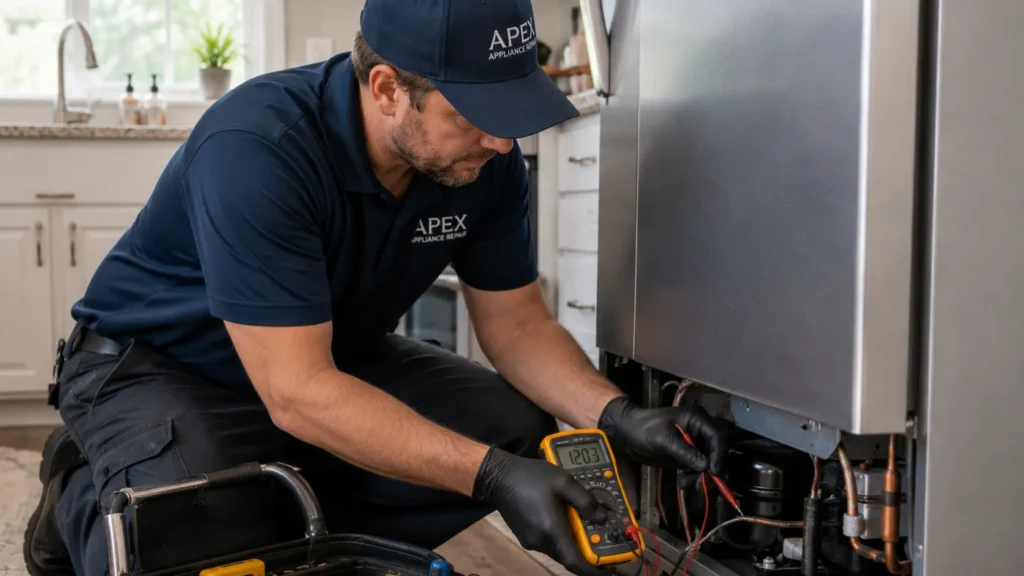
Bundling services can also increase the value of a service call. For example, a multi-appliance maintenance visit could combine refrigerator coil cleaning, washing machine hose inspection, and dryer vent cleaning into one appointment at a lower rate. The customer saves on the bundled price, while your average ticket still increases because you’re completing more paid work in a single visit.
Appliance repair price list for common jobs
A written price list helps you set clearer expectations before the job starts and keeps your team quoting from the same baseline. Customers still need a diagnosis for the final price, but sharing typical ranges can make estimates feel less surprising.
If you’re building or updating your pricing, use a standardized system for labor, parts, and common services. Housecall Pro’s Field Service Price Book Template gives you a practical starting point for organizing rates and keeping quotes consistent across your team.
Small jobs
Small appliance repairs usually wrap up in one visit with parts you already have on hand. They take less labor than major component replacements, but the final price still depends on the appliance model, parts availability, and how much disassembly is involved.
| Job | Typical price range | Factors affecting price |
| Diagnostic visit | $70–$130 | Whether the fee credits to the completed job or is charged on top |
| Belt replacement (washer/dryer) | $60–$190 | Appliance type, belt accessibility, labor time |
| Thermostat replacement | $114–$265 | Appliance model, thermostat type, replacement part cost |
| Door seal/gasket replacement | $120–$500 | Appliance size, gasket availability, installation complexity |
| Igniter or heating element replacement | $100–$350 | Appliance type, part cost, labor to access the component |
Large jobs
Large appliance repairs take more diagnostic work, longer labor, and higher-cost parts than routine calls. Prices vary widely here because you’re often dealing with sealed systems, electronic controls, or major mechanical components—some of which need specialized tools or manufacturer-certified technicians.
| Job | Typical price range | Factors affecting cost |
| Refrigerator compressor replacement | $300–$1,200 | Compressor cost, refrigerant recharge, sealed-system labor, brand |
| Control board replacement | $50–$900 | Board availability, programming requirements, labor time |
| Washing machine motor or drum repair | $400–$900 | Front-load vs. top-load design, parts, disassembly involved |
| Commercial refrigeration repair | $200–$800 | Refrigerant complexity, after-hours service, downtime cost |
| Built-in or luxury appliance repair | $485–$785 | Premium parts, specialized components, technician training |
Emergency services
Charge more for emergency appliance repairs to account for after-hours availability, schedule disruptions, and technician time on nights, weekends, or holidays. A flat emergency service fee on top of your standard labor rate keeps pricing simple and makes the added cost easy for customers to understand upfront.
| Service type | Typical price range |
| Same-day or emergency diagnostic | $125–$250 |
| After-hours commercial appliance repair | $250–$750+ |
Common pricing models for appliance repair
Most appliance repair businesses use a combination of pricing models depending on the type of job, the appliance, and the customer’s needs.
- Diagnostic fee + flat repair rate: Charge a diagnostic fee, then quote a fixed repair price after identifying the problem. This works well for most residential service calls because customers know the total before repairs begin.
- Hourly + parts markup: Bill for technician time plus replacement parts. This model is commonly used for complex or unfamiliar repairs where labor time is difficult to estimate.
- Flat-rate by common repair type: Assign fixed prices to frequently performed repairs, such as replacing a dryer belt or refrigerator thermostat. This speeds up estimating and creates consistent pricing across technicians.
- Recurring maintenance plan: Charge an annual or monthly fee for scheduled inspections and preventive maintenance. This produces recurring revenue while helping customers reduce unexpected breakdowns.
What factors affect appliance repair pricing?
Several variables move the final price of an appliance repair. Apply them consistently to avoid underquoting, especially on gas appliances, commercial equipment, and luxury brands.
- Appliance type: A refrigerator compressor replacement typically costs more than replacing a dryer belt because it requires more labor and specialized parts.
- Gas vs. electric: Gas appliance repairs often cost more because they involve additional safety procedures and higher-priced components.
- Part availability and appliance age: Older or discontinued models often require harder-to-source replacement parts, increasing both cost and repair time.
- Brand tier: Entry-level brands such as GE and Whirlpool generally have lower parts costs than premium brands like Sub-Zero and Wolf.
- Warranty status: Most major appliances include a one-year manufacturer’s warranty covering parts and labor, which can reduce the customer’s out-of-pocket expense.
- The 50% repair-versus-replace rule: If the repair cost approaches half the price of a comparable new appliance, replacement is often the more economical recommendation.
Get In Touch: 858-842-5746
Let us earn your trust
On average, Pros increase monthly revenue generated through Housecall Pro by more than 35% after their first year.
See plan options and feature breakdown on our pricing page.
How to set your appliance repair prices
Your pricing should give you a repeatable way to quote jobs, cover your costs, and protect your margins. The steps below walk through how to build that structure and keep it current as your business changes.
Step 1: Calculate baseline costs
Start by figuring out the full cost of completing a job. This includes fixed overhead that isn’t tied to a single repair, such as insurance, vehicle maintenance, diagnostic tool calibration, software, and the cost of carrying replacement parts in inventory.
Keep in mind that labor costs go beyond hourly wages. Payroll taxes, workers’ comp, benefits, paid time off, and other employee expenses all contribute to your true labor cost.
Use these formulas as a starting point:
- Labor cost per job: (Hourly wage × labor burden) × job hours
- Overhead cost per job: (Total monthly overhead ÷ monthly billable hours) × (Job hours + nonbillable hours)
- Break-even job cost: Labor cost per job + overhead cost per job + parts cost
Once you know your break-even cost, you have a clearer floor for what each job needs to bring in before you add profit.
Step 2: Set your target profit margin
After calculating your break-even cost, add a profit margin that fits the work. Many appliance repair businesses aim for a 45%–55% gross profit margin on service work. Parts-heavy repairs often fall in the 35%–45% range because replacement components make up a larger share of the total cost, while diagnostic-only service calls commonly target 60%–70% margins.
OEM parts and luxury or built-in repairs can support higher margins too, since sourcing those components takes more time and expertise.
Step 3: Match your pricing model to the job
Match your pricing model to the job type instead of picking one model for everything. Diagnostic fee plus flat-rate works well for most residential repairs; hourly labor plus parts markup fits commercial equipment or unfamiliar repairs better. Standardizing which model applies to which job type speeds up quoting and keeps your team consistent.
Step 4: Set minimum charges and base service fees
A minimum service charge covers travel, setup, and diagnostic time, even if the customer declines the repair.
A simple formula is: Base service fee = (Average travel time × labor rate) + overhead per job.
Crediting the diagnostic fee toward an approved repair is a common customer-friendly move. Same-day and emergency visits should carry an added premium above your standard base fee.
Step 5: Adjust for job complexity and scope
Not every repair fits a standard price. Apply predefined upcharges whenever a job needs extra labor, specialized skills, or harder-to-source parts. For example, gas appliances that require added safety procedures, built-ins that take longer to access, or older models with discontinued or limited parts. Consistent pricing rules mean every technician quotes complex repairs the same way.
Step 6: Price add-ons and optional services
Offer add-ons as separate services, not as part of the original repair. Extended labor warranties, annual maintenance plans, and old-appliance haul-away are common options. Price each one by estimating labor, parts, and your target margin, then list it as its own line item so customers can see what’s optional and what’s not.
Step 7: Research local appliance repair rates and validate your pricing
Once you’ve calculated your own costs, compare your prices against other appliance repair companies in your area. Pay attention to their diagnostic fees, whether those fees get credited toward the repair, and how they price emergency service. Use that to understand the local market—not to match it.
If you use OEM parts, provide longer labor warranties, or offer faster response times, explain those differences when presenting your estimate rather than lowering your rates.
Step 8: Build and present the estimate
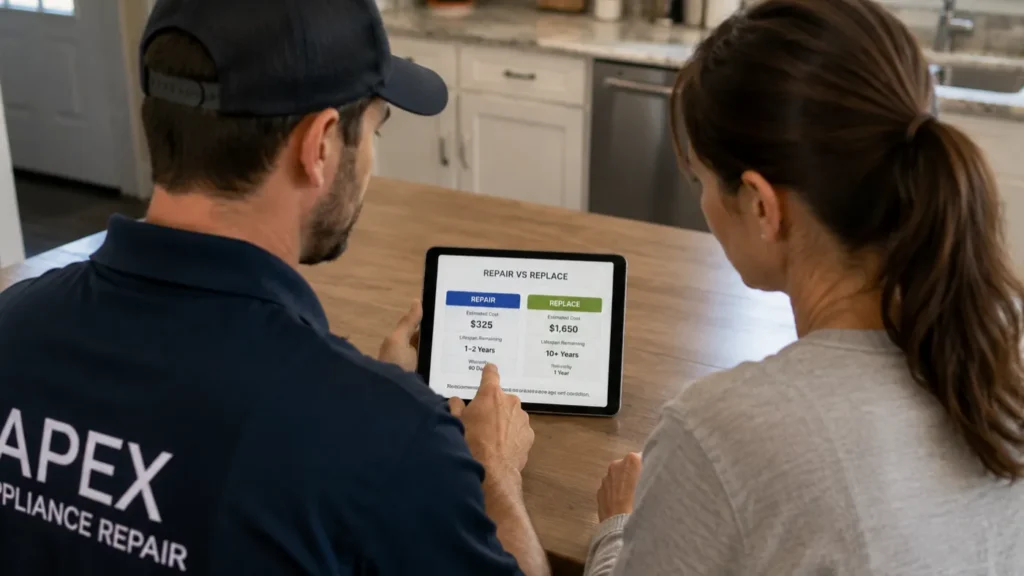
A clear estimate shows customers exactly what they’re paying for before you start. Include the diagnostic charge, labor, replacement parts, taxes, and any exclusions or additional work that could change the final price. If the repair cost approaches 50% of a comparable new appliance, include a repair-versus-replace recommendation so the customer can decide with real information.
Step 9: Review and adjust regularly
Review your pricing on a regular schedule, not just when profits start to shrink. Track labor costs, parts prices, overhead, and gross margins so you catch changes before they hit your bottom line. Reassess any time replacement part costs rise more than 10%, or when a manufacturer discontinues a commonly used part and sourcing gets harder.
Reassessing pricing from memory instead of real numbers is how margins quietly erode. Housecall Pro makes these reviews easier by keeping estimates, invoices, parts, and job history in one place, giving you the information needed to update your pricing based on actual job costs instead of guesswork.
Example appliance repair price calculations
The examples below show how labor, parts, and diagnostic fees come together to produce a final price.
Example 1: Washing machine won’t spin
- Scope: Replace a worn drive belt
- Pricing model: Diagnostic + flat repair rate
- Diagnostic fee: $95
- Belt + labor baseline cost: $110
- Target margin: 50%
- Repair price: $220
- Total price: $315
This approach works well for common repairs because customers receive a fixed price before work begins.
Example 2: Refrigerator not cooling (compressor)
- Scope: Replace compressor and recharge refrigerant
- Pricing model: Diagnostic + parts + labor
- Diagnostic fee: $95
- Compressor + refrigerant recharge baseline cost: $650
- Target margin: 45%
- Repair price: $1,180
- Replacement cost for comparison: $2,400 (repair is below the 50% threshold)
- Total price: $1,275
Always compare higher-cost repairs against replacement value before the customer signs off.
Example 3: Multi-appliance maintenance visit
- Scope: Refrigerator coil cleaning, washer hose inspection, and dryer vent cleaning
- Pricing model: Bundled flat rate
- Refrigerator coil cleaning: $60
- Washer hose inspection: $45
- Dryer vent cleaning: $55
- Booked separately: $160
- Bundled maintenance visit: $150
Bundled pricing encourages customers to schedule preventive maintenance while reducing travel time between service calls.
Note: These calculations assume you know your actual parts costs, labor burden, and diagnostic fee policy. If you haven’t calculated those yet, start with Step 1.
How to improve your appliance repair business profits
Once your pricing structure is set, look for ways to grow profit without just raising every rate across the board. These strategies help you earn more from the right jobs while keeping your pricing consistent.
- Use price anchors to guide decisions: Present premium repair options alongside standard service so customers can compare value instead of focusing only on price.
- Create tiered service levels: Offer standard, priority, and same-day service with different response times and pricing.
- Adjust pricing by demand or timing: Charge higher rates for evenings, weekends, holidays, and peak seasons when technician availability is limited.
- Track effective hourly revenue by appliance type: Review which repairs consistently produce the highest return and adjust your scheduling and marketing around those services.
- Price to filter low-value work: Raise minimum service charges or diagnostic fees if small jobs consistently produce low margins or occupy time that could be spent on more profitable repairs.
Read more: How to get appliance repair leads
How to explain appliance repair pricing to customers
Customers are more likely to approve a repair when they understand how the price was calculated. In a 2025 Housecall Pro survey of 1,000+ U.S. homeowners, 77% said hidden or surprise costs were a top frustration when hiring a pro—which is exactly what a clear breakdown prevents.
The best time to explain your pricing is before work begins, after the diagnosis is complete and before the customer commits to the repair.
- Explain the diagnostic fee: Tell customers upfront whether the diagnostic charge will be credited toward the repair if they approve the estimate.
- Separate parts from labor: Itemize replacement parts, labor, and any additional charges so customers can see exactly where the total comes from.
- Discuss the repair-versus-replace calculation: If the repair approaches 50% of the cost of a comparable new appliance, explain both options so the customer can make an informed decision.
Original language: “The repair will cost about $650.”
Improved language: “The estimate includes a $95 diagnostic fee, $275 in labor, and $280 for the replacement control board. Because the total is well below half the cost of replacing this refrigerator, repairing it is likely the more economical choice.”
How to quote appliance repair jobs consistently
Without a standardized process, diagnostic fees, parts markups, and repair-versus-replace recommendations end up varying from job to job. That inconsistency costs you money. Housecall Pro’s appliance repair software gives businesses a single, consistent way to create estimates, dispatch jobs, and collect payments using the same workflow every time.
- Price Book: Standardizes labor rates and common repair pricing so every quote uses the same numbers, whether it’s just you or a full team.
- Built-in parts pricing: Keeps parts costs organized so every estimate builds from the same numbers.
- Mobile, itemized estimates: Breaks out diagnostic fees, labor, parts, and optional services before work begins.
- Payments and InstaPay: Collects payment in the field and gives contractors faster access to completed job revenue.
- Customer and job history: Stores previous repairs, equipment details, and service notes, making future estimates faster and more accurate.
Sign up for your free 14-day trial today.
FAQs
How much does appliance repair typically cost?
Most residential appliance repairs cost between $100 and $330, with many homeowners paying around $200 for a typical repair. The final price depends on the appliance, replacement parts, labor time, and whether the repair requires specialized work, such as sealed-system service or premium-brand components.
Should I charge a diagnostic fee, and should it be credited toward the repair?
Yes. A diagnostic fee covers the technician’s travel, troubleshooting, and time spent identifying the problem, even if the customer declines the repair. Many appliance repair businesses credit that fee toward the repair when the customer approves the estimate because it builds trust and encourages customers to move forward.
How do I price appliance repair jobs when parts costs vary so widely?
Start with your labor and overhead costs, then add the current replacement part cost and your target profit margin. Set a separate markup tier for standard, OEM, and premium-brand parts—OEM and luxury-brand parts typically support a higher markup than standard aftermarket components because sourcing them takes more time and expertise. Update your pricing whenever supplier costs change significantly or commonly used parts become harder to source.
Is it better to charge flat-rate or hourly for appliance repair?
Flat-rate pricing works well for common residential repairs because customers know the total before work begins. Hourly pricing is often a better choice for commercial equipment, uncommon appliance models, or repairs where the labor time cannot be estimated accurately until the work is underway.
What profit margin should an appliance repair business target?
Many appliance repair businesses target a 45%–55% gross profit margin on service work. Parts-heavy repairs often fall in the 35%–45% range, while diagnostic-only service calls commonly target 60%–70% because they require little or no replacement inventory.
When should I recommend repair versus replacement to a customer?
A common guideline is the 50% rule. If the estimated repair cost approaches 50% of the price of a comparable new appliance, discuss both options with the customer. Age, warranty coverage, and the availability of replacement parts should also factor into the recommendation.
How often should I update my appliance repair pricing?
Review your pricing at least once or twice a year, and sooner if operating costs change. You should also reassess your rates whenever replacement part costs increase by more than 10%, fuel or labor expenses rise significantly, or manufacturers discontinue commonly used parts that take longer or cost more to source.