

UPDATED 2026 GENERAL CONTRACTOR LICENSING GUIDE
Vermont General Contractor License Requirements: No State License, the $10,000 Registration Trigger & $1M Insurance Floor (2026)
Table of Contents
Download the Checklist!
If you’re planning to run a general contractor business in Vermont, there is no state general contractor license, no exam, and no bond. What Vermont has instead is one of the newest consumer protection systems in the country: a Residential Contractor Registration administered by the Office of Professional Regulation inside the Secretary of State’s office. It applies the moment you contract directly with a homeowner for $10,000 or more including labor and materials. Registration costs $75 for a self-employed individual or $250 for a business with employees, requires liability insurance of $1,000,000 per occurrence and $2,000,000 aggregate, and requires you to attest that you use a written contract. Commercial general contracting has no state requirement at all. This page covers the trigger, the two registration types, the insurance floor, the electricians and plumbers Vermont does license, and how permitting actually works here.
Licensing rules vary a lot from one state to the next. Some hand the job to local governments entirely, while others run one central program that every contractor answers to. The demand behind those rules is steady either way. Bureau of Labor Statistics figures from the Occupational Employment and Wage Statistics survey for May 2025 count about 380,360 construction managers, 812,210 first-line supervisors of construction trades, 146,720 construction and building inspectors, and roughly 1,096,780 construction laborers working nationwide. Construction manager jobs are on track to rise 9% between 2024 and 2034, well ahead of the pace for the average occupation.
Vermont is the smallest construction market in this series and the most owner-operated. BLS state figures (Vermont OEWS, May 2025) count 930 construction managers earning a mean of $52.45 an hour, or $109,090 a year, with a median of $103,450. There are 1,010 first-line supervisors of construction trades and extraction workers at an $88,960 mean, 1,430 construction laborers at $51,000, and just 120 construction and building inspectors at $70,850. The revealing figure is the mix. Vermont employs construction managers at a location quotient of 1.26, above the national rate, while laborers sit at 0.67 and inspectors at 0.41. More managers than crew, proportionally, which is what a market of small firms looks like where the owner runs the job. Vermont laborers also average $51,000, the highest crew pay of any state in this series.
Quick answer: do you need a general contractor license in Vermont?
No. Vermont issues no statewide general contractor license, no state contractor exam, and no state bond. Commercial general contracting carries no state credential requirement whatsoever.
What you probably need is Residential Contractor Registration with the Office of Professional Regulation (OPR), part of the Secretary of State’s office. The rule is specific: if you directly enter into a contract with a homeowner where the estimated value is $10,000 or more, inclusive of labor and materials, you must register.
Three things follow from that wording, and each matters:
- The trigger is the contract, not the year. One qualifying contract puts you in the system, with no annual revenue test.
- It applies to direct homeowner contracts. Employees of a registered contractor do not register separately.
- Below $10,000 you are outside the state system, though permits and licensed trades still apply.
Registration is $75 for individuals and $250 for business organizations, requires $1,000,000 per occurrence and $2,000,000 aggregate liability coverage, and requires you to attest to using a written contract. There is no exam, no bond, no continuing education, and no experience verification..
Key takeaways:
How Vermont ended up with a registry instead of a license
Vermont’s system is genuinely new, and the history explains its shape.
The registry was created by legislation in 2019, with applications opening December 1, 2022 and registration required by April 1, 2023. A later act, Act 182, amended it to let self-employed residential contractors without employees register as individuals rather than as businesses.
The design fight was about the threshold. An earlier version set the trigger at $3,500 and was vetoed over the burden on small contractors. The compromise landed at $10,000, exempting small repairs while capturing most substantial work.
That history tells you what the registry is for. It is not a competency screen. It has no exam and no experience requirement because the legislature was not trying to filter out unqualified builders. It was making sure that when a homeowner spends real money, there is a written contract, a real policy behind it, and an entity the state can identify.
The practical consequence: Vermont’s requirements are cheap and fast to satisfy, but the insurance number is high and the contract obligation is not decorative.
Individual or business: choosing your registration type
Vermont splits registration into two types, and picking the wrong one wastes a fee.
| Individual registration | Business registration | |
| Who it is for | Self-employed, no employees | Contractors with employees |
| Fee | $75 | $250 |
| Employees covered | Not applicable | Employees need not register |
| LLC eligibility | Yes, if no employees | Yes |
| Insurance required | $1M per occurrence, $2M aggregate | Same |
| Written contract attestation | Required | Required |
The rule is about employees rather than entity type. An LLC may register either as an individual or as a business, because Act 182 allows self-employed residential contractors without employees to register as individuals regardless of how they are organized. So a single-member LLC with no payroll pays $75, not $250.
Employees of a registered contractor do not need their own registration. That is a meaningful cost saving for a firm with a crew, and it means the $250 business registration covers the whole company rather than each person on it.
What registration actually requires
The application is short. What follows is the complete list.
- Online application through OPR’s Online Services System, with a non-refundable application fee
- Documentation of your business name as registered with the Vermont Corporations Division, showing active status
- A copy of your liability insurance showing minimum coverage of $1,000,000 per occurrence and $2,000,000 in the aggregate
- An attestation that you use a written contract
That is it. No exam score, no work history, no reference letters, no financial statement, no bond, no continuing education.
The Corporations Division item catches people. Your OPR registration and your business registration with the Secretary of State’s Corporations Division are two separate things, and OPR wants proof of the second before it grants the first. Being registered as a business in Vermont does not register you as a residential contractor, and being registered as a residential contractor does not register your business entity.
Applications and renewals are processed online through OPR’s system, where you also update your record, check status, and request verifications.
The insurance floor, and why it is the real requirement
Vermont’s $1,000,000 per occurrence and $2,000,000 aggregate minimum is high for a registration-based system. Most states that register rather than license set the floor far lower or set none at all.
That is by design. Vermont chose insurance as its primary consumer protection mechanism in place of bonds and exams. The logic is direct: a bond gives a homeowner a limited pool to claim against, and an exam tells them nothing about whether a job will go wrong. A real liability policy at commercial limits gives them something to recover from if it does.
For a contractor, this means two things. First, budget for it. If you have been running residential work on a lower limit, moving to $1M and $2M is a genuine premium increase, and you cannot register without it. Second, the coverage has to stay in force. Registration rests on maintaining liability insurance, not just showing a certificate once at application.
| Requirement | Vermont residential registration |
| General liability per occurrence | $1,000,000 |
| General liability aggregate | $2,000,000 |
| Surety bond | Not required |
| Exam | Not required |
| Continuing education | Not required |
| Experience verification | Not required |
| Written contract | Required, by attestation |
Workers’ compensation sits outside the registration requirement but not outside the law. Vermont requires employers to carry coverage for employees, and the state applies that broadly, so if you have a crew this is a separate obligation to sort with the Department of Labor rather than something registration handles.
The written contract obligation
This is the part of Vermont’s system with real teeth, and it is easy to underestimate because it arrives as a checkbox.
Registered residential contractors must execute a written contract before performing qualifying work, and you attest to that when you register. The attestation is a representation to the state, so failing to use written contracts is inconsistent with the basis on which your registration was granted.
The contract is also your own protection. In a dispute, the contractor with a signed scope, price, and schedule is in a fundamentally different position from one working off a handshake.
What a Vermont residential contract should nail down, at minimum:
- Scope of work, in enough detail that “included” and “excluded” are unambiguous
- Total price, and how change orders will be priced and approved
- Payment schedule tied to identifiable milestones rather than dates alone
- Start and substantial completion expectations
- Allowances, and what happens when the selection exceeds the allowance
- How disputes get handled before anyone involves a lawyer
Vermont does not prescribe contract contents the way Rhode Island or Pennsylvania do. It leaves them to you and simply requires that a contract exist: more freedom and more responsibility at once.
How the registry works in practice for a small builder
Vermont’s threshold sits at a level that captures most real work but leaves genuine room underneath, and understanding where the line falls changes how you scope jobs.
A $9,500 bathroom remodel sits outside the state system. A $12,000 one sits inside it. Splitting a single project into two contracts to stay below $10,000 invites exactly the scrutiny the registry exists to apply, and an artificially divided scope reads badly in front of a regulator.
The better read is that registration costs $75 or $250 every two years and takes an afternoon. Most Vermont contractors who work residentially at all should simply register and stop tracking the threshold, which is why OPR says nothing prevents you from registering early.
There is a marketing angle too. Because the registry is public and searchable, being in it is verifiable proof that you carry $1,000,000 in liability coverage and commit to written contracts.
Trades Vermont does license
The absence of a GC license does not mean nobody is licensed. Vermont regulates specific trades, and it does so through a different part of state government than the residential registry.
| Work | Regulator |
| Electrical | Electricians’ Licensing Board |
| Plumbing | Plumbers’ Licensing Board |
| Propane and natural gas technicians | Dept. of Public Safety, Division of Fire Safety |
| Refrigerant handling | U.S. EPA, Section 608 |
| Lead-safe renovation (RRP) | U.S. EPA firm certification |
| Residential contracting over $10,000 | OPR Residential Contractor Registration |
Electricians and plumbers are licensed through their respective boards, with examination, experience, and discipline rules set at board level. If you self-perform electrical or plumbing work, that is a separate credential from your residential contractor registration, and holding one does not substitute for the other.
HVAC is a notable gap. Vermont issues no state HVAC contractor license, no HVAC board exists, and there is no statewide HVAC trade credential. HVAC work in Vermont is governed instead by federal EPA Section 608 certification for refrigerant work, the state’s propane and natural gas technician credentialing through the Division of Fire Safety for fuel gas work, and the residential contractor registration when residential work exceeds $10,000. Mechanical installations are inspected against the International Mechanical Code and International Fuel Gas Code as adopted by the Division of Fire Safety.
The EPA’s Renovation, Repair and Painting rule applies federally on top of all of this. Vermont has some of the oldest housing stock in the country, so a large share of residential remodeling here disturbs pre-1978 painted surfaces and requires firm certification with a certified renovator on the job.
Vermont consumer protection law sits behind the registry
Because the registry has no exam, the enforcement weight in Vermont sits in consumer protection law rather than licensing discipline. Two statutes do most of that work.
The Consumer Protection Act, at 9 V.S.A. Chapter 63, gives homeowners a private right of action for unfair and deceptive acts in commerce, and the Attorney General enforces it publicly. Such a claim can carry remedies beyond breach of contract damages, which changes the arithmetic of a dispute.
Home improvement fraud is a separate criminal statute at 13 V.S.A. § 2029, reaching conduct like taking payment and failing to perform, or misrepresenting your qualifications. In a state with no license to misrepresent, claiming credentials you do not hold is still actionable.
The picture is coherent. Vermont does not test whether you can build. It requires that you be identifiable, insured, and working under a written agreement, then relies on consumer protection and criminal law for the rest.
Permits, energy standards, and the Division of Fire Safety
Vermont’s permitting system does not look like most states’, and this trips up contractors coming from elsewhere.
There is no single statewide residential building permit process run through local building departments the way there is in most states. Many Vermont towns are small and do not operate a full building department. Instead, several statewide requirements attach directly to the work.
Residential Building Energy Standards. Registered residential contractors are required to comply with Vermont’s Residential Building Energy Standards, and OPR addresses this directly in its guidance for registrants. RBES is not a footnote. It is a statutory deliverable with three separate filing steps, set out at 30 V.S.A. § 51.
RBES applies to all new homes and to additions, alterations, and repairs to residential buildings three stories or less above grade. On completion, the certifying party must:
- Complete and sign the RBES certificate, then permanently affix it to the outside of the heating or cooling equipment, to the electrical service panel inside the building, or in a visible location near one of those
- Provide a copy to the Vermont Department of Public Service in Montpelier
- Ensure the certificate is recorded and indexed in the town land records
Three parties can certify: the builder, a licensed professional engineer or architect, or a Vermont-accredited home energy rating organization. A builder may contract with one of the latter to issue certification and to indemnify the builder against liability to the owner for noncompliance, which is a genuinely useful risk transfer on a complex build.
The consequences of getting it wrong are specific rather than vague. A homeowner may seek damages in court within six years of occupancy or of the certificate being filed. The State may pursue Act 250 violations. And towns that issue Certificates of Occupancy must receive an RBES certificate or a Vermont Owner/Builder Disclosure Statement before issuing one, so in those towns the certificate gates occupancy.
There is an upside too. Compliance with RBES creates a presumption of compliance with Act 250 Criterion 9(F) on energy conservation, which saves real time on projects subject to Act 250 review.
One current note: the Department of Public Service adopted an updated RBES rule on April 10, 2026, effective July 14, 2026, and it permits compliance with either the 2020 or the 2024 version of the standard. That flexibility was added deliberately to reduce cost and help with Vermont’s housing shortage, so check which version your project is being built to rather than assuming the newest applies.
The Division of Fire Safety. This is the part residential contractors underestimate, because Vermont’s definition of a “public building” is far broader than the phrase suggests.
Under 20 V.S.A. Chapter 173 and § 2730, a public building is essentially any building other than an owner-occupied single-family residence, with narrow carve-outs for accessory dwelling units, registered home daycares, and certain farm buildings. So a duplex is a public building. A rented single-family house is a public building. A four-unit apartment conversion certainly is.
That matters because a state construction permit from the Division of Fire Safety is required before any new construction, addition, alteration, modification, renovation, demolition, or installation of fixed building equipment within a public building. The Division is the Authority Having Jurisdiction under the Vermont Fire and Building Safety Code, currently the 2025 edition, and it adopts the mechanical and fuel gas codes the state enforces.
Two practical points follow. DFS construction permits are required in addition to any other state or town permits, and independently of town planning and zoning, so a zoning permit is not a substitute. And some municipalities operate under cooperative inspection agreements where an approved municipal inspector acts as the AHJ instead, which changes who you deal with but not whether a permit is required.
For a remodeler whose work is all owner-occupied single-family homes, none of this applies. The moment you take a rental or a duplex, it does.
Local permits. Zoning permits, Act 250 review for larger developments, wastewater and water supply permits, and town requirements all still exist, and the mix varies dramatically between Burlington and a rural town.
Act 250 has no equivalent in most states. Vermont’s land use law triggers a state review on projects above certain size and impact thresholds, weighing traffic, water, scenic impact, and agricultural soils alongside building matters. For a remodeler it rarely comes up. For subdivision work, multi-unit development, or larger commercial projects it can be the longest item on the schedule, and it is a matter for a Vermont land use attorney.
The planning point: Vermont’s schedule risk sits in permitting, not licensing. Registering takes an afternoon. Permitting a large project can take a year.
The practical upshot: in Vermont your compliance research is per-project rather than per-city, and it involves state agencies more than municipal ones.
Insurance is your business decision as well as a rule
Vermont’s $1M and $2M requirement is the state’s floor. Whether it is the right number for your business is a separate question, and worth thinking about rather than treating the minimum as the answer.
Three considerations shape it.
Your customer’s requirements may exceed the state’s. Commercial owners routinely require $1,000,000 per occurrence and $2,000,000 aggregate as a starting point. Since Vermont’s residential minimum already sits there, a remodeler is well positioned to bid light commercial work without changing policies.
Subcontractor coverage is your exposure. Registration checks your insurance, not your subs’. If an uninsured sub causes damage, the claim finds you. Requiring a certificate from every sub, naming you as additional insured, closes a gap the state leaves open.
Coverage has to match the work you actually do. A policy written for light remodeling may exclude roofing, structural work, or excavation. The certificate satisfies OPR either way, so the state’s check is not a substitute for reading your exclusions.
How to register as a Vermont residential contractor
Step 1: Check the $10,000 trigger
Register if you will directly contract with a homeowner for $10,000 or more including labor and materials. OPR is clear that nothing prevents you from registering before you have such a contract, and doing so early is sensible if you expect one.
Step 2: Decide individual or business
No employees means individual registration at $75, even if you operate as an LLC. Employees means business registration at $250, which covers your whole crew.
Step 3: Register the business entity with Corporations
Get your name registered and in active status with the Vermont Corporations Division, because OPR requires documentation of both.
Step 4: Bind liability insurance at $1M and $2M
Get a certificate showing $1,000,000 per occurrence and $2,000,000 aggregate. If you are moving up from lower limits, start this early since it may change your premium materially.
Step 5: Get your written contract in order
You will attest to using one. Make sure the document you are attesting to actually covers scope, price, change orders, payment milestones, and allowances.
Step 6: Apply online through OPR
Applications and renewals run through OPR’s Online Services System. The application fee is non-refundable, so check your documents before submitting.
Step 7: Sort workers’ compensation and payroll
If you have employees, handle workers’ compensation and payroll registrations with the Vermont Department of Labor. Registration with OPR does not address this.
Step 8: Calendar the biennial renewal
Registrations renew by March 31 of odd-numbered years. Put it on a calendar, because the deadline is fixed to the cycle rather than to your approval date.
Vermont registration at a glance
| Requirement | Detail |
| Agency | Office of Professional Regulation, Secretary of State |
| Trigger | Direct homeowner contract of $10,000 or more |
| Includes | Labor and materials combined |
| Individual fee | $75 |
| Business fee | $250 |
| Exam | None |
| Bond | None |
| Continuing education | None |
| Experience verification | None |
| General liability | $1,000,000 per occurrence, $2,000,000 aggregate |
| Written contract | Required by attestation |
| Entity proof | Vermont Corporations Division, active status |
| Renewal | Biennial, by March 31 of odd-numbered years |
| Program start | Applications Dec 1, 2022; required Apr 1, 2023 |
| Commercial GC work | No state requirement |
Entity, taxes, and payroll in Vermont
Registration is the construction credential. These are the pieces around it.
Entity formation. Register with the Vermont Corporations Division through the Secretary of State. Active status there is a prerequisite for OPR registration, not a parallel task.
EIN. Free from the IRS, and needed for banking and payroll.
State taxes. Register with the Vermont Department of Taxes. Contractors are generally treated as the consumer of materials incorporated into real property rather than as retailers. Get an accountant to confirm.
Workers’ compensation. Governed by 21 V.S.A. Chapter 9, with the requirement to secure coverage at § 687. Any employer with one or more employees must carry it, and Vermont applies that broadly compared with Texas or South Dakota. Three details matter for contractors:
- Part-time, seasonal, and family employees count. There is no casual-labor gap to work in.
- Sole proprietors and partners are automatically excluded, but may opt in.
- Corporate officers and LLC members are automatically included unless they file an exclusion with the Vermont Department of Labor. Incorporating does not remove you from the count by itself.
Independent contractor status is not a workaround. Vermont applies a strict right-to-control test, and the Department of Labor runs an active misclassification program aimed squarely at construction. Treating a regular crew member as a 1099 sub to avoid premium is the single most common way a small Vermont builder ends up in an enforcement file. Confirm your position with the Department rather than your bookkeeper.
Unemployment insurance. Registered through the Department of Labor alongside workers’ compensation when you have employees.
What it costs to get started
| Startup cost | Typical amount |
| OPR individual registration | $75 |
| OPR business registration | $250 |
| Vermont entity registration | Filed with Corporations Division |
| EIN from the IRS | Free |
| General liability at $1M and $2M | Varies by trade and payroll |
| Workers’ compensation | Varies by class code and payroll |
| EPA RRP firm certification | Around $300 for five years |
| Exam or bond costs | None, Vermont requires neither |
Confirm every fee with the issuing agency before budgeting. Vermont’s program is recent and its guidance is updated regularly.
Coming in from New Hampshire, New York, or Massachusetts
The trigger is the contract, not your address. An out-of-state contractor performing residential work over $10,000 for a Vermont homeowner registers with OPR the same as a Vermont-based firm.
There is no residency requirement and no reciprocity to negotiate, because there is no license to reciprocate. You need the same package: a Vermont business registration in active status, liability insurance at $1M and $2M, and the written contract attestation.
New Hampshire has no residential contractor registration at all, so a contractor used to working there will find Vermont’s requirements new rather than merely different. Massachusetts runs its own Home Improvement Contractor registration with a guaranty fund. Neither credential transfers.
What happens if you skip registration
Vermont’s enforcement sits with OPR, which regulates dozens of professions and runs an enforcement unit.
Unregistered residential contracting above the threshold is a violation of the registration statute, and OPR has authority to investigate complaints and impose discipline on registrants. Separately, Vermont’s home improvement fraud statute makes certain contractor conduct a criminal matter, and the Consumer Protection Act gives homeowners a private remedy independent of anything OPR does.
The reputational mechanics matter as much as the penalties. The registry is public and searchable, which means a Vermont homeowner can check in seconds whether the person quoting their $40,000 kitchen is registered. In a small state where referral networks carry most of the work, not appearing in that search is a commercial problem before it is a legal one.
One current caution worth passing along: OPR has warned that an email phishing scam has targeted Vermont businesses by impersonating its enforcement unit. If you receive enforcement correspondence you did not expect, verify it by contacting the office directly rather than replying to the message.
There is a quieter risk too. A homeowner who disputes the work and discovers you were required to register and did not has an argument about your credibility before anyone examines the workmanship. In a consumer protection framework, how you present yourself is part of what gets litigated.
Renewal and keeping the registration current
The renewal cycle is fixed rather than personal. Registrations renew biennially by March 31 of odd-numbered years, so your first renewal may come sooner than two years after you register. A contractor registering in early 2028 renews by March 31, 2029, not 2030.
Between renewals, two conditions have to stay true. Your liability insurance must remain in force at the state minimums, since registration rests on maintaining coverage rather than showing a certificate once. And your status with the Corporations Division must stay active, because OPR verified it at application.
OPR’s online system handles renewals, record updates, status checks, and verifications in one place.
What general contractors earn in Vermont
| Vermont, May 2025 | Employment | Mean hourly | Mean annual | Median annual | 10th percentile | 90th percentile |
| Construction managers | 930 | $52.45 | $109,090 | $103,450 | $76,790 | $143,670 |
| First-line supervisors, construction trades | 1,010 | $42.77 | $88,960 | $82,490 | $61,870 | $124,420 |
| Construction and building inspectors | 120 | $34.06 | $70,850 | $66,580 | $49,350 | $92,110 |
| Construction laborers | 1,430 | $24.52 | $51,000 | $48,580 | $39,130 | $61,710 |
Source: U.S. Bureau of Labor Statistics, Occupational Employment and Wage Statistics, Vermont, May 2025.
Two things stand out. Vermont pays its crews better than any other state in this series, with laborers averaging $51,000 and a 10th percentile of $39,130. And the occupational mix is inverted: construction managers run at a location quotient of 1.26, above the national rate, while laborers sit at 0.67 and inspectors at just 0.41. Proportionally more people managing jobs than swinging hammers, which is what you expect in a market of small owner-operated firms. The scarcity of inspectors, 120 statewide, also explains why Vermont leans on state agencies and statewide standards rather than municipal building departments. For how these figures compare across states, see our contractor and construction manager salary breakdown.
Common Vermont registration mistakes
Waiting until the contract is signed. Register before you enter a qualifying contract, not after. Nothing stops you from registering early.
Paying $250 when $75 would do. No employees means individual registration, even for an LLC.
Confusing OPR with Corporations. A Vermont business registration is not a residential contractor registration, and OPR wants proof of the first before granting the second.
Registering on old insurance limits. $1,000,000 per occurrence and $2,000,000 aggregate is the floor, and it is higher than many residential policies carry by default.
Treating the written contract attestation lightly. You are representing to the state that you use one.
Assuming the threshold is annual. It is per contract. One $12,000 job triggers registration.
Missing the March 31 renewal. The cycle is fixed to odd-numbered years, not to when you were approved.
Overlooking energy standards. RBES compliance is part of the picture for registered residential contractors.
Assuming HVAC needs no credential. No state HVAC license exists, but EPA 608 and the propane and gas technician program still apply.
Letting insurance lapse mid-cycle. Coverage at $1M and $2M is an ongoing condition of registration, not an application item you clear once.
Forgetting the RBES filings. The certificate goes on the panel, to the Department of Public Service, and into the town land records. Three steps, not one.
Assuming a duplex is residential. Under 20 V.S.A. § 2730, anything other than an owner-occupied single-family home is a public building needing a DFS construction permit.
In a small market, your paperwork travels ahead of you
Vermont asks less of you upfront than almost any state and more of you contractually. There is no exam to prove you know the work, so the written contract you attest to using is the thing standing between a good job and a dispute. And in a state this size, where referrals carry most of the work, how organized you look on paper reaches the next customer before you do.
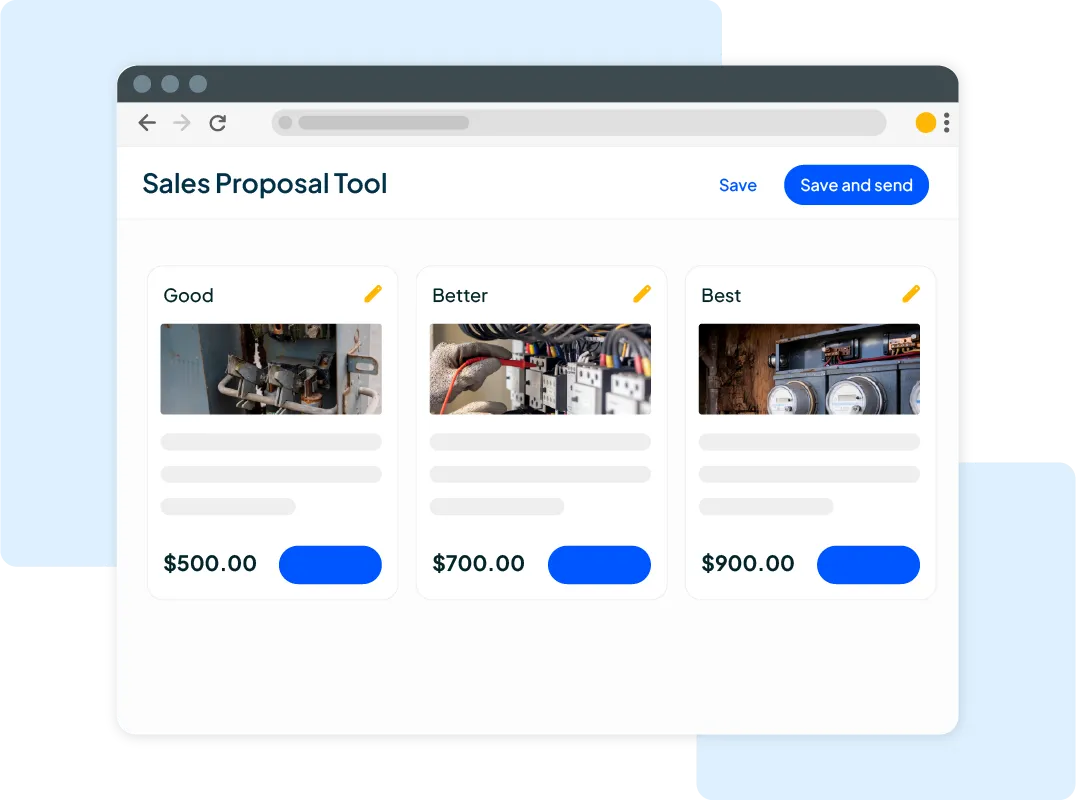
Housecall Pro’s general contractor software keeps job details, pricing, and customer records in one place, so scope and price stay consistent from the first quote through final payment instead of living in three different documents. Build quotes with cost breakdowns and margin visible before you send them with Estimates, collect a signature on the spot so the written contract requirement is handled as part of the sale, then bill larger projects in stages with Invoicing while automated reminders handle the follow-up. Running longer builds? Look at construction management software for remodelers or the general contractor resource hub for free templates. Smaller residential work fits handyman software.
Try Housecall Pro free for 14 days.
Frequently asked questions
Do I need a general contractor license in Vermont?
No. Vermont issues no state general contractor license. Residential contractors who directly contract with a homeowner for $10,000 or more must register with the Office of Professional Regulation instead.
How much does Vermont residential contractor registration cost?
$75 for individuals who are self-employed with no employees, and $250 for business organizations with employees. Both fees are non-refundable.
What is the $10,000 threshold based on?
The estimated value of a contract you enter directly with a homeowner, inclusive of labor and materials. It is a per-contract test, not an annual revenue test.
Do I need to register for commercial work?
No. Vermont’s registration covers residential contracting. Commercial general contractor work has no state licensing or registration requirement.
Is there an exam or bond?
Neither. Vermont’s registration has no exam, no surety bond, no continuing education, and no experience verification.
What insurance does Vermont require?
Liability coverage of at least $1,000,000 per occurrence and $2,000,000 in the aggregate, submitted with your application and maintained while registered.
Can an LLC register as an individual?
Yes. Act 182 allows self-employed residential contractors without employees to register as individuals, and an LLC may register either way depending on whether it has employees.
Do my employees need to register?
No. Employees of a registered contractor are not required to register separately, which is why the $250 business registration covers your whole crew.
Do I have to use a written contract?
Yes. Registration requires you to attest that you execute a written contract before performing qualifying residential work.
When do I renew?
Biennially, by March 31 of odd-numbered years. The cycle is fixed rather than dated from your approval.
Do out-of-state contractors need to register?
Yes. The requirement follows the contract, not your business address, so an out-of-state firm doing residential work over $10,000 for a Vermont homeowner registers with OPR.
Does Vermont license HVAC contractors?
No. There is no state HVAC license or board. Refrigerant work needs federal EPA Section 608 certification, and fuel gas work runs through the Division of Public Safety’s propane and natural gas technician program.
Who issues building permits in Vermont?
It varies. A state construction permit from the Division of Fire Safety is required for work in any public building, which under 20 V.S.A. § 2730 means essentially anything other than an owner-occupied single-family home. Zoning, wastewater, and Act 250 permits come from towns and state agencies separately.
What are the RBES filing requirements?
Under 30 V.S.A. § 51 the certificate must be signed and permanently affixed near the panel or the heating and cooling equipment, copied to the Department of Public Service, and recorded and indexed in the town land records. A homeowner can sue for noncompliance within six years.
How much do general contractors earn in Vermont?
Construction managers average $109,090 a year with a median of $103,450, according to BLS data for May 2025. The bottom 10% earn $76,790 and the top 10% earn $143,670. Trade supervisors average $88,960.
LEARN FROM THE PROS
Helpful content for the trades
Explore our collection of helpful articles written by top experts in their field to seasoned pros in the field. Strengthen your field service knowledge and stay current on the latest industry topics and trends.
General contractor pricing guide: How to price jobs in 2026
Housecall Pro’s inaugural Trades Thursday draws thousands of pros nationwide
How to choose the right HVAC scheduling app
How to get junk removal leads: 15 proven strategies
Junk removal ads to win more customers (ideas, costs, and examples)
10 junk removal marketing strategies to grow your business
How to create a Google Business Profile: Step-by-step guide
TradeWire #49: A blade built for nails, an Amana recall, and the most unforgettable name in the trades
How to set up payment processing for recurring service agreements
How to write a junk removal business plan (+free template)
How to write a pressure washing contract (+free template)
Is a handyman franchise worth it? Costs and best brands
Get $50 gift card
Talk to an expert and see how Housecall Pro can fit your needs.
Prefer to explore on your own?


