Plumbing Measurements
Pipe Volume Calculator
This Plumbing pipe volume calculator helps plumbers, engineers, and contractors instantly calculate the volume of any pipe and the weight of liquid flowing through it. Enter the pipe’s inner diameter and length — and get results in cubic inches, cubic centimeters, gallons, and ounces instantly. Download a free copy and use it on any job, in the field or at the office.
What is a pipe volume calculator?
A pipe volume calculator is a tool that estimates the internal volume of a pipe based on its inner diameter and length. It uses the standard cylinder volume formula to calculate how much space exists inside the pipe — and how much liquid it holds at full capacity. Plumbers use it to size systems correctly, estimate fluid capacity, calculate fill times, and ensure proper flow rates on every install.
Who uses a pipe volume calculator?
This calculator is useful for anyone working with pipe systems:
- Plumbers use it to calculate water volume inside supply lines, drain lines, and sewer laterals for accurate system sizing and flow rate estimates.
- HVAC contractors use it to calculate fluid capacity in hydronic heating and cooling systems.
- Engineers rely on it to design piping systems with precise flow and pressure requirements.
- Construction contractors use it to estimate materials and fluid volumes for large commercial pipe installations.
- Homeowners use it for DIY projects like sizing irrigation systems, calculating pond fill volumes, or planning water feature installs.
What is the pipe volume formula?
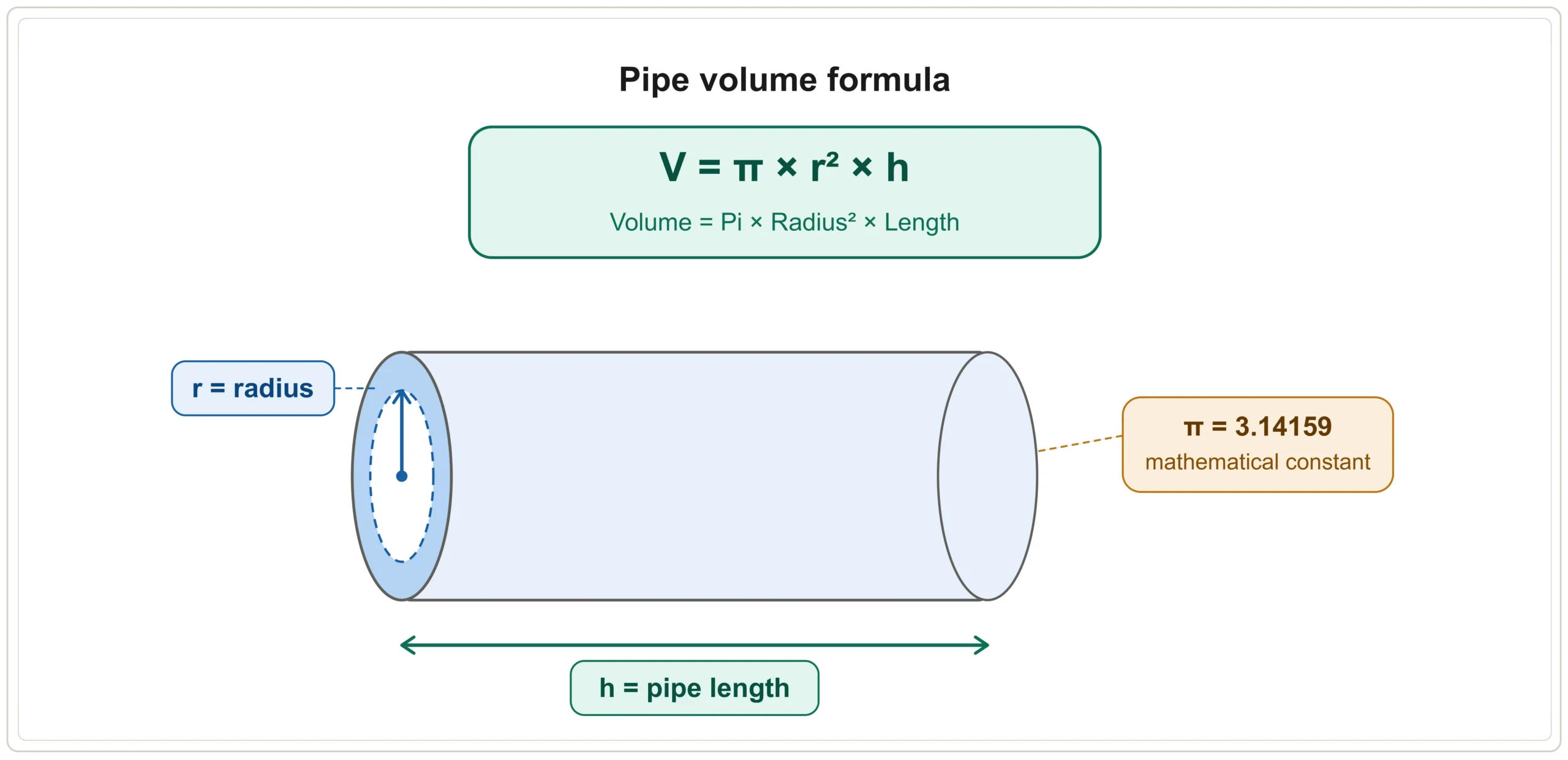
The calculator uses the standard cylinder volume formula:
V = π × r² × h
Where:
- V = Volume of the pipe
- π = Pi (approximately 3.14159)
- r = Inner radius of the pipe (half the inner diameter)
- h = Length of the pipe
How to calculate pipe volume (with example)
Here’s how the calculator works using a real-world pipe measurement.
Inputs:
- Pipe Inner Diameter: 1 inch
- Pipe Length: 8.333 feet (100 inches)
Step 1 — Find the Radius
r = 1 inch ÷ 2 = 0.5 inch
Step 2 — Calculate Volume in Cubic Inches
V = π × r² × h
V = 3.14159 × (0.5)² × 100
V = 3.14159 × 0.25 × 100 = 78.54 in³
Step 3 — Convert to Cubic Centimeters (mm³)
1 cubic inch = 16,387.064 mm³
78.54 × 16,387.064 = 1,286,594.99 mm³
Step 4 — Convert to Gallons
1 U.S. gallon = 231 cubic inches
78.54 ÷ 231 = 0.34 gallons
Step 5 — Convert to Ounces
1 cubic inch = 0.554113 oz
78.54 × 0.554113 = 43.52 oz
Pipe Volume Results:
Cubic Inches: 78.54 in³
Cubic Millimeters: 1,286,594.99 mm³
Gallons: 0.34 gallons
Ounce: 43.52 oz
Know Exactly How Much Your Pipe Holds — Before the Job Starts
Undersizing a pipe system costs you time, callbacks, and materials. Download the free pipe volume calculator and know the exact fluid capacity of any pipe — in gallons, ounces, cubic inches, and cubic millimeters — before a single fitting goes in. Whether you’re sizing a water supply line, calculating fill volume for a hydronic system, or estimating liquid weight for a commercial install, this calculator gives you the precise numbers you need to get it right the first time.
Plumbing Pipe volume calculator: FAQs
What is the difference between inner diameter and outer diameter for pipe volume?
Pipe volume is calculated using the inner diameter — the measurement from one inside wall to the opposite inside wall. The outer diameter includes the pipe wall thickness and is larger than the inner diameter. Always use the inner diameter when calculating how much liquid a pipe holds. Using the outer diameter will overestimate volume and lead to inaccurate system sizing.
How do I measure the inner diameter of a pipe?
To measure inner diameter, use a caliper placed inside the pipe opening and measure the distance from one inside edge across the center to the opposite inside edge. For pipes already installed in a wall or ceiling, refer to the pipe manufacturer’s specifications — nominal pipe sizes have standard inner diameter values that are well documented for copper, PVC, PEX, and galvanized steel pipe.
Can I use this calculator for different pipe materials?
Yes. The volume formula applies to any pipe regardless of material — copper, PVC, PEX, CPVC, galvanized steel, cast iron, or concrete. The inner diameter and length are the only variables that determine volume. However, if you need to calculate the weight of the pipe material itself (not the liquid inside), you will need to factor in the density of the specific pipe material separately.
Can I download the pipe volume calculator in Excel?
Yes. Download a free copy of the calculator as a Google Sheet formatted file. Click the download button above, fill out the short form, and the calculator will be sent directly to your email. Make a copy of the sheet, enter your pipe dimensions, and use it freely on any job.
How can I download and use the pipe volume calculator?
Click the download button above and fill out the short form with your name, email, and company details, then hit “Download Now.” You’ll receive the calculator directly to your email as a Google Sheet formatted file. Make a copy of the sheet, enter your pipe dimensions, and use it freely anytime.
Try out some more of our plumbing calculators!
-


Water Pipe Size Calculator
Determine the correct pipe size for any water supply line based on flow rate and system pressure.
-


Business Valuation Calculator
Find estimated financial worth or value of your plumbing business.
-


Drain Pipe Slope Calculator
Get the correct drain pipe slope percentage instantly by entering pipe fall and pipe length.
-


Service Price Calculator
Instantly calculate plumbing service price based on labor, parts and overhead.