PLUMBING MEASUREMENTS
Drain Pipe Slope Calculator
This plumbing drain pipe slope calculator helps plumbers and contractors determine the exact slope of any drain pipe installation. Enter the pipe fall and pipe length, and get the correct slope percentage instantly — so every drain, sewer lateral, and waste line you install flows the way it’s supposed to. No manual math, no guesswork, no callbacks for slow drains.
What is a drain pipe slope calculator?
A drain pipe slope calculator is a tool that determines the correct angle — the slope — at which a drain pipe must be installed so wastewater and sewage flow properly by gravity. Slope (also called grade, pitch, or fall) is expressed as a percentage or as inches of drop per foot of pipe. Enter your pipe fall and pipe length, and the calculator does the math instantly, eliminating guesswork on every install.
Use it to check bathroom and kitchen branch drains, main building drains, and sewer laterals before the pipe ever goes in the ground.
How do you calculate drain pipe slope?
To calculate drain pipe slope, divide the pipe’s vertical fall by its length, then multiply by 100 to express the result as a percentage. The drain pipe slope formula is:
PS = (PF / PL) × 100
Where:
- PS = Pipe Slope (%)
- PF = Pipe Fall (ft)
- PL = Pipe Length (ft)
The calculator uses this exact formula, so the number you see matches the number you’d work out by hand — just faster and without arithmetic errors on the job.
How to calculate drain pipe slope (with example)
Here’s how the calculator works using a real installation scenario.
Inputs:
- Pipe Fall: 25 ft
- Pipe Length: 97 ft
Calculation:
PS = (25 ÷ 97) × 100 = 25.77%
Drain Pipe Slope: 25.77%
Plug your own pipe fall and pipe length into the calculator above and you’ll get an instant, accurate slope percentage for the job in front of you.
How do you calculate a 2% slope for drainage?
To calculate a 2% slope, the pipe must fall 2 units for every 100 units of length, so the total fall equals the pipe length × 0.02. A 2% slope is the same as the standard ¼ inch of fall per foot used on most residential drain lines.
Example: for a 50 ft drain run, fall = 50 × 0.02 = 1 ft (12 inches) of drop. Over the 97 ft run from the example above, a 2% slope needs 97 × 0.02 ≈ 1.94 ft of fall.
To confirm it on the job, enter your pipe length in the calculator and adjust the pipe fall until Pipe Slope reads 2.00%.
What is the proper slope for a drain pipe?
The best (proper) slope for a drain pipe is ¼ inch of fall per foot of pipe, which works out to about 2%. This is the ideal, industry-standard drain pipe slope recommended by most plumbing codes for residential drain lines 2½ inches or smaller in diameter.
- For larger pipes (3 inches and above), a minimum slope of ⅛ inch per foot (about 1%) is generally acceptable.
- Never go below ⅛ inch per foot — water won’t move fast enough to carry solids.
- Avoid excessive slope (roughly steeper than 3 inches per foot for standard residential lines) — water outruns the solids it’s carrying and leaves them behind.
Getting this right on every job protects your work, your reputation, and your customer’s home.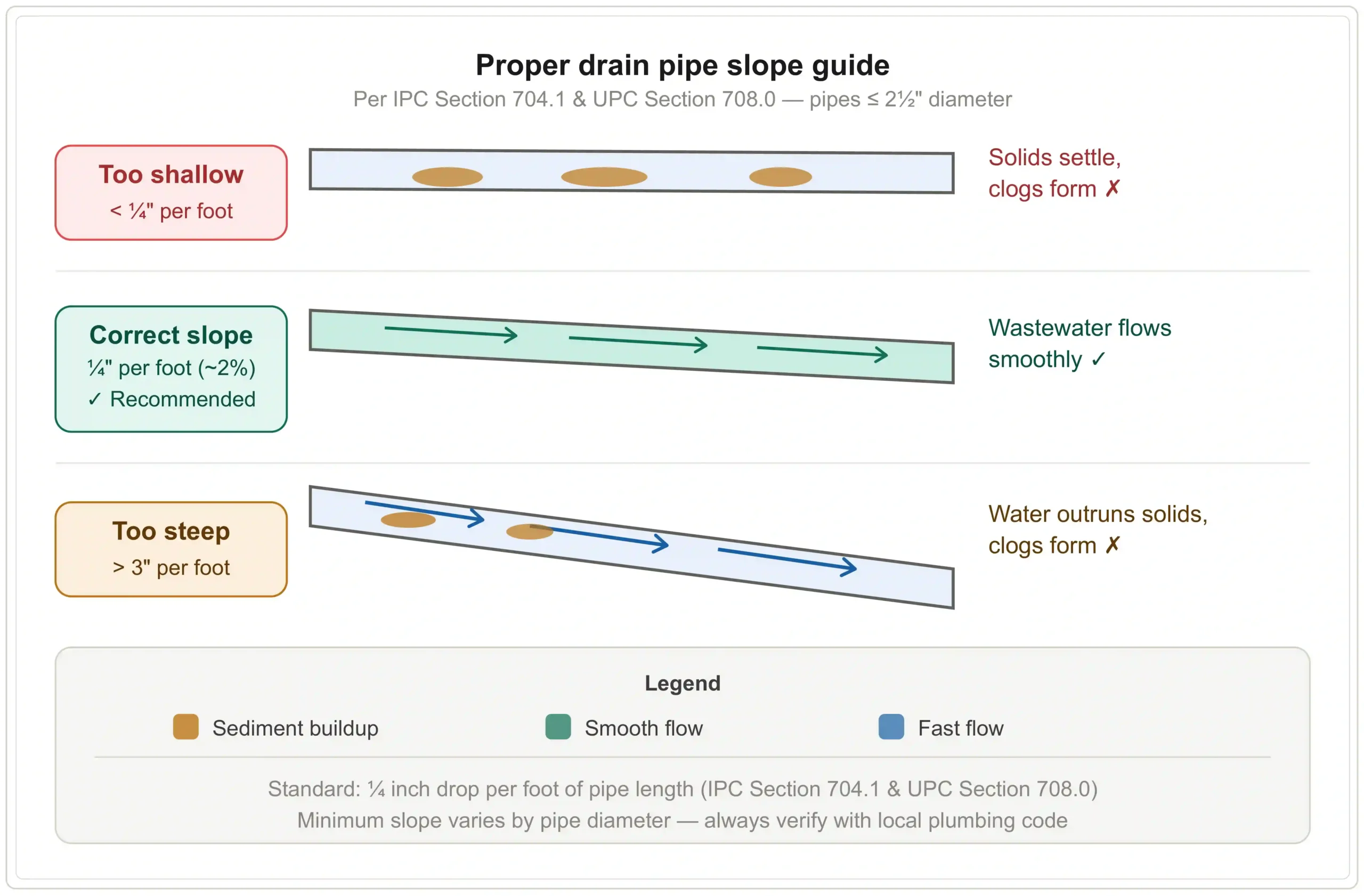
How much fall do I need for a drain pipe?
For the standard ¼-inch-per-foot slope, the pipe needs ¼ inch of fall for every foot of pipe length. Because the calculator takes both Pipe Fall and Pipe Length in feet (ft), convert that total fall to feet before you enter it.
Example: a 20 ft run needs 20 × ¼ inch = 5 inches of fall, which is 5 ÷ 12 ≈ 0.42 ft. Enter Pipe Fall = 0.42 ft and Pipe Length = 20 ft, and the calculator returns a 2.08% slope (the ¼-inch-per-foot standard). A 40 ft run needs 10 inches ≈ 0.83 ft of fall. Use the calculator to confirm the resulting slope lands at ~2% or meets the minimum for your pipe size.
Working the full plumbing rough-in? Pair this tool with our other free calculators: use the pipe volume calculator to find exactly how much wastewater a drain run holds, and the water pipe size calculator to size the water supply lines feeding the same job.
Drain pipe slope chart (inches per foot, percent & ratio)
Use this drain pipe slope chart to convert between the formats you’ll see on plans, on a laser level, and in the calculator. The standard ¼ inch per foot slope is highlighted because it’s the target for most residential drain lines.
| Slope (inches per foot) | Slope (percent) | Grade (ratio, run : rise) | Typical use |
| 1/16 in per ft | 0.52% | 1 : 192 | Large-diameter runs (8″+) where code permits |
| 1/8 in per ft | 1.04% | 1 : 96 | Building drains and sewers 3″–6″ |
| 3/16 in per ft | 1.56% | 1 : 64 | Optional steeper grade for larger pipe |
| 1/4 in per ft | 2.08% (≈2%) | 1 : 48 | Standard for drains 2½” and smaller |
| 3/8 in per ft | 3.13% | 1 : 32 | Short branch runs with extra fall available |
| 1/2 in per ft | 4.17% | 1 : 24 | Short runs only — watch for over-steep grade |
Quick rule: percent slope ≈ inches per foot × 8.33. So ¼ inch per foot × 8.33 ≈ 2.08%.
Minimum drain pipe slope by pipe size (IPC)
The minimum slope for water drainage depends on the pipe diameter. Under the International Plumbing Code (IPC), pipes 2½ inches and smaller need at least ¼ inch per foot (2.08%), 3-to-6-inch pipes need ⅛ inch per foot (1.04%), and pipes 8 inches and larger need 1/16 inch per foot (0.52%). Smaller pipes need a steeper minimum so flow stays fast enough to carry solids; larger pipes move more volume and can run flatter:
| Pipe diameter | Minimum slope (inches per foot) | Minimum slope (percent) |
| 2½ inches or smaller | ¼ in per ft | 2.08% |
| 3 inches to 6 inches | ⅛ in per ft | 1.04% |
| 8 inches or larger | 1/16 in per ft | 0.52% |
These are code minimums, not targets — many plumbers grade a little steeper to keep a self-cleaning velocity. Local codes (including the UPC) can be stricter, so always confirm the requirement for your jurisdiction before you set a grade. Because slope is dictated by pipe diameter, it pays to lock in line sizes early; when you’re sizing the water supply side of the same job, our water pipe size calculator finds the correct diameter from flow rate and velocity.
Why is drain pipe slope important?
Drain pipes rely on gravity to move wastewater from point A to point B. Slope is what makes that gravity flow work:
- Too shallow — water moves too slowly, solids settle inside the pipe, and you get clogs, backups, standing water, and foul odors.
- Too steep — water rushes through and outruns the solids it’s carrying, leaving them behind to build up and block the line.
Dialing in the correct slope on every install is the difference between a drain that runs clean for decades and a callback in six months. To estimate how much wastewater a given run carries at full capacity, drop the pipe’s inner diameter and length into our pipe volume calculator.
Can you install a drain pipe without a slope?
No. A drain pipe installed without a slope will not drain properly. Wastewater and sewage sit stagnant inside the pipe, creating blockages, foul odors, and serious health hazards over time. Every drain pipe installation requires a calculated slope — no exceptions. Run your numbers through this calculator before each install to confirm the pipe fall and length give you a code-compliant slope.
How to convert drain slope between percent and inches per foot
Plans, laser levels, and inspectors don’t always speak the same units, so it helps to convert quickly:
- Percent → inches per foot: multiply the percent by 0.12. Example: 2% × 0.12 = 0.24 in per ft (≈ ¼ inch).
- Inches per foot → percent: divide by 12, then multiply by 100. Example: ¼ inch ÷ 12 × 100 = 2.08%.
- Fall needed for a target slope: multiply the run by the slope grade. Example: a 2% slope over 50 ft = 50 × 0.02 = 1 ft of fall.
The calculator returns slope as a percentage; use the chart above to translate it into inches per foot for the field.
Get the free plumbing drain pipe slope calculator for every install
Never guess a drain slope again. Download the free calculator and get the correct pipe slope percentage for any job — bathroom drains, kitchen lines, sewer laterals, and more. Enter your pipe fall and pipe length, and get an instant, code-compliant slope result built for plumbers who need to install fast and install right.
Running the whole job, not just the math? Housecall Pro’s plumbing software helps you quote, schedule, invoice, and get paid — so your team spends less time on paperwork and more time in the field. Explore all our free plumbing templates and calculators.
Frequently asked questions
What is the difference between pipe slope, fall, grade, and pitch?
Fall (or drop) is the raw vertical distance the pipe descends, measured in feet or inches. Slope is that fall spread over the pipe length and written as a percentage. Grade is the same ratio written as a plain decimal. Pitch is a common trade term for the same idea. They describe one relationship in different formats — this calculator converts your fall and length into a slope percentage.
What angle should a drain pipe have?
Drain pipe slope is normally expressed as slope or pitch, not degrees. The standard ¼ inch of fall per foot works out to roughly 1.2° below horizontal (about a 2% slope). Because a fraction of a degree is hard to set in the field, plumbers work in inches per foot or percent and use a level or laser rather than measuring an angle.
What is a 1 in 40 fall per meter?
A 1 in 40 fall means the pipe drops 1 unit for every 40 units of length — equal to a 2.5% slope, or 25 mm of fall per meter of pipe. It’s a common gradient for smaller drainage pipes under metric plumbing codes and is slightly steeper than the US standard of ¼ inch per foot (about 2%).
How do you calculate drain pipe slope in mm?
Use the same formula: slope (%) = (fall ÷ length) × 100 — with both measurements in the same metric unit. Measure the fall and length in millimeters (or both in meters), divide, then multiply by 100. Example: a 30 mm fall over a 3,000 mm run = (30 ÷ 3,000) × 100 = 1%. To express it as fall per meter, divide the total fall by the length in meters. Note: the calculator on this page takes feet, so convert your measurements to feet if you want to run them through the tool directly.
What is the maximum slope for a 4-inch sewer pipe?
The IPC sets a minimum slope of ⅛ inch per foot for a 4-inch pipe but does not set a strict maximum. As a practical rule, avoid grades steeper than about 3 inches per foot on standard residential lines — water can outrun the solids it carries and leave them behind, causing clogs.
What happens if a drain pipe slope is too shallow?
A slope that’s too shallow lets water move too slowly, so sediment settles, standing water forms, and you get slow drains, odors, and eventually blockages. Any slope below ⅛ inch per foot is generally considered insufficient under most plumbing codes.
What happens if a drain pipe slope is too steep?
If the slope is too steep, water drains too quickly and rushes ahead of the solids it’s carrying. The solids are left behind inside the pipe and build up into clogs. A slope steeper than about 3 inches per foot is generally considered too steep for standard residential drain lines.
How deep should drainage pipes be?
Depth depends on the run, the required slope, and local frost and code requirements rather than a single fixed number. Start from your connection point, apply the correct slope (¼ inch per foot for most lines) across the full length, and bury the pipe below the local frost line. Use the calculator to work out total fall over the run, which sets how deep the downstream end lands.
Can this calculator be used for commercial plumbing jobs?
Yes. The formula — pipe fall divided by pipe length, multiplied by 100 — applies to any drain pipe installation, residential or commercial. For commercial projects, pipe diameters and local code requirements may differ, so always cross-reference your calculated slope against the applicable building code for the specific job.
Try out some more of our plumbing calculators!
-


Pipe Volume Calculator
Calculate the exact volume of water inside any pipe by entering the pipe diameter and length. Perfect for sizing jobs and fluid capacity estimates.
-


Water Pipe Size Calculator
Determine the correct pipe size for any water supply line based on flow rate, velocity, and system pressure to ensure efficient water delivery.
-


Service Price Calculator
Instantly calculate accurate plumbing service prices by factoring in labor, parts, and overhead, so every quote reflects your true job cost.
-


Labor Cost Calculator
Calculate total labor cost for any plumbing job, including hourly rates, burden, and overtime, so you can price work accurately and protect your margins.