Want to win more jobs with less effort?
Grow your business and send quick quotes with our home service software.

Want to see your potential revenue?
See what businesses like yours earn with Housecall Pro in 1 - 2 minutes.
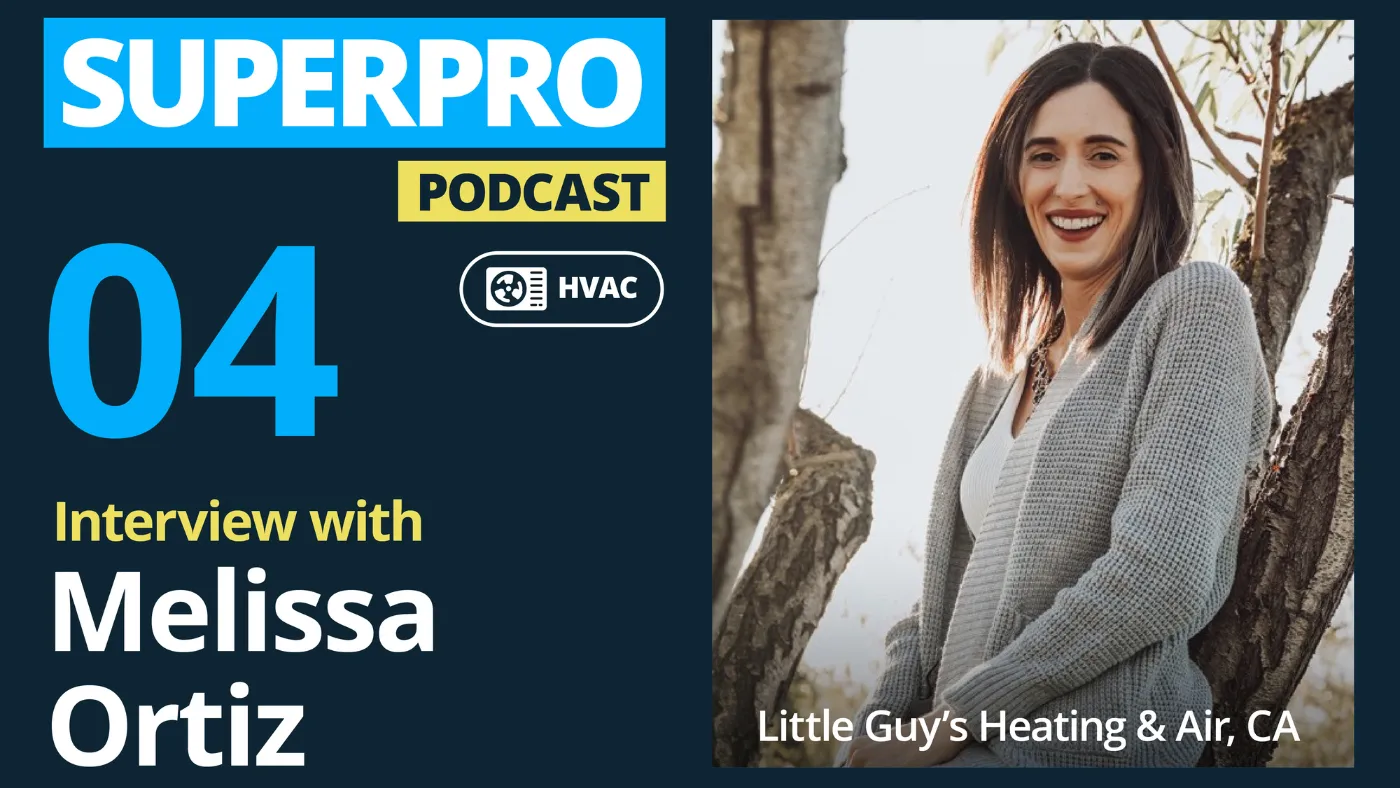
Little Guy’s Heating and Air Conditioning may be a small company, but founders Melissa Ortiz and her husband Chris run one of the most efficient, quickly growing HVAC businesses in California’s Central Valley. With three technicians, a growing office team, and a reputation that’s pulled in 170+ five-star Google reviews, they’re proving that small HVAC companies can scale fast when they focus on what matters: great customer experiences, smart hiring, and predictable year-round revenue.
In this episode of Housecall Pro’s Superpro podcast, Melissa highlights the systems and decisions that helped Little Guy’s grow. Below, you’ll find a full episode summary, key takeaways, and a complete transcript to help you apply these strategies.
Learn more: How To Grow Your HVAC Business and Get More Customers (With Expert Tips)
Key takeaways
Here’s what you’ll learn about HVAC business growth in the Superpro podcast:
Build a brand that sticks: A memorable name and story help customers remember your HVAC business.
Let reviews and referrals do the work: Positive Google reviews and referral programs keep your company busy without heavy ad spend.
Keep revenue steady with service agreements: Maintenance plans and commercial contracts create predictable year-round work.
Hire the right people to protect your culture: Hiring the right HVAC techs and support staff sets the foundation for long-term growth.
Use software to scale: Features like VoIP, payroll, expense cards, and job costing make dispatching and operations much smoother.
Jump ahead
Episode overview: How Little Guy’s grew their HVAC business
This episode of the Superpro podcast is a prime example of HVAC business growth. Melissa explains how Little Guy’s got started, built their reputation, and hired new technicians. Some of their key growth drivers? Positive customer reviews, a family-friendly brand, and service agreements that drive predictable revenue. She also shares how Housecall Pro made it easier to manage dispatching, speed up invoicing, and keep a clear view of their finances.
“I don’t think you can ever train enough. The HVAC industry is changing constantly; there’s always something new to learn.” —Melissa Ortiz
HVAC marketing lessons: Reviews, referrals, and branding that work
Little Guy’s has built a solid customer base thanks to a strong online presence and positive customer experiences. Referrals, postcards, and reliable service help keep new jobs coming consistently, while their family-focused, memorable brand builds trust and encourages word-of-mouth growth.
HVAC maintenance agreements: How to keep revenue steady year-round
Maintenance agreements give Little Guy’s a consistent stream of work throughout the year. Seasonal technicians help handle the summer rush, while ongoing maintenance and commercial contracts fill in slower months. Together, these strategies create a more predictable schedule and stable cash flow.
Housecall Pro: How HVAC software helps your business grow
The right tools can make growing your team a lot easier. With Housecall Pro, dispatching, invoicing, and payroll all happen in one place, saving time and cutting down on headaches. Melissa shares how features like VoIP, Payroll, Job costing, and Expense Cards helped her run her company smoother.
→ Ready to streamline your HVAC operations like Little Guy’s? Start your free trial of Housecall Pro and see how much easier running your business can be.
Episode timestamps
- 00:02 – Introduction: Meet Melissa Ortiz, co-founder of Little Guy’s HVAC, and get an overview of the business.
- 00:24 – Getting started: How Melissa and Chris launched their HVAC business from home.
- 01:10 – Jumping into entrepreneurship: How Melissa convinced her husband to move from tech to business owner.
- 02:30 – How customers find you: Referrals, Google reviews, and postcard marketing.
- 03:24 – Hiring HVAC technicians: Strategies for finding skilled techs through referrals and job boards.
- 04:11 – Company name story: The inspiration behind “Little Guy’s HVAC.”
- 05:35 – Branding and community perception: How a memorable, family-focused brand builds trust.
- 06:54 – Growth plans: Short-term and long-term strategies for expanding the business.
- 07:12 – Expanding the team: Adding technicians and office staff to support growth.
- 07:35 – Managing seasonal demand: Handling summer spikes and seasonal hiring.
- 08:17 – Maintenance agreements: Using service plans to stabilize revenue year-round.
- 09:33 – Lessons learned: Insights on spouse partnerships, hiring, and business culture.
- 11:14 – Adopting software: How Housecall Pro became essential for operations.
- 12:34 – Scaling with software: Why integrated software matters as your business grows.
- 13:02 – Expense cards: Streamlining purchases and office expenses.
- 14:13 – Job costing and financial clarity: Tracking costs and understanding net profit.
- 14:49 – VoIP features: How Housecall Pro VoIP protects technician privacy and improves customer communication.
- 16:45 – Training and staying ahead: Continuous education for HVAC growth and compliance.
- 17:24 – Final advice: Melissa shares tips for HVAC business owners.
Watch the episode
Episode transcript
Roland Ligtenberg (00:02)
Hi everybody, this is Roland Ligtenberg. I’m one of the co-founders of Housecall Pro. We are on the Superpro podcast. We have the honor of talking to Melissa today. Melissa is online with us. She is one of the co-owners of Little Guy’s HVAC. Tell us a little bit about your business, Melissa. How are you?
Melissa (00:24)
Hi, I’m good. Thank you so much for having me. So we are the Little Guy’s Heating and Air Conditioning. We’re located in Manteca, California. We’re right in between Stockton and Modesto. We’re just a small company. We’ve got three technicians, myself, and an office assistant. My husband is one of those technicians. So we’re still a very small business, just kind of, as you can see, working out of our home. Currently, we’re…looking for a business or a brick-and-mortar kind of building that we can work out of since we’re growing still.
Roland (01:01)
Nice. Tell me, how did you guys get into the business? You and your husband, where did it start? Who had the idea? What is the genesis story?
Melissa (01:10)
My husband has been doing this for a little over 25 years, and he just kind of fell in love with it. He’s had a passion for it since he started doing it, and he wanted to eventually get out on his own. So after I filled out the application for the third time, he finally decided that it was time to do it.
All of his friends were a little bit younger than him and they went out and did it themselves, got their [contractor’s] license first, and he decided, OK, now’s the time to do it. So he did it, he got his license, and we took it from there, and so far, everything has been great. We’ve been thriving and growing, and of course, being my husband, I followed him into it, and we’ve been doing great ever since.
Roland (02:06)
So you’ve been on board right since day one. You were the one who was like, “Hey, let’s do this, let’s do this.” And then finally, he was like, all right, we’re doing it. And so you both jumped ship. You both went into this full-time entrepreneurial endeavor together right out of day one.
Melissa (02:19)
Yes, right, right out of day one. It took a lot of convincing, and eventually, after that third application, it was like, OK, let’s get it done. It’s fine.
Roland (02:30)
And so tell me a little bit, now you’ve got a couple of other technicians, a couple of other trucks that are out there. How are people hearing about you guys? How are you finding new business? Where are people finding Little Guy’s Heating and Air conditioning?
Melissa (02:43)
Some of them are referrals. A lot of them we get just from Google itself. We have a lot of, not to brag, we have a lot of five-star reviews. So we come up kind of [often]. The Housecall referral/review feature has been great for us. So thank you for that. So yeah, a lot of them are referrals and word of mouth.
Roland (02:55)
171 right now, like it’s a lot, and it’s a perfect five-star.
Melissa (03:10)
Just finding us on Google. We do a little bit of marketing through Postcards. We initially started with Yelp marketing through them, and that’s kind of how we started everything.
Roland (03:24)
You got started, and then the ball got rolling. So you’ve got technicians now who are helping out in the field. Where did you find the technicians? How did you start growing your team? I feel like a lot of pros are always like, “I don’t know if I can find someone else that does it as well as I.” How are you guys able to do it?
Melissa (03:41)
That’s, that’s very much my husband’s mentality, actually. But one of them was hired about a year and a half ago, almost two years ago. He’s a friend of my husband’s and he’s been wonderful. One we found, I believe it was on ziprecruiter.com, and he’s been working for us for only about three or four months now. And he’s been great as well.
Roland (04:11)
Nice. And when you guys were coming up with your name for the company, whose idea was it to name it Little Guy’s, and what’s the meaning behind Little Guy’s Heating and Air?
Melissa (04:22)
So it was a family kind of decision. My husband, the company that he worked for prior to starting the business, had a little worker guy on the truck. And so my husband would come home and tell my daughter that it was just the little worker guy. And so initially we were going to name the company the Little Worker Guy, and we decided to kind of collapse that down to the Little Guy’s because I felt like the Little Worker Guy sounded kind of funny. So we decided to just go with the Little Guy’s. We felt that it was important to have the apostrophe in there. She was also obsessed with apostrophes. She was three or four years old, and so she was just kind of learning what everything was.
Learn more: 250+ HVAC Company Names to Inspire Your Brand
Roland (04:59)
Mm-hm.
Melissa (05:21)
So we made sure to throw the apostrophe in there. And then the actual little guy itself, we had him created to look a little bit like our son.
Roland (05:35)
I like it, yeah, in the logo itself. I think good branding goes such a long way, and I really like the story behind that. And it’s very memorable, you know, if someone were to tell me, oh, the Little Guy’s, like that would stick right away in my mind. And I feel like that’s a really important marketing element that I don’t know if enough pros spend enough time really thinking about, rather than maybe just using a last name or, like, Joe’s HVAC.
Melissa (05:38)
Yes.
Roland (06:01)
You know, there’s a time and a place, but I really like the direction you guys took, and that’s super clever, and I’m sure that’s really helpful in terms of your word-of-mouth marketing.
Learn more: 10+ HVAC Marketing Strategies to Get More Leads
Melissa (06:10)
Yeah, yeah, we have a lot of customers who really like the name. And it’s a great story to tell them how we came up with that name, too.
Roland (06:19)
Yeah, people love stories. People definitely love stories. And then they buy into that. And I also think little guys—like I would rather want little guys at my place than some big guys corporate thing, you know? And so I think just that perception of having that small kind of hometown feel, even though it’s not small anymore, you guys are five people, that’s the kind of people that I wanna do business with because I know they’ll honor and really do good work.
Melissa (06:46)
Yeah, and we live in a community where people really value that. They value a family kind of business like that.
Roland (06:54)
That makes a lot of sense. From just, like, a business standpoint, where do you guys kind of see yourself in the next couple of years? Are you guys in the growth stage? Are you looking to add more trucks? Are you looking to become more efficient? How are you guys kind of thinking about that, at least [in] the short-term future here?
Melissa (07:12)
In the next couple of years, we’re hoping to add a couple more guys. I would like a little bit more help in the office. Right now, [our office assistant] is doing great. She’s handling all of our marketing for us, but definitely another couple of technicians, a couple of trucks to get everything done that we need to, especially during summertime when it’s our busiest time.
Roland (07:35)
Yeah, I’m sure you guys are slammed right now, so thanks for taking the time during some of the busy summer months. I don’t know what temperature it is, but it’s been hot in California for sure this summer, which is good for business I guess. But how do you think about that when you’re like, OK, I need more people in the summertime, but then in the colder season, I don’t need as many people. Do you think hiring temporary work or temporary help to accommodate for the demand is important?
Melissa (07:38)
Yeah, of course.
Roland (08:03)
Or do you just shift people’s focus from selling replacements to more repair, maintenance, maybe service plans or memberships? Do you guys offer that? And how does that all fit together?
Melissa (08:17)
So we do have a maintenance agreement or service agreement, and that’s the Big Guy’s Maintenance Agreement. So that keeps us busy year-round. As far as how we hire, we do have seasonal employees who we keep on for the summertime. And then we have a lot of commercial business that keeps us busy throughout the year as well, because those are….quarterly visits, so that helps to keep us busy during our slow season.
Learn more: How To Write an HVAC Maintenance Contract (Free Template & Sample)
Roland (08:50)
Yeah, I think that’s great advice. I think definitely if you’re in the HVAC space, but even in some of the other mechanical trades [like] plumbing, to the extent you can offer maintenance agreements, memberships, service agreements, service plans, there are lots of different ways to kind of pitch that marketing lingo. But the fact is, being able to have that recurring work irrespective of an increase, just like the consumer side demand, is really important during those colder seasons. And that’s a good tip. And I don’t think enough pros are taking that seriously, especially as they’re trying to get up there in size.
Because once you get employees, you gotta keep them busy. And it’s a constant seesaw of like, get enough work, keep them busy. Oh, too much work, we can find more people. And it, you know, keeps going back and forth.
Melissa (09:28)
Yeah, it’s definitely a balancing act for sure.
Roland (09:33)
Yeah. What are some things that you know now that you wish you had known when you started Little Guy’s?
Melissa (09:44)
There are a few. There’s always gonna be disagreements when you go into business with your spouse. Be careful who you hire. Sometimes you hire the wrong person…[so] be slow to hire and quick to fire. I think that’s a very important thing to remember.
Roland (10:05)
Mm-hmm. Good [call out].
Melissa (10:10)
So those are probably the two most important that come to mind.
Roland (10:16)
Yeah, I think working with your spouse is an interesting dynamic between you. When are you in a relationship mode? When are you in business mode? And how do you like to keep those things from affecting one another? I think that’s tough. And I think a lot of our pros are in a similar situation with their spouses, and similar to the way that you and your husband started the business together, lots of our pros start businesses together with their spouses, because it just makes sense. And you work it together, and you know, that’s the easiest way to start. And then slow to hire, quick to fire.
I think culture is super important and you know, it’s obvious [that] you guys have tons of five-star reviews. It’s because you’ve got a good culture, good people working for you. And I think that reflection on your brand is ultimately what helps you drive your growth. So I know that some people are like, “Oh my God, I need more people.” But if you put the wrong person in there, you know, that could be toxic. You could make the actual great employees…want to leave, which is absolutely the wrong way to do it.
Melissa (11:12)
Very, very much.
Roland (11:14)
Yeah, yeah. Well, tell me a little bit about how you see software playing into the mix, into your business. What was the moment when you’re like, aha, we gotta use software at this point? We gotta do it this way, we gotta be organized. Was it from the get-go? Did you do it a little bit into the business? What was that painful moment that you’re like, all right, we need to do it this way?
Melissa (11:35)
So we knew initially that we needed some sort of software. We needed to be able to invoice our customers…but we didn’t know exactly how we were going to dispatch. When we started, it was kind of just inputting things into my husband’s schedule on his phone and saying, “Hey, you’re going to this address.”
Once we discovered Housecall Pro, it made everything so much easier for us. We were able to dispatch and do all of our invoicing in one place. And then now that we are growing the way that we are, it’s been such a huge help. We can see in the office who’s going where at what time. So it’s been a tremendous help for us. Without software, you know, I wouldn’t be able to do payroll. I wouldn’t be able to do time cards and things like that.
Roland (12:34)
Yeah, I think early on, sometimes people are like, oh, you know, I can maybe use Google Calendar, but then quit it pretty quickly, you know, using four different things all doing the same thing becomes a lot of extra effort. And you should be looking at things all in one. And I hear that a lot from a lot of pros are like, yeah, I just wanted something that can do all the things in it, rather than using all these different tools because it was just getting messy.
Melissa (12:58)
Very much. Yeah.
Roland (13:02)
You guys use our expense cards quite a bit. Tell me a little bit about how you use them, like kind of maybe what the rules are? I think there are a lot of pros that might not even know that we have that as something that we offer via Housecall Pro, but how does that work in your company? What are the rules, and how did you set that up?
Melissa (13:21)
So I have an expense card for the office expenses, for fuel, things like that. The technicians have them for parts if they need to go to an outside parts store that is not really a distributor, just Home Depot, Ace Hardware. The technicians have a limit on their cards just because there’s no reason for them to be spending more than a certain amount at another store that’s not a distributor for us. And then my husband has one, and as the owner, obviously, he doesn’t have a limit on his card either.
Learn more: The Best HVAC Brands for Your Business—and Where to Get Them
Roland (13:48)
Mm-hmm.
Melissa (13:59)
But a lot of times it’s used mainly for fuel and just extra parts for them to keep on their truck or a part that they need for a specific job. That’s helped a lot.
Roland (14:13)
Yeah, I think our ultimate goal there is to help it tie into, like, the job costing and being able to really understand, like, the amount of COGS [Cost of Goods Sold], right, that go into any given job. So you can really start to determine the net profit of the job and get that job costing dialed in, and the ability to upload receipts. All those things are definitely kind of on the roadmap in our minds as we continue to develop on that feature.
Is there anything in particular that you feel is just a really underrated feature of Housecall Pro, something that doesn’t get enough attention, but you think other pros should definitely be using or should know about?
Melissa (14:49)
Definitely Housecall Pro VoIP. I think that it is underutilized by a lot of people. I know that there are a few people who use Housecall Pro Assist, but along with that, the VoIP is so easy. It’s so nice to have.
With Housecall Pro Assist, you know, sometimes you’ll have to request the recordings, but with VoIP, you just have them right at your fingertips. Just a click of a button. And with VoIP, you also have the ability for the technicians in the field to call your customer and mask their cell phone numbers so that the customer doesn’t get a hold of their cell phone numbers and contact them during off-hours.
So it’s definitely an underutilized tool, I think.
Roland (15:43)
Yeah, I think call masking in particular is useful for, you know, folks maybe in other industries too, there might be higher employee turnover, but also, you know, you wanna shield your employees from getting those late night calls from customers. And really, you should be the one that’s handling it and that maybe someone else is on call for that weekend or for those night jobs or emergency jobs or your husband, maybe you dispatch him out for those late ones. Call masking works great for that because, you know, when your guys and gals dial out…
Melissa (16:04)
Yeah, of course.
Roland (16:13)
Then it shows that office number, right? That one unified number versus all these random numbers that the customer might get confused by.
Melissa (16:20)
Yeah, it’s been very helpful for our technicians out in the field. So it’s worked wonders for us.
Roland (16:28)
That’s really great to hear. Do you have any nuggets or wisdom, like things that you think other people should do that you think if only you had done this last year would have saved you a world of hurt?
Melissa (16:45)
Training. I don’t think you can ever train enough, whether it’s just training through the Housecall Pro program or outside training.
Roland (16:48)
Mm-hmm.
Melissa (17:15)
The HVAC industry is changing constantly, and the laws and regulations are changing; there’s always something new to learn.
Roland (17:24)
I think that’s really, really good advice. There’s always something new to learn, and always be learning mindset and seeking wisdom out there because it’s out there. It’ll only make you better. That’s super helpful. Thank you so much for taking time out of your guys’ busy summer to chat with me on here, Melissa, and really appreciate your guys’ partnership and you guys picking out Housecall Pro as your partner on the software side. Thank you so much. Take care, Melissa.
Melissa (17:46)
Yeah, of course. Thank you for having me. Thank you.
Get In Touch: 858-842-5746
Let us earn your trust
On average, Pros increase monthly revenue generated through Housecall Pro by more than 35% after their first year.
See plan options and feature breakdown on our pricing page.s
FAQ
-
How do I get more customers for my HVAC business?
-
The best way to get more HVAC customers is to combine strong local marketing with excellent service. Focus on getting online reviews, asking satisfied clients for referrals, offering service agreements, and maintaining a memorable, trustworthy brand. Using software like Housecall Pro can also help streamline scheduling, invoicing, and follow-ups, so you never miss an opportunity to gain more customers.
-
How do HVAC companies get more leads without paid ads?
-
To get more leads without paid ads, many HVAC companies focus on Google reviews, referral programs, and strong branding. For example, Little Guy’s HVAC has more than 170+ five-star reviews, which pushes them to the top of local search results and drives consistent inbound calls. A memorable brand name also helps customers remember and recommend them.
-
How can HVAC businesses avoid slow seasons?
-
The most reliable way to avoid slow HVAC seasons is to secure maintenance agreements and commercial service contracts. These create recurring revenue and fill in schedule gaps during colder seasons.
-
What’s the best way to hire HVAC technicians?
-
The best way to hire HVAC technicians is to get referrals and post on job boards. Make sure you have a clear vetting process in place. Look for technicians who align with your company’s service standards, offer proper training, and set expectations upfront. Take your time—successful HVAC owners emphasize being slow to hire and quick to fire.
-
Why is branding important for HVAC companies?
-
Branding affects trust, memorability, and referral volume. Names that feel approachable, like “Little Guy’s,” signal a family-run, community-oriented business, which increases customer preference and loyalty. Strong branding also improves click-through rates on Google searches.
-
How can software help an HVAC business run more efficiently?
-
Modern HVAC businesses rely on all-in-one platforms to handle dispatching, invoicing, scheduling, payroll, and communication. Tools like HCP Assist, VoIP, job costing, and expense cards help teams stay organized, reduce errors, and speed up cash flow. Little Guy’s Heating and Air Conditioning credits early software adoption as a major growth factor.
-
What services help HVAC businesses increase revenue?
-
Recurring services such as seasonal tune-ups, preventive maintenance visits, indoor air quality inspections, and membership plans keep revenue stable and help build long-term customer relationships.