Want to win more jobs with less effort?
Grow your business and send quick quotes with our home service software.

Want to see your potential revenue?
See what businesses like yours earn with Housecall Pro in 1 - 2 minutes.
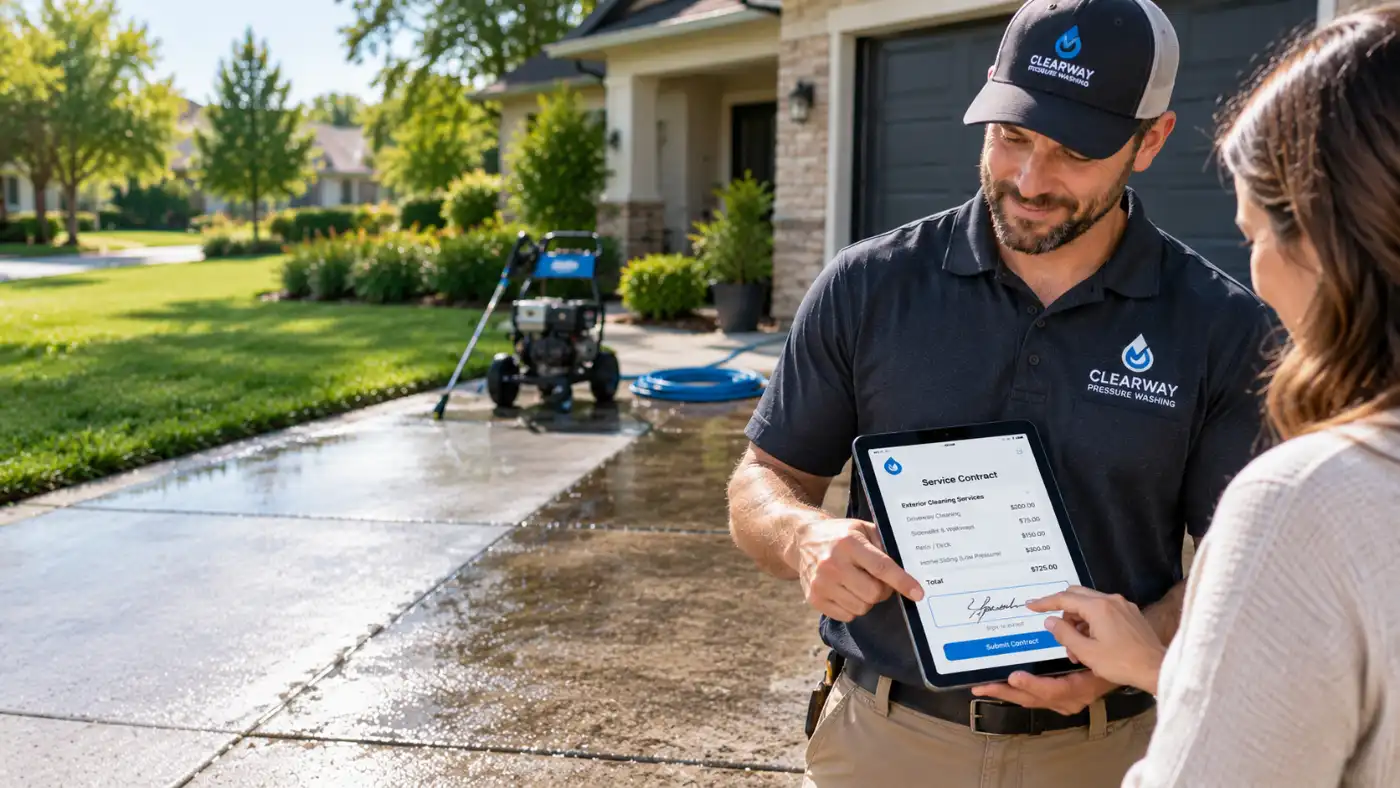
A clear pressure washing contract helps you and your customer agree on the details of a job before work starts. Even for a quick driveway or siding wash, having one gives you a clear record to reference if questions come up about the price, scope, or finished work.
This guide covers what to include in your pressure washing contracts, common mistakes to avoid, and how to create an agreement that fits each job.
Download Housecall Pro’s free, customizable contract template to save time and create professional agreements without starting from scratch.
Quick answer: What should a pressure washing contract include?
A pressure washing contract should spell out the scope of work, pricing and payment terms, materials and equipment covered, service frequency, warranty and liability terms, and signatures from both parties. Putting these details in writing helps set clear expectations and gives you and your customer a record to reference if questions or disputes come up.
Key takeaways
Here's what matters most when building your pressure washing contracts:
Contracts protect both you and your customers: A written agreement creates a shared record of the work, price, and terms.
Clear terms support steady cash flow: Payment schedules and due dates show customers what they owe and when.
Different jobs require different contract types: Build templates for residential, commercial, specialty, one-time, and recurring maintenance work.
Clarity prevents disputes: Detailed descriptions of services, surfaces, and payment terms help prevent misunderstandings and scope creep.
Table of contents
- What are common types of pressure washing contracts?
- What should you include in a pressure washing contract?
- Pressure washing contract example
- How do you create a pressure washing contract? (Step-by-step)
- Common mistakes to avoid when writing a pressure washing contract
- How to manage pressure washing contracts without the paperwork
What are common types of pressure washing contracts?
Most pressure washing businesses rely on five main contract types. The right one depends on the job, the customer, and how you’re getting paid. If you offer specialty services that don’t fit neatly into these categories, you can build custom contract templates in Housecall Pro.
Pressure washing service agreement
A pressure washing service agreement is a written agreement that covers a single job’s scope, timeline, and pricing. It’s typically used for one-time residential or commercial work, such as cleaning a driveway, siding, or roof.
Use a service agreement when:
- Completing a one-off job
- Working with new customers
- Defining a clear start and completion date
State who’s responsible for water and electricity access, plus any special site accommodations, so there’s no confusion when you arrive.
Pressure washing maintenance contract
A pressure washing maintenance contract covers recurring service for storefronts, HOAs, fleets, and other properties that need cleaning on a set schedule.
Use a maintenance contract when:
- Working with HOAs or property managers
- Providing recurring maintenance services
- Building long-term customer relationships
Schedule automatic renewal notices to go out a month before the contract ends. You can also offer an early-renewal incentive to keep recurring work on the calendar.
Want to offer maintenance agreements? Download Housecall Pro’s free Small Business Maintenance Agreement Template
Financing or payment plan agreement
A financing or payment plan agreement breaks a job’s cost into deposits and milestone payments. It can be useful for larger commercial jobs or cleaning projects completed in phases.
Use a financing agreement when:
- Project costs are high
- Customers request flexible payment options
- You need to reduce the risk of incomplete payment
Explain how you’ll handle change orders and delays, including weather-related delays, and when additional charges apply.
Learn more: How to offer customer financing
Subcontractor agreement
A subcontractor agreement defines responsibilities, payment terms, and liability when you bring in extra help for a larger job or a one-time specialty service.
Use a subcontractor agreement when:
- Hiring day workers
- Outsourcing parts of a project
- Protecting your business from liability
- Working as a subcontractor yourself
If you’re hired as a subcontractor, use a written agreement with the general contractor to document payment terms, responsibilities, and liability before work begins.
Unsure what classification your workers are? Check out our guide to Subcontractors vs. Employees.
Commercial pressure washing contract
A commercial pressure washing contract may include added insurance requirements, compliance standards, and project management terms for larger or more formal client relationships.
Use a commercial contract when:
- Working with office buildings, retail centers, restaurants, warehouses, or industrial properties
- Contracting with property management companies
- Dealing with a company rather than an individual homeowner
If a commercial client asks you to sign their agreement instead, have a lawyer review it so you understand your obligations and can confirm the contract includes the details you need.
Get In Touch: 858-842-5746
Let us earn your trust
On average, Pros increase monthly revenue generated through Housecall Pro by more than 35% after their first year.
See plan options and feature breakdown on our pricing page.
What should you include in a pressure washing contract?
Every contract template should cover the following, whether you’re customizing a template or building one from scratch.
- Business and client details: Your company name, contact info, and license or permit numbers, plus the customer’s name, contact details, and job address.
- Scope of work: Exactly which surfaces you’ll clean (driveways, siding, roofs, patios, decks, parking lots), any prep work or specialty treatments, and clear exclusions.
- Materials and equipment covered: The cleaning products, detergents, sealers, and equipment included in the price, plus anything the customer is supplying.
- Frequency or duration of service: Start and completion dates for one-time jobs, or the cleaning schedule for recurring maintenance work.
- Pricing and payment terms: A cost breakdown, deposit and due dates, accepted payment methods, and late payment fees.
- Warranty and liability: Any workmanship guarantees, exclusions, insurance details, and liability limitations.
- Termination clauses: The conditions under which either party can cancel, notice requirements, and any cancellation fees.
- Signatures and dates: Both parties’ signatures (electronic or physical) and the date signed.
Pro tip: Chasing signatures and tracking renewal dates by hand eats into hours you could spend on paying jobs. Housecall Pro lets you build digital contracts, collect e-signatures, and automate renewal reminders instead.
Pressure washing contract example
A sample contract can help you see how the structure, language, and required details fit together before you write your own.
Please note that this contract is provided for informational purposes only. It is not intended to serve as a legally binding agreement. Have a licensed attorney review any contract before you use it, to make sure it complies with your local and state laws.
This Agreement is made on [Date], between:
Contractor: [Your Business Name], located at [Business Address]
Client: [Client Name], located at [Client Address]
Together referred to as “the Parties.”
1. Scope of Work
The Contractor agrees to provide pressure washing services as follows:
Project Description: [exterior soft washing of driveway and walking path]
Preparation Work Includes:
- Surface cleaning and pre-washing
- Covering plants and safeguarding exterior spigots and outlets
Pressure Washing Details:
- Type of cleaning products
- Type of equipment
Exclusions (if any): [Example: pressure washing siding of the house, removal of insect nests on eaves, etc.]
Work Location: [Property Address]
2. Project Timeline
Start Date: [Date]
Estimated Completion Date: [Date]
Delays may occur due to weather, material availability, or unforeseen conditions. (Here you can address any penalties for delays or change orders, or state exceptions to assessing penalties for delays.)
3. Payment Terms
The Client agrees to pay:
Total Project Cost: [$X,XXX.XX]
Payment Schedule:
- Deposit: [$X or %] due before work begins
- Progress Payment (optional): [$X or %] due at [milestone]
- Final Payment: Remaining balance due upon completion
Accepted Payment Methods: [Cash, check, card, etc.]
Late payments over [X days] may incur a fee of [X% or $X].
Pro tip: Include a link to online payment options to make it easier for your clients to pay right away.
4. Materials
☐ Contractor will supply all materials
☐ Client will supply cleaning supplies/materials
If the Client supplies materials, the Contractor is not responsible for product quality or performance.
5. Client Responsibilities
The Client agrees to:
- Remove or protect personal belongings before work begins
- Provide access to the property during agreed hours
- Ensure pets and children are kept away from work areas
Failure to do so may result in delays or additional charges.
6. Change Orders
Any changes to the original scope (added locations, repairs, etc.) must be:
- Requested in writing
- Approved by both Parties
Change orders may result in additional costs and time extensions.
7. Workmanship Warranty
The Contractor guarantees workmanship for [e.g., 1 year] from the completion date.
This warranty covers: [describe coverage]
This warranty does NOT cover:
- Normal wear and tear
- Damage from moisture, leaks, or structural issues
- Client-supplied materials
8. Cleanup
The Contractor will:
- Remove tools and materials
- Dispose of job-related debris
- Leave the work area in a clean condition
9. Liability
The Contractor is insured [if applicable: include insurance details].
The Contractor is not responsible for:
- Pre-existing damage
- Hidden structural or surface issues
Liability is limited to the total amount paid under this Agreement.
10. Termination
Either party may terminate this Agreement with [X days] written notice.
Immediate termination may occur if:
- Payment is not made as agreed
- Terms of the contract are violated
The Client must pay for all work completed up to the termination date.
11. Independent Contractor
The Contractor is an independent contractor, not an employee of the Client.
Contractor signature: ______________________________ Date: ___________
Client signature: ______________________________ Date: ___________
How do you create a pressure washing contract? (Step-by-step)
Some verbal agreements may be enforceable, but a written contract gives you and your customer a clear record to reference. Follow these steps to build yours.
- Gather client and business information: Collect the customer’s name, address, and contact details, along with your own business information and license numbers.
- Define the scope of work: List every surface you’ll clean, the cleaning methods, stain treatments, prep work, and exclusions. Adding photos or notes from your estimate helps set expectations.
- List materials and equipment covered: Specify the exact detergents, sealers, surface cleaners, and equipment you’ll use, and note anything the customer is supplying.
- Set service frequency and duration: Include start and completion dates for one-time jobs, or build a recurring schedule for maintenance contracts.
- Establish pricing and payment terms: State the total cost, deposit, payment schedule, accepted payment methods, and any late fees. For larger commercial jobs, consider tying payments to project milestones to support steadier cash flow. For instance, a 30% deposit, 40% at the project’s midpoint, and 30% due on completion for a $10,000 multi-building HOA cleaning job.
- Include warranty and liability information: Note any workmanship guarantees, expiration dates, exclusions, insurance details, and license numbers.
- Add termination clauses: Explain how either party can cancel, including notice periods and any fees, plus how disputes will be resolved if they come up.
- Include signatures and dates: Have both parties sign and date the agreement. If you can’t accept an e-signature, tell your client how to return the contract.
- Review and customize: Have a lawyer review each template for legal compliance, then adjust the details for the specific job before sending it.
Common mistakes to avoid when writing a pressure washing contract
Missing details in a contract can lead to big misunderstandings once work begins. Watch for these common mistakes before you send your next agreement.
- Skipping the contract on “quick” jobs: Verbal agreements can be difficult to prove if a customer questions the price or scope. Put small jobs in writing, too.
- Leaving the scope of work vague: List the exact surfaces, cleaning methods, and exclusions so both sides know what’s covered.
- Not setting payment terms upfront: Contracts without a deposit amount, due dates, and late fees make non-payment harder to resolve—set terms before work starts.
Read more: What to do when a customer refuses to pay
How to manage pressure washing contracts without the paperwork
A solid template is only the starting point. You also need a simple way to send agreements, collect signatures, track renewals, and bill customers based on the approved terms. Housecall Pro keeps those steps connected, helping your office stay organized from approval through payment.
- Digital contracts and e-signatures: Send contracts by email or text and signatures before work begins.
- Contracts linked to invoices and payments: Connect each contract to its invoice so billing reflects the approved terms and customers can pay on the spot.
- Automatic renewals for recurring agreements: Set maintenance contracts for HOAs and repeat customers to renew automatically, so a service agreement never lapses unnoticed.
- Centralized contract and customer records: Store every signed contract in one place instead of a filing cabinet or scattered inbox, so you can pull it up fast if a dispute comes up.
- Renewal and expiration tracking: Get notified before a contract expires so you can follow up and protect repeat revenue.
Ready to spend less time chasing paperwork? Sign up for Housecall Pro’s free 14-day trial.
Pressure washing contract FAQs
Do pressure washing contractors need a written contract?
Not legally, but you should use one anyway. Verbal agreements can be enforceable, but they’re hard to prove if a customer disputes the price or scope—a written contract protects both parties.
What should be included in a pressure washing service contract?
A service contract should include the scope of work, materials and equipment, pricing and payment terms, timeline, warranty and liability details, and signatures from both parties.
How do I protect myself from non-payment as a pressure washing contractor?
Require a deposit before starting work, set a clear payment schedule with due dates, and include a late payment fee in your contract so customers know the terms upfront.
What's the difference between a service agreement and a maintenance contract?
A service agreement covers a single job with a defined start and end date, while a maintenance contract covers recurring service, like monthly storefront washing or scheduled HOA cleanings.
Can I use a template for my pressure washing contracts?
Yes. A template saves you time, but customize the scope of work, pricing, and customer information for each job before sending it.
What happens if a customer disputes a pressure washing contract?
Refer back to the signed contract to resolve the disagreement. Clear documentation of the scope, pricing, and terms makes it much easier to prove what was agreed to. If you can’t resolve it directly, mediation or small claims court are the next steps for unpaid or disputed work.
Is a verbal agreement legally binding for pressure washing work?
It can be, but it’s difficult to enforce. Without anything in writing, it’s hard to prove what was actually agreed to if there’s a disagreement—a written contract offers much stronger protection.
Do I need insurance to include in my pressure washing contract?
Yes. List your general liability coverage (and workers’ comp if you have employees) in the contract’s liability section so clients can see you’re covered before you start. Most commercial clients and HOAs will ask for a certificate of insurance before signing. See our guide to business insurance costs and coverage types for what’s typical for a service business your size.
Are electronic signatures legally binding for pressure washing contracts?
Yes. Under the federal ESIGN Act and state UETA laws, an e-signature carries the same legal weight as a handwritten one for most service contracts, including pressure washing agreements. Keep a timestamped copy of the signed document and you’re covered the same way you would be with a paper original.