Want to see your potential revenue?
See what businesses like yours earn with Housecall Pro in 1 - 2 minutes.
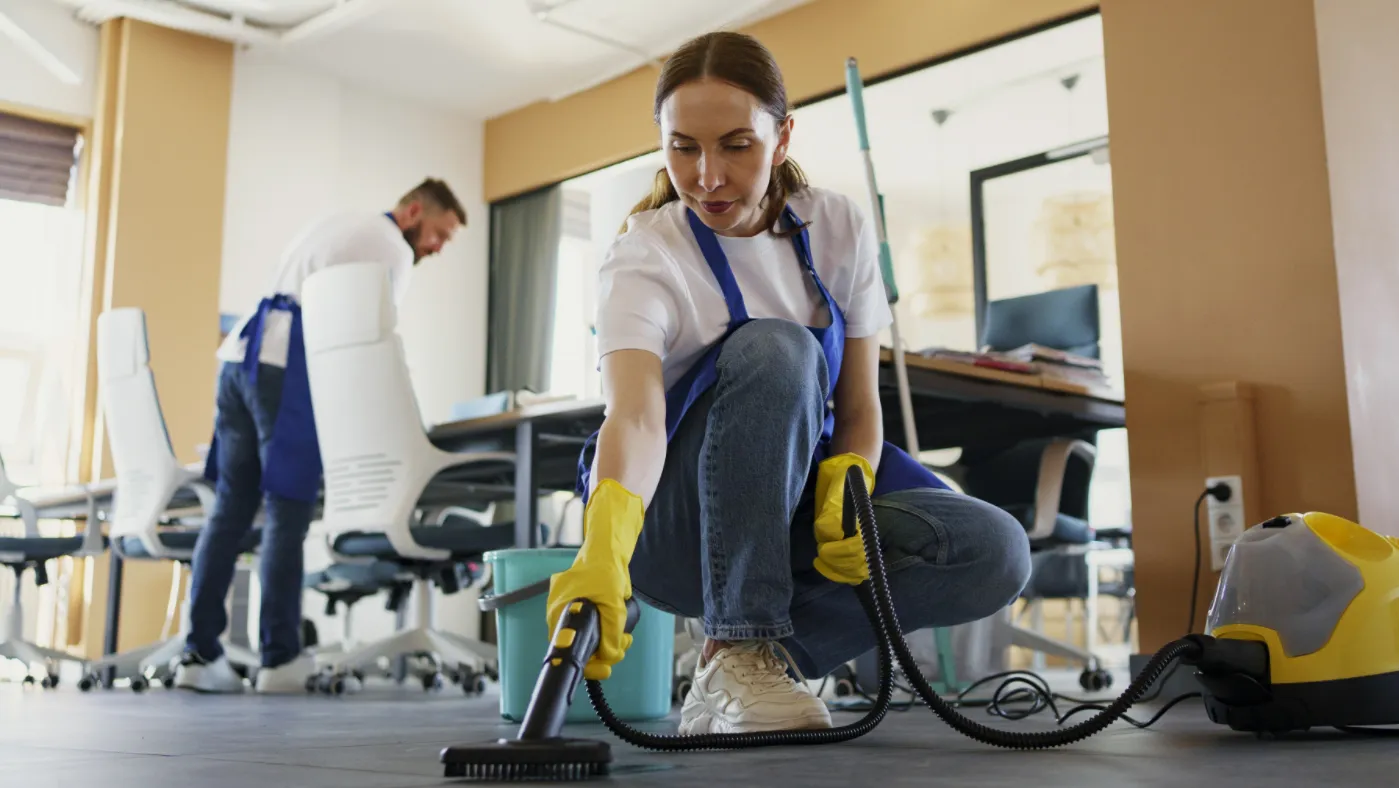
Offices, medical buildings, retail centers, and industrial facilities rely on commercial cleaning services to keep their businesses running smoothly. Whereas residential cleaning has a low-barrier to entry, commercial cleaning requires specialized skills, certifications, and equipment—creating opportunities for more profitable, long-term contracts.
Whether you’re branching out on your own or shifting from residential to commercial work, this guide will walk you through exactly how to start a commercial cleaning business. We’ll cover licensing, budgeting, pricing, and marketing your company, plus show how tools like Housecall Pro help manage scheduling, invoicing, and growth.
Key takeaways
Here’s what to keep in mind as you plan your commercial cleaning business:
Start with training and certification: Build a solid foundation so you’re ready for commercial‑grade safety standards, chemicals, and workflows.
Create a focused business plan: Use it to guide your pricing, services, and long-term goals instead of guessing as you go.
Budget for startup costs: Prepare for equipment, insurance, marketing, and early operations.
Prioritize marketing: Make it easy for clients to find and vet you both online and off.
Use the right tools: Platforms like Housecall Pro help organize scheduling, contracts, and payments in one place as your client list grows.
Commercial cleaning business startup steps
Starting a commercial cleaning company can feel overwhelming when you’re staring at a long list of to‑dos. This checklist breaks the process into clear steps so you can move forward confidently.
- Step 1: Build your commercial cleaning skills
- Step 2: Create a commercial cleaning business plan
- Step 3: Register and license your commercial cleaning business
- Step 4: Budget startup costs
- Step 5: Get commercial cleaning business insurance and bonding
- Step 6: Buy commercial cleaning tools and equipment
- Step 7: Price your commercial cleaning services
- Step 8: Market your commercial cleaning business
- Step 9: Grow your commercial cleaning business
Step 1: Build your commercial cleaning skills
Commercial cleaning involves specialized techniques, safety standards, and processes far more detailed than residential work. Before taking on clients, get hands-on training and industry knowledge. This will prepare you for bigger job sites, stricter client expectations, and more complex jobs.
Here are some training options to consider as you get started:
- Trade school programs: Structured instruction in sanitation practices, chemical handling, Occupational Safety and Health Administration (OSHA) standards, and commercial equipment use.
- Apprenticeships: Hands-on learning under experienced cleaners or janitorial companies on real job sites.
- Combined approach: Classroom training plus field experience, so you build both technical and practical skills.
Certification vs. licensing
Certification and licensing both matter, but they serve different purposes:
- A certification is usually voluntary and focuses on demonstrating your competence. It signals that you follow industry standards and have completed training or passed an exam. Holding certifications can help you stand out, win contracts, and add credibility, especially with larger clients.
- A license is issued by your state, city, or county and grants you legal permission to operate your business. Licensing requirements vary by location, so you’ll need to confirm what’s required where you plan to work.
We’ll revisit licenses and permits later in this guide, but it’s smart to keep both in mind so you don’t skip any legal steps.
Why certification matters
Commercial cleaning certifications like the Cleaning Industry Management Standard (CIMS) validate your expertise and reassure property managers and facility directors. These programs often include coursework, an assessment, and periodic continuing education requirements. These requirements keep your skills current as your business grows.
Step 2: Create a commercial cleaning business plan
A business plan is your roadmap for decisions, budgeting, and long‑term direction. You’ll refer to it as you launch, refine your services, and decide when to hire or invest in new equipment.
Your business plan should include:
- Executive summary: A brief overview of your business, mission, and goals.
- Company description: Details about your commercial cleaning services, target market, and business structure.
- Market analysis: Research on your competitors, industry trends, and customer needs.
- Services offered: A clear list of cleaning services you’ll provide and any specialized offerings.
- Marketing and sales strategy: How you’ll attract clients, build relationships, and grow your business.
- Operations plan: Day-to-day procedures, staffing needs, and equipment management.
- Financial plan: Budget, pricing strategy, projected income, and expenses.
- Growth plan: Plans for scaling, expanding into new markets, or adding services over time.
We’ll cover how to get started below. Download our small business plan template to get set up quickly.
Research your market and competitors
Start by mapping out who already serves your area using Google Maps, Yelp, and local business directories. Look at services, customer reviews, response times, and how competitors position themselves.
Note gaps such as industries they don’t cover, limited hours, or missing specialties like medical facility cleaning or floor care. These openings can help you stand out.
Create a commercial cleaning services list
Pick services that match your training, equipment budget, and local market demand. Start with common offerings such as:
- Routine office cleaning
- Janitorial services
- Floor care (stripping, waxing, polishing)
- Carpet cleaning
- Window cleaning
- Restroom sanitation
- Post-construction cleanup
- Commercial disinfection
You can always add more as you grow your client base and bring on more staff.
Set goals
Setting goals keeps your commercial cleaning business moving in the right direction. Short-term goals, like landing your first five clients or generating a set monthly revenue, help you build momentum. Long-term goals could involve adding new service categories, hiring a team, or securing multi‑year contracts.
Use SMART goals—specific, measurable, attainable, relevant, and time-bound—to avoid vague targets and set milestones you can actually track.
Step 3: Register and license your commercial cleaning business
Your commercial cleaning company has to meet local legal requirements before you can take on paid work. The licenses and permits you’ll need depend on your state, county, and city, and the fees can vary widely from one area to the next. Some locations only require a general business license, while others ask for additional permits or registrations (especially if you handle certain chemicals or work in regulated facilities).
Review local guidelines early to avoid paperwork delays. Small business offices, local government sites, and the Small Business Administration (SBA) all publish license and permit checklists you can use as a starting point.
Choose a business structure
Your business structure affects how you’re taxed, how exposed your personal assets are, and how formal your operations need to be.
These are the most common structures:
- Sole proprietorship: The simplest to set up—you’re in full control, but your personal assets are on the line if something goes wrong.
- Limited Liability Company (LLC): Protects your personal assets while keeping taxes flexible. The structure is simpler than a corporation and setup costs are moderate.
- Partnership: Two or more owners share control and responsibility. Liability is similar to a sole proprietorship unless you create a limited liability partnership.
- Corporation: A separate legal entity that offers the strongest liability protection, but comes with more paperwork, stricter rules, and different tax treatment depending on the type.
Most commercial cleaning businesses choose an LLC, but if you’re unsure which route to take, a lawyer or accountant can walk you through your options. You can also check out our guide to paying yourself as a business owner to understand how each structure affects payroll and taxes.
Apply for a business license
Most commercial cleaning businesses need a general business license from their city or county. Start by checking your local government website. You’ll typically apply online through a portal, submit your business details, pay a fee, and renew the license on a regular schedule.
If you serve multiple cities or counties, you may need separate licenses in each.
Pro tip: Store documents digitally in Housecall Pro so you can share them quickly when clients or vendors ask for verification.
Get In Touch: 858-842-5746
Let us earn your trust
On average, Pros increase monthly revenue generated through Housecall Pro by more than 35% after their first year.
See plan options and feature breakdown on our pricing page.
Step 4: Budget startup costs
Commercial cleaning startup costs can add up quickly. Equipment alone can be thousands of dollars, and you’ll also need to factor in a website, marketing, vehicle costs, insurance, and uniforms.
How much does it cost to start a commercial cleaning company?
Total costs depend on your service mix, the size of your coverage area, and the equipment needed. For example, a company specializing in office janitorial work will need fewer machines than a business focused on large retail centers or full-service floor care.
This is a general breakdown of what new commercial cleaning business owners can expect to spend:
- Equipment and supplies ($2,000–$10,000): Depends on whether you purchase industrial vacuums, floor scrubbers, carpet extractors, and commercial-grade chemicals.
- Licensing and permits ($50–$500): Check your state and city or county requirements.
- Insurance ($500–$3,000 annually): Driven by factors like coverage limits, staff size, service types, and claims history.
- Marketing and branding ($300–$3,000): For website setup, logo design, business cards, initial online ads, and printed materials.
- Initial operational expenses ($500–$5,000+): Covers day-to-day costs like transportation, uniforms, cleaning consumables, and minor equipment maintenance.
As you plan your budget, list your must-have items first. Then, decide which purchases can wait until you secure more clients.
Secure business financing
Managing costs out-of-pocket can put pressure on your cash flow, especially when you’re new. Financing gives you breathing room to invest in quality tools and a professional setup from day one.
Here are some common options to consider:
- Government funding: Some states and cities offer small business grants or subsidized loan programs for new companies in service industries.
- SBA loans: SBA loans often come with longer repayment terms and may be more accessible for newer businesses with limited credit history.
- Business lines of credit: These grant you flexible access to funds you can use as needed, then repay as cash comes in.
- Business grants: Local organizations, chambers of commerce, and private foundations sometimes run grant programs that don’t need to be repaid.
Step 5: Get commercial cleaning business insurance and bonding
Insurance is one of the most important protections you can put in place before working in commercial spaces. Cleaning crews often handle chemicals, move equipment through busy areas, and work inside offices filled with valuables. Without the right coverage, a single accident can sink your business.
Most commercial cleaning companies need several types of coverage:
- General liability insurance: Covers third-party injuries or property damage.
- Workers’ compensation: Required if you have employees; covers medical bills and lost wages.
- Commercial auto insurance: Applies to vehicles used to transport equipment, chemicals, and supplies.
- Bonding: Protects against theft or dishonest acts; sometimes required by clients.
Get quotes from multiple providers and compare on price, limits, deductibles, exclusions, and whether each policy meets the requirements of the clients and facilities you plan to serve.
Pro tip: Ask insurance agents to walk through sample claim scenarios to help you understand the practical differences between plans.
Step 6: Buy commercial cleaning tools and equipment
Having the right cleaning equipment is key to delivering safe, consistent, and professional service, especially in commercial spaces where expectations are higher and job scopes are larger.
Common tools and equipment for commercial cleaning companies include:
- Hand tools: Microfiber cloths, scrub brushes, buckets, dustpans and brooms, spray bottles, grout tools, and squeegees for everyday tasks.
- Power tools: Industrial vacuums, floor scrubbers, carpet extractors, buffing machines, and pressure washers for exterior walkways or entrances.
- Safety equipment: Gloves, masks or respirators as needed for the chemicals you use, slip‑resistant footwear, eye protection, wet floor signs, and proper chemical storage containers.
- Vehicles and storage: A reliable cargo van or SUV, interior racks or shelving for organizing supplies, and secure compartments for chemicals so everything stays safe and accessible in transit.
Most new owners spend several thousand dollars on equipment to get fully set up. Industrial vacuums can range from a few hundred dollars to the low thousands, while floor scrubbers can cost as much as $4,400. Specialized tools like carpet extractors or pressure washers increase costs.
Here are some tips to manage and lower your equipment costs:
- Consider buying used or refurbished equipment from reputable resellers.
- Set aside funds for repairs and routine upkeep to keep equipment working well.
- Build relationships with trusted suppliers who carry commercial-grade tools.
Step 7: Price your commercial cleaning services
By the time you reach this step, you should know which services you’ll offer, your basic costs, and the revenue targets you need to hit to stay profitable. Now it’s about choosing the right pricing structure and rates to support your goals. The more intentional you are here, the easier it’ll be to quote jobs and avoid undercharging.
Choose a pricing model
Your pricing model determines how you charge clients and how predictable your income will be. Different models work better for different job types, so it’s common to use more than one:
- Hourly pricing: Works well for smaller offices or predictable work
- Flat-rate pricing: Best for recurring contracts or projects with a clear scope, like floor care, carpet cleaning, or post-construction cleanup.
- Hybrid pricing: Combines both approaches. For example, charging a flat monthly rate for recurring office cleaning while billing hourly for add-on tasks and deep-cleans. This gives you flexibility while protecting your margins.
Set your rates
Your rates should reflect your real costs plus a healthy profit margin, not just what competitors are charging. Here’s a simple process to follow when pricing commercial cleaning jobs:
- Calculate your base costs: Add up labor, payroll taxes, supplies, transportation, and time spent setting up, managing, and closing out each job. This is your minimum to break even.
- Add your profit margin: Decide how much profit your business needs to stay sustainable, then add a margin that aligns with your long-term financial goals. Most commercial cleaners aim for 15%–25%.
- Research competitor pricing: Check what other commercial cleaners in your area charge by reviewing their websites, calling for quotes, or watching bidding patterns on job boards. This helps you understand local expectations; treat it as a reference, not the only factor.
- Adjust based on service type: Specialized work, like medical office cleanup, floor refinishing, or high-rise window cleaning, typically has higher rates because of the skill, equipment, and risk involved.
Get detailed instructions and see competitive benchmarks in our guide to pricing commercial cleaning jobs.
Pro tip: Housecall Pro’s Job Costing tools can help you calculate rates accurately, ensuring your prices reflect your overhead, time, and desired profit.
Step 8: Market your commercial cleaning business
Marketing helps people find, remember, and pick you over other commercial cleaning businesses. Done well, it keeps work coming in instead of waiting for the phone to ring.
We’ll cover the basics below. Check out our in-depth guide to marketing your cleaning business for more ideas and tips.
Design your brand
Your branding is the first impression clients get, often before they ever talk to you. Keep it clear and consistent so it’s easy to understand who you serve and what you do.
Before finalizing your business name, check domain availability and social media handles to keep everything aligned. Create a simple, clean logo that reflects your niche, whether it’s office cleaning, janitorial services, or eco-friendly commercial care. Use the same colors, fonts, and tone across your website, uniforms, vehicles, and printed materials. Consistency builds recognition and makes your business look organized.
More resources:
- 750+ Cleaning Company Names (and How to Pick One)
- 70+ Cleaning Company Slogans (and How to Write the Perfect One)
Build an online presence
A clean, easy-to-navigate cleaning website is the foundation of your online presence. Include your core services, areas you serve, pricing framework or samples, and a visible contact button on each page.
Next, create or claim your Google Business Profile so you show up in local search results when potential clients search terms like “commercial cleaning services near me.” Add photos, updated hours, and service descriptions that match what’s on your website.
Maintain active social media profiles on platforms like Facebook, Instagram, and LinkedIn, Post client reviews, before-and-after images, and helpful resources to help potential customers feel more confident hiring you.
Pro tip: Use Housecall Pro’s website builder to create a professional site that’s optimized for bookings and local search. Just enter your business details and we’ll handle the rest—it’s that easy.
Use offline marketing strategies
Offline marketing still plays a big role in winning commercial cleaning clients. Flyers and door hangers can work well in office parks, industrial complexes, and retail centers. Direct mail—like introductory postcards to local businesses—also helps you get on the radar of property managers and office tenants who may not be actively searching online.
Networking is just as important. Attend community events and industry meetups where property managers, contractors, and business owners gather. You might even partner with real estate agents or commercial leasing offices that know tenants looking for new service providers. And never underestimate word-of-mouth. Friends, family, and your earliest clients can become strong referral sources.
Pro tip: With Housecall Pro, you can create, send, and track postcards all in one place, making your outreach simple and measurable
Step 9: Grow your commercial cleaning business
Growing your business takes planning, patience, and a clear picture of your numbers. Scale in stages to avoid stretching your time, cash flow, or staff too thin. Start by reviewing profitability:
- Which services bring in the strongest margins?
- Which clients require the most labor?
- Where are you losing time or money?
Once you have a solid base of recurring commercial clients, you can add complementary services like carpet extraction, floor refinishing, or high-dust cleaning. Another option is expanding into new neighborhoods or nearby cities, starting where you already have referrals or local visibility.
Revisit your business plan as you grow. Update goals, forecasts, and staffing needs to stay grounded and scale sustainably.
Hire commercial cleaning employees
If your workload outgrows your own capacity or you start winning multi-day or multi-facility contracts, it’s time to expand your team.
- Write clear job descriptions: Outline responsibilities, hours, pay, and required experience.
- Screen candidates carefully: Conduct interviews and check references thoroughly.
- Verify certifications: Ensure roles that require safety or floor-care certifications are compliant.
Once someone joins your team, onboarding is your chance to set expectations. Provide hands-on training, walkthroughs of each service type, chemical safety guidance, and quality standards. Do regular check-ins, ride-alongs, and refreshers to help your team stay consistent and maintain service quality.
How Housecall Pro’s cleaning business software can help
Housecall Pro is designed to help commercial cleaning business owners manage daily tasks, stay organized, and save valuable time on admin. Scheduling, job details, invoices, and client communication live in one place so you spend less time on spreadsheets and more time on the work that actually grows your business.
Our cleaning software includes:
- Scheduling and client management: Book appointments, send reminders, and manage recurring commercial jobs.
- Pricing and invoicing tools: Use price calculators and templates to set your service rates and send polished invoices quickly.
- Marketing and client acquisition: Request and track online reviews, automate follow-up messages, and organize referrals to turn good experiences into repeat business.
- Operational efficiency: Process payments, complete digital forms, and access job details through the mobile app.
- Growth support: Manage employees, contractors, and multiple locations as your company scales.
Start building your business with the tools that make a real difference. Sign up for a free 14-day trial today.
Frequently asked questions
-
Is a commercial cleaning business profitable?
-
Commercial cleaning can be very profitable, especially once you secure recurring contracts with offices, retail centers, or medical facilities. Profitability depends on your pricing, overhead, and ability to retain clients. Businesses need ongoing maintenance, so it’s a reliable service with predictable demand.
-
How much does it cost to start a commercial cleaning business?
-
Specific startup costs vary by niche and location. Expect to spend at least a few thousand dollars on equipment, supplies, insurance, licensing, website setup, and marketing materials. Larger investments in things like industrial vacuums or floor scrubbers can raise your initial expenses. Building a clear budget helps you stay organized and avoid unexpected financial strain during the launch stage.
-
What equipment is needed to start a commercial cleaning business?
-
Most commercial cleaning companies use a mix of hand tools, power tools, and safety gear. Common items include microfiber cloths, brooms, scrub brushes, industrial vacuums, floor scrubbers, carpet extractors, gloves, masks or respirators as needed, and wet floor signs, along with a reliable vehicle to move everything between job sites. Your exact list should match the services you plan to offer so that you’re not overbuying equipment you don’t need.