Want to win more jobs with less effort?
Grow your business and send quick quotes with our home service software.

Want to see your potential revenue?
See what businesses like yours earn with Housecall Pro in 1 - 2 minutes.
Starting a business from scratch means creating your own pricing, service menu, workflows, and marketing plan. Buying a handyman franchise gives you a head start by providing an established brand, training, and ongoing support.
That can be worth the investment if you want more structure and can afford the upfront costs and other required fees, but your results still depend on how well you run and grow the handyman business. Before signing an agreement, compare the total investment, recurring fees, territory terms, and day-to-day support so you know exactly what you’re getting
This guide breaks down the costs, benefits, potential drawbacks, and leading handyman franchise options to help you decide.
Quick answer: Is a handyman franchise worth it?
A handyman franchise may be worth it if you want established processes, field training, marketing support, and a protected territory. Across the major brands compared in this guide, initial investments range from about $70,000–$239,000.
The biggest advantage is having a system ready from day one. The biggest drawback is that royalties and required fees reduce what you keep from each job. A franchise is generally a good fit if you want structure, support, and a management-focused business model and are comfortable giving up some control over business decisions.
Table of contents
Should you buy a handyman franchise?
Buying a handyman franchise can make sense if you want to own a business with an established foundation. You’ll still be responsible for running the operation, hiring and managing your team, serving customers, and growing locally, but you’ll start with a recognized brand and proven processes.
A handyman franchise may be a good fit if you:
- Want an established brand. You can start under a name customers may already recognize instead of building brand awareness from scratch.
- Prefer structured training. Franchise systems typically include training on services, sales, processes, and daily operations.
- Value marketing support. You’ll generally have access to established branding, marketing materials, and campaigns, but local marketing will still be your responsibility.
- Have enough startup capital. You’ll need enough cash or financing to cover the initial investment plus operating expenses while you grow your customer base.
- Want ongoing guidance. Many franchisors offer continued training, coaching, or operational support after you open.
Starting independently may be the better choice if you:
- Want complete control. You decide how to price jobs, which services to offer, what tools to use, and how to run the business.
- Already have a customer base. Existing referrals and repeat customers can make an established franchise brand less valuable to you.
- Want to avoid royalty payments. As an independent owner, you won’t owe an ongoing percentage or fee to a franchisor.
- Prefer building your own brand. You can create a business identity that’s entirely yours and adjust it as the company grows.
Both options require consistent work to build a successful handyman business. Your choice comes down to how much structure you want and how much control you’re comfortable giving up.
Read more: How to start a handyman business (step-by-step guide)
What does a handyman franchise really cost?
Among the handyman franchises reviewed for this guide, estimated startup costs range from $70,000–$239,000. For example, TruBlue lists an estimated initial investment of $70,050–$96,400 in its 2026 Franchise Disclosure Document (FDD), while Handyman Connection lists an estimated initial investment of $115,837–$238,736.
The franchise fee is only part of that investment. You might also need money for a vehicle, tools, insurance, licenses, marketing, technology, and daily expenses while you build up your customer base. Once you’re up and running, ongoing royalties and marketing fees become part of your overhead, too.
Handyman franchise costs to budget for
An FDD breaks down what you can expect to spend before and after opening. When comparing handyman franchise costs, look at the total investment, not just the franchise fee.
| Cost | What it covers | What to compare between brands |
| Franchise fee | Your initial right to operate under the brand | Fee amount, payment timing, and available discounts |
| Vehicle | A service vehicle and required branding | Vehicle requirements and whether a vehicle you already own qualifies |
| Equipment and inventory | Tools, safety equipment, materials, and opening supplies | Required purchases and approved suppliers |
| Insurance | Required business, vehicle, workers’ comp, and other insurance | Minimum coverage requirements |
| Licensing | State and local licenses, permits, or registrations | Requirements for your area |
| Working capital | Cash reserve for payroll, bills, and startup expenses | How much the franchisor recommends and how many months it covers |
| Technology and software | Required systems for scheduling, CRM, and daily operations | Setup costs and recurring technology fees |
| Marketing | Local ads, grand-opening promotions, and brand marketing | Required local spending and recurring marketing fees |
| Royalties | Ongoing payments for using the franchise brand and operating system | Percentage-based or flat fees and any minimum payments |
Take a close look at royalties and other ongoing fees because you’ll keep paying them after the business opens. For example, TruBlue charges a 6% royalty on gross revenue. Handyman Connection also charges a 6% royalty, plus a 2% contribution to its brand development fund.
Pay attention to what’s included in the initial investment, too. A franchise with a lower starting price may require you to spend more separately on a vehicle, equipment, marketing, or working capital. Review the FDD line by line so you have a realistic startup budget.
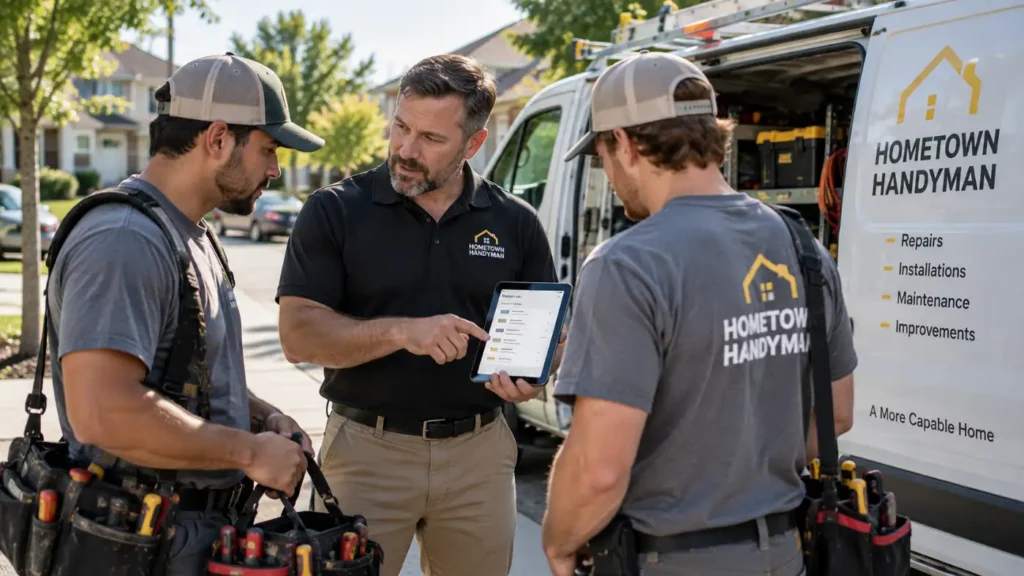
Example of a handyman franchise startup
Let’s look at Ace Handyman Services as an example. Its current FDD estimates a total initial investment of $131,497–$223,597, including expenses during the first three months of operation. Here’s what that breakdown looks like:
| Expense | Ace Handyman Services estimate |
| Initial franchise fee | $70,000–$100,000 |
| Travel and living expenses during training | $3,000–$4,500 |
| Lease deposit | $1,000–$3,000 |
| Rent for the first three months | $3,500–$4,800 |
| Leasehold improvements and signage | $600–$4,000 |
| Furnishings | $600–$4,000 |
| Tools and equipment | $0–$2,500 |
| Truck or van | $0–$9,000 |
| Computer hardware and office equipment | $2,500–$5,500 |
| Software and internet fees (three months) | $1,797 |
| Initial marketing spend | $9,000–$16,000 |
| Utility deposits and fees | $500–$1,000 |
| Licenses and permits | $1,000–$5,000 |
| Insurance | $5,500–$7,000 |
| Professional fees | $500–$6,000 |
| Miscellaneous opening costs | $2,000–$4,500 |
| Additional funds (three months) | $30,000–$45,000 |
| Total estimated initial investment | $131,497–$223,597 |
This example shows how quickly costs can add up beyond the franchise fee. Ace recommends setting aside an additional $30,000–$45,000 for the first three months, in addition to expenses such as marketing, insurance, software, and a vehicle. That extra cash can help cover bills while you fill the schedule and build steady revenue.
Learn more: How to write a handyman business plan (free template)
How to compare handyman franchises
The lowest startup cost isn’t always the best value. Before you compare price tags, look at what each franchise includes, what you’ll keep paying after you open, and how much say you’ll have in running the business.
As you compare handyman franchise opportunities, pay attention to:
- Brand recognition: A familiar name can give you a head start with customers, but what matters is how well-known the brand is in the area where you plan to operate.
- Initial investment: Compare the full investment in the Franchise Disclosure Document (FDD), including working capital, equipment, vehicles, and opening marketing. The franchise fee only tells you part of what you’ll need to get started.
- Royalty structure: Check how royalties are calculated, when they’re due, and whether there’s a minimum payment. Percentage-based royalties grow along with your sales, so consider what those fees could look like as the business gets busier.
- Marketing support: Find out what your required marketing fees actually pay for and what you’ll still handle locally. Ask about lead generation, advertising materials, website support, and minimum local marketing spending.
- Training: Look at what the initial training covers, how long it lasts, and what help is available after you open. Ongoing coaching can be particularly useful if this is your first time running a home service business.
- Territory protection: Find out exactly where you can operate and what happens near the edges of your territory. The FDD should explain whether another franchisee or company-owned location can operate nearby.
- Required software: Check which systems you have to use, how much they cost, and what they help you manage. Scheduling, estimates, invoicing, payments, and customer communication will be part of your day-to-day workload.
- Franchisee satisfaction: Talk to current and former owners before you sign. Ask what surprised them about the costs, how helpful the support has been, and what they wish they’d known before opening.
- Growth and exit options: If you eventually want to expand into multiple territories, find out whether the franchise allows it and what an additional territory would cost. Check the rules for selling or transferring the business, too, so you know what your options are if plans change.
Best handyman franchise opportunities
There’s no single best handyman franchise for every owner. The right fit depends on your budget, the services you want to offer, your desired level of support, and how involved you want to be in daily operations.
Here’s how seven leading handyman franchise opportunities compare. Investment figures represent the estimated initial investment, not the amount you’re guaranteed to spend:
| Franchise | Initial investment | Franchise fee | Royalty | Best fit |
| TruBlue | $70,050–$96,400 ¹ | $49,900 ¹ | 6% ² | Lower startup investment and recurring home maintenance |
| HandyPro | $69,840–$129,643 ³ | $9,500 plus $39,500 territory fee ⁴ | 6% ³ | Handyman work plus accessibility and home modifications |
| House Doctors | $119,850–$191,000 ⁵ | $65,000 ⁵ | 6% ⁵ | Owners seeking broad home improvement services and central support |
| PatchMaster | $122,950–$157,950 ⁶ | $54,500 ⁶ | 5% to 9% ⁶ | Owners who prefer a specialized drywall repair model |
| Ace Handyman Services | $131,497–$223,597 ⁷ | $70,000–$100,000 ⁷ | 6% ⁷ | Owners who value a widely recognized home improvement brand |
| Mr. Handyman | $161,900–$215,000 ⁸ | $67,000 ⁸ | 7% ⁸ | Owners who want an established, management-focused handyman model |
| Handyman Connection | $115,837–$238,736 ⁹ | $71,000 ⁹ | 6% ⁹ | Owners who want extensive launch training and a broad service model |
2. TruBlue – Franchise Opportunity FAQs, 2026
3. US Entrepreneur – HandyPro, 2026
4. Franchise Payback – HandyPro FDD, Costs, & Fees, 2026
5. House Doctors – Franchise Investment, 2026
6. PatchMaster – Buy a PatchMaster Franchise, 2026
7. Ace Handyman Services – Investment, 2026
8. Mr. Handyman – Own a Mr. Handyman® Home Repair Franchise, 2026
9. FranDB – Handyman Connection, 2026
TruBlue: Best for a lower initial investment and recurring maintenance
TruBlue has one of the lowest current startup ranges in this group at $70,050–$96,400, including a $49,900 franchise fee. Franchisees pay a 6% royalty on gross revenue, along with a 2% marketing fee.
Its service mix also differs from that of a traditional handyman business. TruBlue combines on-demand handyman work with senior home safety services and ongoing maintenance plans for seniors and busy homeowners. It may be a good fit if you want to build recurring customer relationships alongside one-time repair work.
Potential drawback: The aging-in-place and ongoing maintenance focus may not fit your goals if you want to focus on remodeling or traditional handyman projects. Franchisees and their technicians also have certification, licensing, and insurance requirements that vary by state.
Ace Handyman Services: Best for established brand recognition
Ace Handyman Services operates under the Ace name and uses a broad handyman model. Its current FDD lists an estimated initial investment of $131,497–$223,597, with a $70,000–$100,000 franchise fee and an ongoing 6% royalty.
The model is built around managing a team instead of completing every repair yourself. Owners hire craftspeople to do the work while they oversee scheduling, customer communication, sales, and other operations.
Potential drawback: It’s one of the more expensive options in this group. In addition to the royalty, franchisees contribute 2% of gross revenue to the National Brand Fund and are subject to ongoing local marketing requirements.
Mr. Handyman: Best for a management-focused business model
Mr. Handyman is another option for owners who want to run the business rather than spend their days doing the repair work. Current 2026 data from Neighborly puts the estimated startup investment at $161,900–$215,000, with a $67,000 initial franchise fee and a 7% royalty on gross sales.
As part of the Neighborly network, franchisees get access to training, franchise coaching, marketing resources, vendor relationships, and opportunities to expand into additional territories. The company serves both residential and commercial customers, which gives you a broader pool of potential work.
Potential drawback: The 7% royalty is higher than the standard royalty disclosed by other franchises in this comparison. Mr. Handyman also has local marketing spending requirements, so the ongoing cost goes beyond the royalty alone.
Handyman Connection: Best for a structured launch and training program
Handyman Connection estimates opening costs of $115,837–$238,736, including a $71,000 franchise fee. Its ongoing royalty is 6% of gross sales, with another 2% going toward its brand development fund.⁹
New owners get five weeks of pre-opening training through webinars and conference calls, followed by five days of in-person training and support in their territory. This structure can help if you have management or sales experience but are new to running a handyman company.
Potential drawback: The upper end of the initial investment is the highest among the current figures in this comparison. Owners also need to budget for technology and substantial opening marketing expenses in addition to the franchise fee.
House Doctors: Best for broad home improvement services and centralized support
House Doctors covers a wide range of work, from everyday repairs and maintenance to remodeling, painting, commercial services, and aging-in-place projects. Its current investment range is $119,850–$191,000, including a $65,000 franchise fee, and the ongoing royalty is 6%.
One of the model’s key features is centralized customer service. House Doctors says its team can handle customer calls and appointment scheduling, giving franchise owners more time to manage their teams and grow locally. Franchisees also get virtual, in-person, and field training.
Potential drawback: Support comes with additional ongoing costs. In addition to the 6% royalty, House Doctors lists marketing and contact center fees, so prospective owners should look beyond the royalty when comparing recurring expenses.
HandyPro: Best for accessibility and home modification services
HandyPro combines general handyman work with home modifications designed to help older adults and people with disabilities stay safely in their homes. The latest detailed public figures available list an estimated investment of $69,840–$129,643 and a 6% royalty.
The company uses an executive model, so you don’t need a construction background to become an owner. HandyPro provides business training, while craftspeople perform the work. Its accessibility focus can also create opportunities for projects such as grab bars, wheelchair ramps, and other home modifications.
Potential drawback: HandyPro’s focus on accessibility and home modifications may be less appealing if you’d prefer your business to focus on general repair and remodeling work. The specialized service mix can be a strength, but it may not match the type of handyman business every owner wants to run.
PatchMaster: Best for a specialized repair business
PatchMaster is the most specialized franchise on this list. Rather than offering a full handyman service menu, the company focuses on drywall and other wall-surface repairs for residential and commercial customers.
Its 2026 FDD data lists an estimated initial investment of $122,950–$157,950 and a $54,500 franchise fee. PatchMaster also provides training and ongoing support for owners entering the drywall repair niche.
Potential drawback: Specialization cuts both ways. A narrower service menu can make the business easier to define and market, but you won’t have the same range of potential jobs as full-service handyman franchises. If you want to cover everything from furniture assembly to remodeling, a broader franchise may fit your goals better.
Read more: How to market a handyman business (11 strategies)
Get In Touch: 858-842-5746
Let us earn your trust
On average, Pros increase monthly revenue generated through Housecall Pro by more than 35% after their first year.
See plan options and feature breakdown on our pricing page.
Handyman franchise vs. starting your own business
A franchise gives you a business model and support from day one. Going independent gives you more control over how you run and grow the company. Here’s how the options compare.
| Factor | Franchise | Independent business |
| Startup costs | About $70,000–$239,000 among the franchises compared in this guide | $2,000–$10,000+ |
| Brand recognition | Established franchise brand | Build your own local brand |
| Marketing | Brand support plus required marketing contributions | Set your own budget and marketing strategy |
| Operational freedom | Follow franchise standards | Set your own pricing, services, vendors, and processes |
| Royalties | Typically 6%–7% among the brands compared here | No franchise royalties |
| Profit potential | Operating profit after expenses and franchise fees | Operating profit after business expenses |
| Scalability | Add territories under franchise terms | Expand without franchise territory fees |
| Support | Initial training and ongoing franchise support | Build your own systems and support network |
Typical costs and business considerations for U.S. handyman franchises vs. independent handyman businesses, 2026.
What to know before buying a handyman franchise
Buying into an established system can give you a head start, but you’re still running a local business. Consider these practical realities before you sign a franchise agreement:
- Royalties reduce your profit. A 6% royalty means $6 of every $100 in gross revenue goes to the franchisor before you account for payroll, materials, insurance, and other operating costs.
- You’ll still need to market your business. National campaigns and ready-made materials can help, but you’ll still need to earn local reviews, generate referrals, and build a strong presence in your community.
- Building a reliable team is your responsibility. A franchisor may provide recruiting resources or hiring guidance, but you’ll be responsible for finding the people who actually serve customers and keep jobs moving. Tools like an AI Recruiter can help screen and schedule candidate interviews at scale, which is useful if you’re hiring craftspeople faster than you can personally vet them.
- Your local reputation still matters. A recognizable name may help you get noticed, but the quality of your work, customer service, and reviews will determine whether people call again or recommend you.
- Franchise standards may limit your flexibility. Depending on the franchise agreement, you may have requirements for pricing, vendors, technology, branding, marketing, or the services you offer.
- Strong day-to-day operations have a bigger role in long-term success than branding alone. You still have to keep the schedule full, control costs, manage your team, collect payments, and know which jobs are actually making money.
How to run a successful handyman franchise
Buying a franchise gives you a blueprint to start with, but you still have to keep the day-to-day business running. As you add jobs and technicians, handyman business software can help you manage the moving pieces without relying on separate calendars, spreadsheets, and customer records.
When schedules change, Dispatching helps you see where technicians are headed and reassign jobs as needed. For recurring customers, Service Plans keep membership details and future visits organized, while automated maintenance reminders help your team stay ahead of upcoming work.
Giving customers a clear price is easier when your team can build and send Estimates from the field. For larger jobs, Consumer Financing gives eligible customers another way to pay, and Payments helps you collect payment as soon as the work is complete.
As your business grows, Reporting helps you track sales, jobs, and other performance data in one place. If you manage multiple territories, standard processes for scheduling, estimates, payments, and reporting can help you deliver a consistent experience as you expand.
See how Housecall Pro can help you run and grow your franchise. Start your free 14-day trial today.
Read more: AI in franchising: How to stay competitive
FAQs
Are handyman franchises profitable?
Handyman franchises can be profitable, but profitability depends on your sales, labor and material costs, overhead, and franchise fees. For example, a 7% royalty send the first $7 from every $100 you earn to the franchisor before you factor in payroll, insurance, materials, and other operating costs.
Which handyman franchise has the lowest startup cost?
HandyPro has the lowest minimum startup cost among the franchises compared here, with an estimated initial investment of $69,840–$129,643. TruBlue is close behind at $70,050–$96,400 and has a considerably lower upper-end estimate.
Can you own multiple territories?
Yes, some handyman franchises allow you to own multiple territories, but the rules and costs vary by franchisor. Mr. Handyman, for example, offers opportunities to expand into additional territories. Check the current FDD for territory availability, additional fees, and eligibility requirements.
How long does it take to break even?
The time it takes to break even as a handyman franchise varies depending on your initial investment, monthly expenses, sales, and profit margins. For example, if you invest $150,000 to open, the business needs to generate $150,000 in cumulative profit before you recover that initial investment. Franchises with lower franchise fees and royalty rates, or ones you can run without a full crew from day one, generally have a shorter runway to that break-even point than higher-investment, higher-royalty models.
Do I need handyman experience?
You may not need handyman experience to own a handyman franchise. Brands such as Ace Handyman Services, Mr. Handyman, and HandyPro use management-focused models where the owner runs the business and hires skilled craftspeople to perform the work. However, training and experience requirements vary by franchise.
Is buying a franchise better than starting my own business?
Buying a franchise can be better than starting your own business if you value an established brand, training, operating systems, and ongoing support. Starting your own handyman business may be a better fit if you want complete control over pricing, services, marketing, and operations, and want to avoid ongoing franchise royalties.
Can you get a loan to buy a handyman franchise?
Yes. Most buyers cover part of the cost with personal savings and finance the rest, and the SBA 7(a) loan program is the option the International Franchise Association points new owners toward most often for franchise purchases. Many handyman franchises are listed on the SBA’s Franchise Directory, which can speed up loan approval. Check with each franchisor directly to confirm they’re listed and see what financing partners they work with.
Do you need a contractor's license to run a handyman franchise?
It depends on your state and the size of the job—thresholds vary widely. California exempts work under $1,000 in combined labor and materials from its contractor’s license requirement, while Florida’s threshold is $2,500, and states like Washington require registration for any paid handyman work regardless of job size. Check your state’s contractor licensing board, and see Housecall Pro’s guide to handyman business licenses for state-by-state requirements, before you sign a franchise agreement.
How much do handyman franchise owners actually make?
It varies significantly by brand, territory, and how well the business is run, and franchisors aren’t required to disclose average earnings. When a franchisor does share financial performance data, it’s called Item 19 of the Franchise Disclosure Document (FDD), and as of a 2024 industry survey, 86% of franchisors now include this disclosure. Ask each franchisor whether their FDD contains an Item 19 section, and if so, request the full disclosure, including how many units the average is based on, before relying on any earnings figure.