Want to win more jobs with less effort?
Grow your business and send quick quotes with our home service software.

Want to see your potential revenue?
See what businesses like yours earn with Housecall Pro in 1 - 2 minutes.
Pricing commercial cleaning jobs requires more than picking a per-square-foot rate. To price work profitably, you need to account for labor, supplies, overhead, frequency, building type, and local market conditions. This guide breaks down average commercial cleaning rates in 2026, when to use hourly versus square-foot pricing, and how to build quotes that protect your margins as your business grows.
Quick answer: How much should you charge for commercial cleaning?
Commercial cleaning prices usually range from $0.07 to $0.20 per square foot for standard recurring office cleaning, while hourly rates often fall between $30 and $75 per hour, depending on the job scope, building type, and local labor costs (see methodology). One-time deep cleans, post-construction cleanups, and medical, restaurant, and industrial cleanings often cost more because they take more labor, more supplies, and more specialized work.
Most commercial cleaning businesses use one of three pricing models: per-square-foot, hourly, or flat-rate contract pricing. Per-square-foot pricing works best for recurring jobs with a predictable scope. Hourly pricing makes more sense for one-time cleanings, irregular work, or buildings where the condition can change from visit to visit. Flat-rate pricing usually works best once you know your production rates and can confidently estimate labor time.
How we sourced commercial cleaning pricing data
All price ranges in this guide reflect 2026 averages from Thumbtack, HomeGuide, and Angi, using thousands of self-reported rates from cleaning professionals and customers across the U.S. Actual rates vary by:
- Market labor rates
- Facility type and size
- Cleaning frequency
- Region
These are average market estimates, not regulated benchmarks. Use them as a starting point, then adjust based on your local labor costs, overhead, and competition.
Key takeaways
Here's what to know to price commercial cleaning jobs profitably:
Know your rates: Most commercial cleaning jobs fall between $0.07–$0.25 per square foot or $30–$75 per hour, depending on facility type and local labor costs.
Account for labor: Labor makes up roughly 50%–80% of total job costs, so efficiency matters.
Adjust by space type: Commercial cleaning companies charge more for medical, industrial, and post-construction jobs due to safety and sanitization requirements.
Offer add-ons: Carpet cleaning, window washing, and disinfection increase average job value without requiring you to reprice your core contract.
Quote consistently: Standardizing your estimates reduces underbidding and helps convert quotes into scheduled jobs faster.
Table of contents
- Average commercial cleaning rates in 2026
- Commercial cleaning rates by business type
- How location affects commercial cleaning rates
- Additional commercial cleaning cost considerations
- Commercial cleaning price list
- Commercial cleaning pricing models
- How to price commercial cleaning jobs
- Step 1: Calculate your baseline costs
- Step 2: Estimate cleaning time
- Step 3: Research local commercial cleaning rates
- Step 4: Choose your primary pricing model
- Step 5: Add a profit margin
- Step 6: Set minimum charges and service thresholds
- Step 7: Use add-ons to adjust for job complexity
- Step 8: Review and update pricing regularly
- Example commercial cleaning price calculations
- Pricing multi-location accounts
- How to write a commercial cleaning quote
- What to do when a client asks for a lower price
- How Housecall Pro’s cleaning software can help
Average commercial cleaning rates in 2026
Commercial cleaning rates fall within a fairly wide range because pricing varies by building type, the level of cleaning required, and how often the work is performed. Standard recurring office cleaning typically runs between $0.07 and $0.20 per square foot, while hourly rates range from $30 to $75.
Commercial cleaning rates by business type
Two buildings of the same size can take very different amounts of time to clean, depending on foot traffic, layout, restrooms, break rooms, flooring, and sanitation requirements. A standard office usually has a more predictable routine, while restaurants, medical offices, and industrial facilities often require more labor, more frequent touchpoint cleaning, or more specialized products and procedures.
The table below shows average pricing by building type. These prices reflect estimated cost per standard cleaning visit for recurring service, based on 2026 market averages.
| Building Type | Average Price per Square Foot | Typical Services |
| Office | $0.07–$0.20 | Vacuuming, dusting, trash removal |
| Medical | $0.12–$0.30 | Sanitization, disinfecting, compliance cleaning |
| Retail | $0.08–$0.18 | Floor care, high-traffic area cleaning |
| Industrial | $0.10–$0.20 | Floor maintenance, equipment cleaning |
| Post-construction | $0.15–$0.30 | Debris removal, deep cleaning, detailing |
Use these prices as starting points, then adjust for labor time, frequency, access, and the condition of the space. A 3,000-square-foot office cleaned three times a week will not price the same way as a 3,000-square-foot medical suite, restaurant, or post-construction cleanup, even if the square footage is identical.
How location affects commercial cleaning rates
Where you operate can have one of the biggest impacts on what you need to charge. Local wages, cost of living, and demand for cleaning services can vary widely by market, which directly affects your labor costs and the rates customers are used to paying.
According to Bureau of Labor Statistics wage data for building cleaning workers (SOC 37-2019, 2025), hourly pay ranges from $15.56 to $30.78 nationally, with a median of $21.17 per hour. Use your state’s wage range as a starting point, then factor in payroll taxes, workers’ compensation, benefits, and other labor-related expenses to determine the minimum you need to charge.
| Region | Low | Typical (avg. of state medians) | High |
| National | $15.56 | $21.17 | $30.78 |
| Northeast | $15.49 | $29.23 | $50.40 |
| Midwest | $12.46 | $22.48 | $37.91 |
| West | $11.37 | $21.15 | $31.25 |
| South | $9.73 | $19.16 | $30.38 |
What this means for your pricing
- Start with local labor costs. Check your state’s wage data before looking at competitor pricing. If you pay cleaners around or above the state median, make sure your rates can comfortably cover those wages.
- Account for differences within your market. Wage ranges can vary by $10–$20 per hour or more depending on the location and type of work. Consider separate pricing tiers for metro and rural jobs, standard office cleaning, specialty work, or other higher-cost services.
- Build your rate around your business costs. Local wage data shows what workers are earning in your market. Your actual labor costs, overhead, and target profit margin determine what you need to charge customers.
Additional commercial cleaning cost considerations
Keep these additional factors in mind when setting your final price:
- Labor costs: Wages are the largest expense, often accounting for 50%–80% of the total job cost, according to industry benchmarks from the Building Service Contractors Association International (BSCAI).
- Cleaning frequency: Nightly contracts price differently from weekly or monthly service.
- Type of facility: Medical, food service, and industrial spaces require stricter protocols.
- Time of service: Daytime cleaning usually costs more than overnight service, sometimes considerably more, since it requires more coordination around occupied space and limits crew flexibility.
- Square footage and layout: Open offices are faster to clean than segmented layouts.
- Supplies and equipment: Green products or specialty equipment increase costs.
- Travel and routing: Multi-location contracts benefit from route density.
- Insurance and bonding: Core coverage—general liability and a janitorial bond—usually runs about $700 per year for a small commercial cleaning business. Spread that cost across your billable hours and build it into your overhead. It’s not something you want to eat out of your profit.
Commercial cleaning price list
The table below covers common commercial cleaning services and their typical 2026 price ranges. Use it as a reference when building quotes or setting your service menu.
| Service | Typical price range |
| General office cleaning | $0.07–$0.20 per sq. ft. |
| Commercial cleaning | $30–$75 per hour |
| Medical office cleaning | $0.12–$0.30 per sq. ft. |
| Retail cleaning | $0.08–$0.18 per sq. ft. |
| Industrial cleaning | $0.10–$0.20 per sq. ft. |
| Post-construction cleaning | $0.15–$0.30 per sq. ft. |
| Floor stripping and waxing | $0.30–$0.80 per sq. ft. |
| Carpet cleaning | $0.08–$0.40 per sq. ft. |
| Window cleaning | $2–$7 per pane |
| Restroom sanitizing add-on | $25–$75+ per visit |
| Trash removal and liner restock | Often included or itemized |
Standard services include:
- Dusting, vacuuming, and mopping
- Trash removal
- Restroom cleaning
- Surface disinfecting
- Common areas and high-touch areas
Add-on services include:
- Floor stripping and waxing
- Carpet cleaning
- Window cleaning
- Restroom sanitizing
- Day porter coverage
- Disinfection services
- Pressure washing
Commercial carpet cleaning price
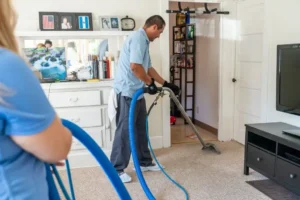
Carpet cleaning is one of the most common add-on or specialty services for commercial clients, but pricing depends heavily on the space’s size and the level of buildup. Smaller offices might only need light extraction, while large retail or medical facilities require deep cleaning, stain removal, or protective treatments that take longer and use more material.
- Hourly: $30–$50
- Flat rate: $75–$200 per room
- Per square foot: $0.15–$0.30
Deep extraction or the use of eco-certified solutions typically raises costs. Offer these services as optional upgrades or include them in tiered cleaning packages for high-traffic facilities.
Get In Touch: 858-842-5746
Let us earn your trust
On average, Pros increase monthly revenue generated through Housecall Pro by 35% after their first year.
See plan options and feature breakdown on our pricing page.
Commercial cleaning pricing models
Most commercial cleaning businesses rely on one of three pricing strategies: per-square-foot, hourly, or flat-rate contract pricing. Some also use a hybrid approach, where recurring cleaning is priced one way and specialty tasks are billed separately.
Square foot prices for commercial cleaning
Per-square-foot pricing is one of the most common ways to price commercial cleaning jobs. For standard recurring cleaning, many commercial cleaners charge about $0.07 to $0.20 per square foot, but the right rate depends on how long the space takes to clean, how often it’s serviced, and what kind of facility you’re working in.
Best for:
- Recurring office cleaning: Weekly or nightly service with a stable scope
- Retail spaces: Jobs with predictable floor care and restroom cleaning needs
- Multi-tenant common areas: Hallways, lobbies, and shared restrooms
- Routine janitorial contracts: Spaces with repeatable tasks and steady traffic patterns
Why it works:
- Easy to explain
- Fast to quote
- Consistent for repeatable work
Watchouts:
- Specialty buildings need adjustments
- Restrooms, kitchens, and high-touch spaces take longer
- Access issues and after-hours work can skew labor
Hourly prices for commercial cleaning
Hourly pricing is usually the better fit when the scope is less predictable. Most commercial cleaners charge $30 to $75 per hour, with specialty and after-hours work pushing higher.
Best for:
- Deep cleans
- First-time cleans
- Post-construction cleaning
- Jobs with unclear scope
Why it works:
- Protects you from underbidding
- Easier to use when labor time is uncertain
- Works well for variable-condition jobs
Watchouts:
- Needs clear communication
- Customers may want tighter expectations up front
- You should define what is and isn’t included
Pro tip: Compare the hours included in your estimate with the time your crew actually spends on the job. That helps you identify underpriced accounts and improve future labor estimates. If you’re not sure whether actual hours match what you quoted, Housecall Pro’s time-tracking tools record hours across your whole crew automatically.
Flat-rate pricing for commercial cleaning
Flat-rate pricing works well for recurring commercial accounts once you understand the labor and scope involved. Instead of charging by the hour or by the square foot every time, you quote a set amount per visit or per month based on the expected work.
Best for:
- Weekly office cleaning
- Ongoing janitorial contracts
- Accounts with stable scope
Why it works:
- Easy for customers to budget
- Speeds up approvals
- Makes recurring pricing more predictable
Watchouts:
- Only works well when labor is well understood
- Scope creep can hurt margins if extras aren’t itemized
- Add-ons should stay separate
Hybrid pricing
Some jobs are easiest to price with a hybrid approach. For example, you might charge a flat, recurring rate for routine janitorial services, then charge for floor care, carpet cleaning, window cleaning, or disinfection as separate add-ons. That keeps the base contract simple without burying extra labor inside the standard rate.
Pro tip: Store your recurring services, specialty add-ons, and package prices in a shared price book so everyone quotes from the same approved numbers. If your team is quoting from different spreadsheets, Housecall Pro’s Price Book keeps everyone pulling from the same approved services and prices.
Other common pricing models
Beyond hourly, flat-rate, and square-foot methods, many commercial cleaners use flexible models that better fit specialty services or long-term contracts.
Task-based pricing
Task-based pricing charges for individual cleaning units, such as windows, restrooms, workstations, or floor zones. This model works well for specialized jobs or clients who want itemized invoices. For example, you might quote $40 per restroom, $5 per interior window, and $75 for a breakroom instead of applying one rate to the entire building.
Contract pricing
Contract pricing gives the customer a fixed monthly or quarterly rate for an agreed-upon scope and service schedule. For example, a client might pay $1,200 per month for cleaning three times per week, with floor care, window cleaning, and other specialty services billed separately. Clearly define service frequency, included tasks, supply responsibilities, and additional charges in the contract.
Tiered pricing
Tiered pricing packages services into Basic, Standard, and Premium options so customers can compare scope rather than negotiate one price. For example:
- Basic: $600–$750 per month for weekly floors, trash removal, dusting, and surface cleaning
- Standard: $900–$1,150 per month for three visits per week, including restrooms and breakrooms
- Premium: $1,400–$1,800 per month for nightly service, high-touch disinfection, and periodic floor care
These are example package ranges, not market averages. Build each tier from your expected labor, supply, and overhead costs.
Custom pricing
Custom pricing works best for medical facilities, factories, laboratories, post-construction sites, and other spaces with specialized requirements. Build the quote from the actual labor, equipment, training, certification, disposal, and documentation requirements instead of relying on a standard square-foot rate.
How to price commercial cleaning jobs
Pricing commercial cleaning jobs profitably starts with understanding your actual costs and the margin your business needs—not copying a competitor’s rate. “It starts with the margin that we need to survive. Then I go backwards and set the inflation rate,” says Stephen Pajevic, owner of Crystal Clean Green Cleaning. Once you know your minimum required margin, you can build square-foot, hourly, or flat-rate prices that protect it.
Here’s how to approach the process step by step:
Step 1: Calculate your baseline costs
Start by calculating your full cost to complete the job, not just the time spent cleaning.
Factor in:
- Labor
- Payroll taxes and labor burden
- Supplies and consumables
- Equipment costs
- Vehicle and travel costs
- Admin time
- Insurance and overhead
Use these formulas:
Labor cost per job
(Hourly wage × labor burden) × total labor hours
Overhead cost per job
Total monthly overhead ÷ monthly billable hours × (job hours + nonbillable hours)
Break-even job cost
Labor cost per job + overhead cost per job + supply cost
Step 2: Estimate cleaning time
This is the step many businesses skip, and it’s where underpricing usually starts. Build your quote from labor time first, then use square footage or flat-rate pricing as the format that best fits the job.
For example:
- Open office space usually cleans faster than medical exam rooms
- Restrooms take more time per square foot than desks or hallways
- First-time cleans usually take longer than recurring service
- Buildings with heavy traffic or deferred maintenance require more labor
Step 3: Research local commercial cleaning rates
Local benchmarks help you understand what customers expect in your market. To benchmark local rates, request quotes from 2–3 competitors as a potential client, review Thumbtack and Angi listings filtered to your ZIP code, and check local cleaning association rate surveys if available.
Use competitor rates as a reference point, not as a rule. This research is especially helpful when explaining your pricing versus competitors and positioning your value.
Step 4: Choose your primary pricing model
Most commercial cleaning businesses rely on one primary pricing model and then adjust based on job conditions.
Common models include:
- Per-square-foot pricing: Best for recurring work with a stable scope
- Hourly pricing: Best for one-time or unpredictable jobs
- Flat-rate pricing: Best for recurring contracts once the labor is understood
- Hybrid pricing: Best when specialty services need separate line items
Step 5: Add a profit margin
Your prices should cover today’s costs while leaving room for supervision, scheduling changes, higher supply costs, and business growth.
Use this formula:
Break-even cost ÷ (1 − target margin) = target price
Example:
$400 break-even ÷ (1 − 0.30) = $571 target price
Step 6: Set minimum charges and service thresholds
Even small cleaning jobs require travel, setup, and admin time. Minimum charges help short visits stay profitable.
To set a minimum:
- Calculate your average mobilization cost
- Include travel and setup time
- Apply the minimum consistently
Step 7: Use add-ons to adjust for job complexity
Add-ons let you charge for extra work only when it’s needed. That way, you cover labor, supplies, or specialty work without overpricing simpler accounts.
Common commercial cleaning add-ons include:
- Floor care
- Carpet cleaning
- Window cleaning
- Day porter coverage
- Restroom sanitizing
- Post-construction cleanup
- Disinfection services
Always show add-ons as separate line items on your estimate.
Step 8: Review and update pricing regularly
Cleaning costs change over time, especially labor, consumables, and fuel. Review your pricing at least once a year, or sooner if wage pressure, supply prices, or routing costs change in your market.
Example commercial cleaning price calculations
Seeing how pricing breaks down in real scenarios makes it easier to build estimates confidently.
Example 1: Recurring office cleaning
Scope: 5,000 sq. ft. office, cleaned 3 times per week
Pricing model: Per square foot
Estimated labor and overhead cost per visit: $425
Target margin: 30%
Total price:
$425 ÷ (1 − 0.30) = $607 per visit
Effective square-foot rate:
$607 ÷ 5,000 = $0.12 per sq. ft.
Example 2: First-time deep clean
Scope: 4,000 sq. ft. retail space
Pricing model: Hourly
Estimated labor: 12 hours × $55/hour = $660
Supplies and disposal: $90
Break-even cost: $750
Target margin: 25%
Total price:
$750 ÷ (1 − 0.25) = $1,000
Example 3: Medical office account
Scope: 3,500 sq. ft. outpatient clinic, 5 visits per week
Pricing model: Flat-rate contract
Estimated labor, supplies, and overhead per visit: $520
Target margin: 30%
Total price:
$520 ÷ (1 − 0.30) = $743 per visit
Medical pricing usually runs higher because the scope includes more touchpoint cleaning, more detailed restroom work, and stricter cleaning expectations.
Pricing multi-location accounts
Multi-location accounts—clients with two or more buildings under one contract—can be valuable recurring jobs when the numbers work. But pricing them isn’t as simple as multiplying your single-site rate.
Most clients will expect some kind of volume discount (usually 10%–20%), but that only makes sense if the work is actually easier to service. Three buildings next to each other? That’s efficient. Three buildings across town? That’s more drive time, more coordination, and more labor cost. Your pricing should reflect that difference.
Before you offer any discount, map out the locations and look at your real cost per site—including travel time between stops. That’s what tells you whether a discount is worth it.
How to structure your pricing
The simplest way to price multi-location work is a flat rate per site, bundled into one contract with the same scope across every building. It keeps things clean, easy to explain, and easier to renew later.
For anything outside the standard scope—floor work, restocking, post-event cleanups—keep those as add-ons and price them per location. That way you’re not baking extra work into your base rate and cutting into your margins.
If you’re managing multiple sites, staying organized matters just as much as pricing. You need visibility into each location without losing track of the full account, and Housecall Pro’s Job Management tools are built to handle that at scale.
How to write a commercial cleaning quote
Every quote should break down the job’s scope and frequency, plus optional upgrades so the client feels informed rather than surprised.
Start with a walkthrough or video call to confirm the scope before sending the proposal. Then include the following in your written estimate:
Step 1: Job overview and frequency
Summarize the scope of work, location, and cleaning schedule. Make sure the frequency (daily, weekly, monthly, etc.) and duration are clearly stated.
Example: “Nightly cleaning, Monday through Friday, for a 10,000-square-foot office including two restrooms, a breakroom, and high-touch disinfection.”
Step 2: Itemized service list
List out core cleaning tasks as line items so clients can see what’s included. Use simple, descriptive language that matches your service tiers.
Included services:
- Vacuuming, mopping, and dusting
- Trash removal and liner replacement
- Restroom cleaning and disinfection
- Kitchen or breakroom cleaning
- Entryway and lobby maintenance
Optional add-ons:
- Interior glass and window cleaning
- Deep carpet extraction (quarterly)
- Floor waxing and buffing
- Upholstery cleaning
- Pressure washing
Step 3: Pricing summary
Show both total cost and cost structure (hourly, flat rate, or per square foot), along with any discounts or recurring contract rates. Include a note that pricing reflects standard cleaning frequency and supplies, and that specialized services (such as biohazard or post-construction cleanup) may be quoted separately.
Example:
- Nightly cleaning: $0.12 per square foot × 10,000 square feet = $1,200 per week
- Optional add-ons:
- Interior glass cleaning: +$150/month
- Quarterly carpet extraction: +$300/quarter
Step 4: Contract terms and policies
Add notes on cancellation windows, rescheduling, and access procedures. This avoids future misunderstandings.
Example:
“Quotes are valid for 30 days. Pricing assumes standard business-hour access. Additional charges may apply for after-hours service or secure-access areas. Monthly invoicing occurs on the first business day of each month.”
Getting the customer’s approval before work begins can also prevent disagreements after the cleaning is complete. “I’m so grateful to have E-Signatures because I’ve heard some horror stories from other friends in the trades. Nobody wants to start a negotiation after the job is done,” says Gina H. of Helt Heat & Air.
Send the completed quote for electronic approval before scheduling the job. Housecall Pro’s estimate builder handles branded, e-sign quotes in one step, so approval doesn’t stall your schedule. Keep the signed version with the customer record so your office and field teams can refer to the same scope if questions come up later.
Step 5: Branding and professionalism
Every quote should reinforce your brand. Include your company logo, business license number, contact info, and payment methods. Professional formatting gives the impression of an established, reliable business.
Pro tip: Use branded, e-sign quotes that customers can approve and book in one step. It cuts down back-and-forth and helps you close jobs faster. Housecall Pro’s estimate builder handles the whole process in one place.
Step 6: Follow-up and confirmation
Always follow up within 24–48 hours if a client hasn’t responded. A polite check-in often turns a “maybe” into a booked contract. If quotes go cold because nobody followed up, use Housecall Pro to automate your reminders and save time.
Putting it all together
Here’s what a complete quote looks like when all six steps are applied:
Client: Metro Financial Services
Property: 10,000-square-foot office—two restrooms, one breakroom
Frequency: Nightly, Monday–Friday
Included: Dusting, vacuuming, trash removal, restroom cleaning, high-touch disinfection
Add-ons: Interior glass cleaning (+$150/month), quarterly carpet extraction (+$300/quarter)
Rate: $0.12 per sq. ft. = $1,200/week
Contract term: 12-month agreement; billed monthly
Access: After 6 p.m.; building-provided key card
This format keeps everything clear: what’s included, what’s optional, and how much each piece costs. It also gives clients a simple, professional proposal they can sign on the spot.
What to do when a client asks for a lower price
Price pushback is common in commercial cleaning. How you respond determines whether you protect your margins or give them away. The goal is to show value and offer options without lowering your core rate.
Explain your pricing first
When a client says your price is too high, they’re usually asking why. Walk them through what drives the quote: labor time, visit frequency, building type, scope, and insurance coverage. Vetting matters here too. If your crews are background-checked and insured, explain how those added protections factor into the value of your service. Clear breakdowns often resolve the objection without changing the price.
Adjust scope, not your rate
If the client needs a lower total cost, change the scope instead of discounting your rate. You can:
- Reduce cleaning frequency (e.g., 3x/week to 2x/week)
- Remove lower-priority tasks
- Keep add-ons separate instead of bundled
This keeps your base pricing intact while giving the client flexibility.
Offer flexibility through contract terms
If needed, offer a lower rate in exchange for a longer contract. A longer commitment gives you predictable revenue and more efficient scheduling, which can justify the adjustment.
Avoid flat discounts
Discounting without changing scope cuts directly into your margins and sets a lower baseline for future work. It also encourages clients to negotiate every renewal.
If the job doesn’t work after adjusting scope or terms, it’s likely not the right fit—not a sign your pricing is wrong.
How Housecall Pro’s cleaning software can help
Accurate pricing is only one part of running profitable commercial cleaning jobs. You also need consistent quotes, clear job records, and a reliable way to stay organized as your business grows.
Housecall Pro’s cleaning business software brings quoting, scheduling, invoicing, and reporting into one platform so you’re not managing those pieces separately.
A few areas where it makes a measurable difference:
- Profitability tracking: Built-in dashboards show you which clients, service types, and crew members are actually driving margin so you can make better decisions about where to focus.
- Invoicing and payments: Approved estimates convert directly into invoices. Clients can pay by credit card or ACH online, which reduces the back-and-forth that slows down cash flow.
- Recurring contract management: Nightly, weekly, and monthly jobs can be scheduled with automated reminders and full service history, so recurring accounts run without constant manual oversight.
If you’re still quoting jobs by hand or tracking profitability in a spreadsheet, Housecall Pro can help you keep estimates, jobs, payments, and performance in one place. Try it free for 14 days.
FAQ
What factors affect commercial cleaning rates?
The main drivers are facility type, local labor costs, cleaning frequency, building condition, access requirements, and whether the job requires specialty work like disinfection or floor care. Medical, industrial, and post-construction jobs consistently price higher than standard office cleaning due to stricter protocols and longer labor time.
How much should I charge per square foot for commercial cleaning?
Most commercial cleaning jobs fall around $0.07 to $0.25 per square foot, but your actual rate should reflect labor time, building type, cleaning frequency, and local operating costs. Office cleaning usually prices lower than medical, industrial, and post-construction work.
Is it better to charge hourly or per square foot for commercial cleaning?
Per-square-foot pricing usually works best for recurring jobs with a stable scope. Hourly pricing works better for one-time cleanings, first visits, and jobs where the condition of the building can change the labor required.
How do I price commercial cleaning in my area?
Start with your loaded labor cost, then adjust for local wages, travel time, parking, access requirements, and the kind of facilities you serve. For a quick gut-check, compare your local wage to the national median of $21.17/hour for janitors and building cleaners (BLS, 2025). If your market runs higher, build that into your baseline before applying national price ranges. National averages are useful benchmarks, but the real cost of delivering service changes from market to market.
Why does medical office cleaning cost more than regular office cleaning?
Medical offices often require more detailed touchpoint cleaning, more frequent restroom sanitizing, and stricter cleaning procedures. That extra labor and consistency is one reason they usually price higher than routine office cleaning.
What should be included in a commercial cleaning quote?
A strong quote should include the scope of work, frequency, pricing model, assumptions, included tasks, optional add-ons, exclusions, and any access requirements. If the account includes specialty services, those should appear as separate line items.
Can I charge more for green cleaning products?
Yes. Eco-certified or hospital-grade products typically carry a modest per-unit premium over standard supplies—often small enough that concentrated dilution and bulk buying absorb it, though the exact bump depends on the specific product and your coverage area. Confirm current supplier pricing before building a specific number into your rate. If your process changes as a result, that labor should be reflected in your rate as well.
How much does a one-time or deep commercial clean cost?
One-time and deep cleans usually price hourly rather than per square foot, since the condition of the space—not just its size—drives labor time. A 4,000-square-foot retail space needing a first-time deep clean, for example, might run about 12 labor hours at $55/hour plus supplies, landing around $1,000 total after a standard margin. Expect one-time and deep cleans to cost more per square foot than recurring service.