Want to win more jobs with less effort?
Grow your business and send quick quotes with our home service software.

Want to see your potential revenue?
See what businesses like yours earn with Housecall Pro in 1 - 2 minutes.

New aggregated platform data from HVAC businesses using Housecall Pro shows that repair work accounts for a larger share of total revenue than it did just a few years ago. While installs continue to generate the highest single-ticket jobs, sustained repair volume and higher average repair tickets are changing how many contractors make money.
This report examines how repair trends are reshaping the HVAC revenue mix—and which types of businesses are seeing the biggest impact.
Want the full breakdown of HVAC trends and benchmarks? Download the complete report.
HVAC industry trends at a glance (2021–2025)
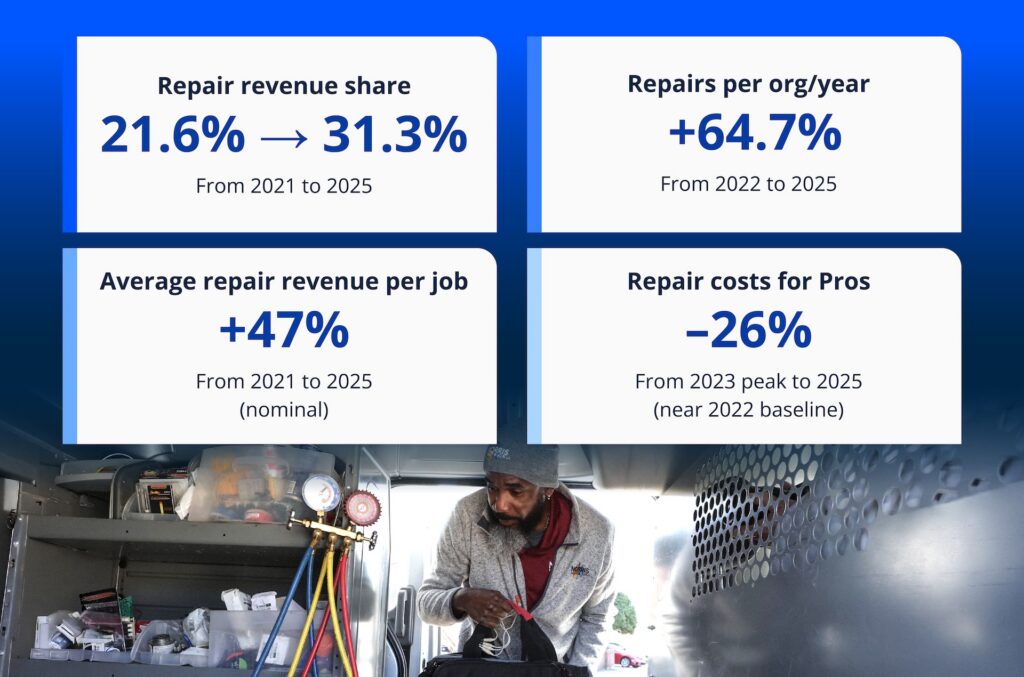
- Repair revenue share increased from 21.6% in Q4 2021 to 31.3% in Q4 2025.
- Repairs per organization per year rose 64.7% from 2022 to 2025.
- Average repair revenue per job increased 47% from 2021 to 2025
- Average repair costs declined 26% from their 2023 peak to 2025.
Trend #1: Repair revenue is gaining share across the HVAC industry
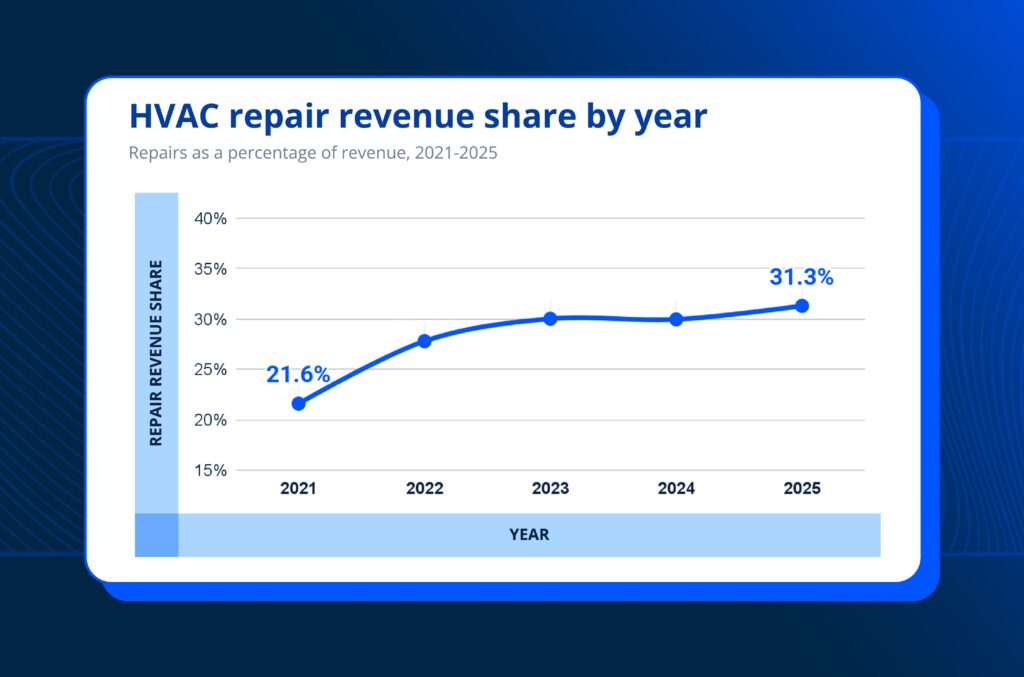
Housecall Pro data shows repair revenue share climbing from 21.2% in Q4 2021 to 33.4% in Q4 2025, a gain of more than 12 percentage points. Following a slight dip in 2023, repairs grew steadily from Q4 2023 to Q4 2025. Q4 2025 marks the highest repair revenue share in the period analyzed. Similar growth patterns can be seen on a full-year basis, with repairs increasing from 21.6% of HVAC revenue in 2021 to 31.3% in 2025.
Trend #2: Multi-tech HVAC shops are showing the strongest growth in repair revenue
The shift toward repairs is not evenly distributed across business sizes.
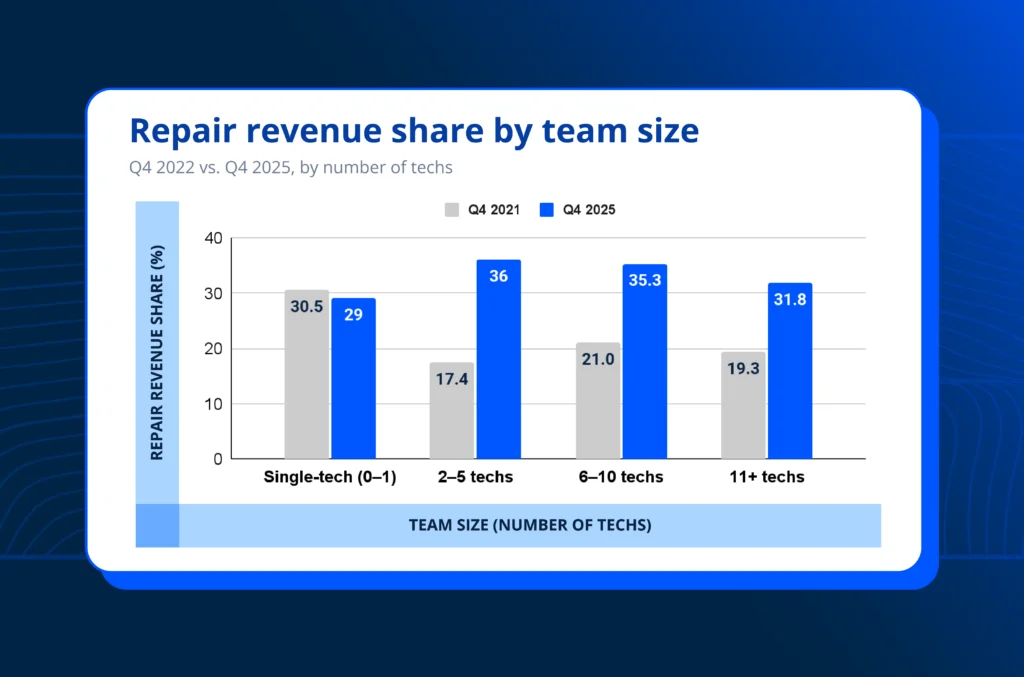
Looking at just Q4 metrics, repair share nearly doubled for businesses with 2-5 techs and rose by 14.3 and 12.5 percentage points for those with 6–10 and 11+ techs, respectively. By contrast, single-tech businesses saw relatively flat repair share over the same period.
This pattern suggests that larger teams may be better positioned to capture rising repair demand and manage higher service volume.
Learn more: The ultimate HVAC hiring guide: Find, recruit, and manage top techs
Trend #3: HVAC repair volume has reset at a higher level
The increase in repair revenue is partly driven by higher job volume.
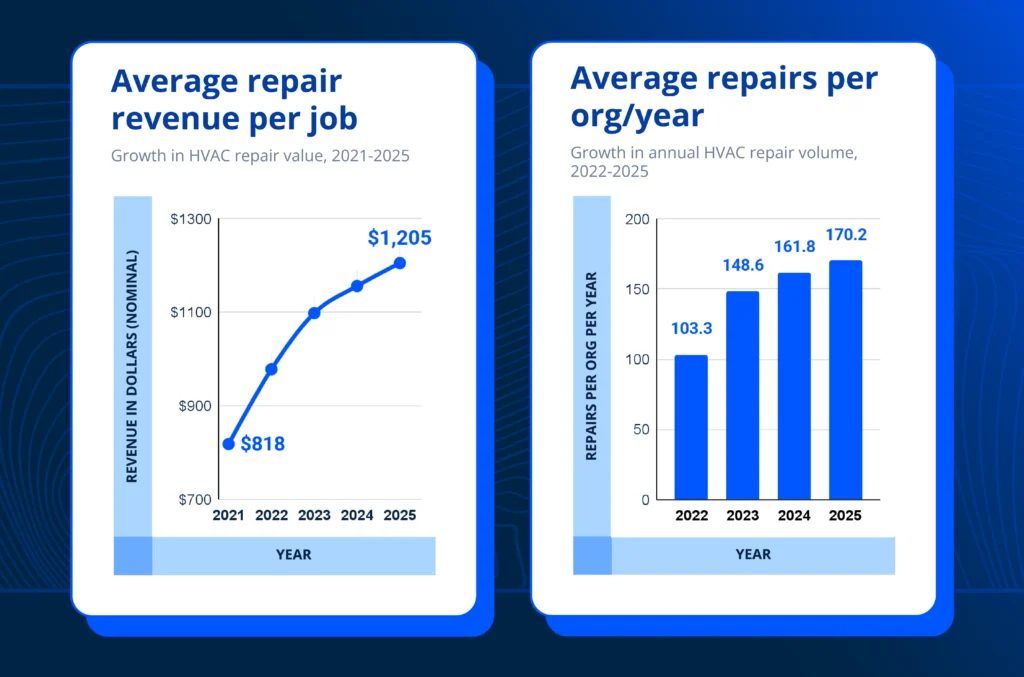
Repairs per organization rose from 103 per year in 2022 to more than 170 in 2025—an approximately 65% increase. While year-over-year growth has stabilized, annual repair volume remains well above pre-2022 levels. The pattern is consistent with a durable reset in repair demand rather than a temporary spike.
While repair growth has stabilized year-over-year, repair volume continues to rise. Repairs per organization rose from 103 per year in 2022 to more than 170 in 2025—an approximately 65% increase. The pattern suggests a structural shift in repair demand rather than a temporary spike.
Want to see what increased repair volume means for your bottom line? Try our HVAC profit margin calculator to forecast your profitability.
Trend #4: Average HVAC repair tickets are increasing
Average repair revenue per job increased from $818 in 2021 to $1,205 in 2025 (a 47% nominal increase, or 24% after inflation). That means the typical HVAC repair ticket is materially larger than it was several years ago.
For HVAC contractors and service professionals, this trend impacts pricing strategy, technician productivity, and overall margin planning.
Trend #5: Repair costs have eased after a 2023 peak
After peaking in late 2023 and remaining elevated through 2024, average repair costs declined in 2025. By Q4 2025, repair costs were 26% below their 2023 peak and roughly 6% below 2022 levels.
Lower costs combined with higher average ticket values can help improve repair margins for HVAC businesses.
Learn more: How to maximize HVAC profit margins and revenue
Broader market context: Replacement costs remain elevated
These HVAC industry trends are unfolding against continued pricing pressure.
According to U.S. Bureau of Labor Statistics data, HVAC wholesale and equipment prices remain elevated. Higher system replacement costs may influence homeowner decision-making, increasing the likelihood that customers choose repair over full replacement.
As replacement costs rise, the economic case for repair strengthens.
What these HVAC industry trends mean for contractors
Installs still drive the highest-ticket jobs, but repairs are becoming a larger and more consistent share of HVAC revenue. As repair work takes on a bigger role in day-to-day performance, many businesses will need to adapt their operations to support higher service volume. This includes:
- Improving scheduling and dispatch workflows to handle consistent repair demand
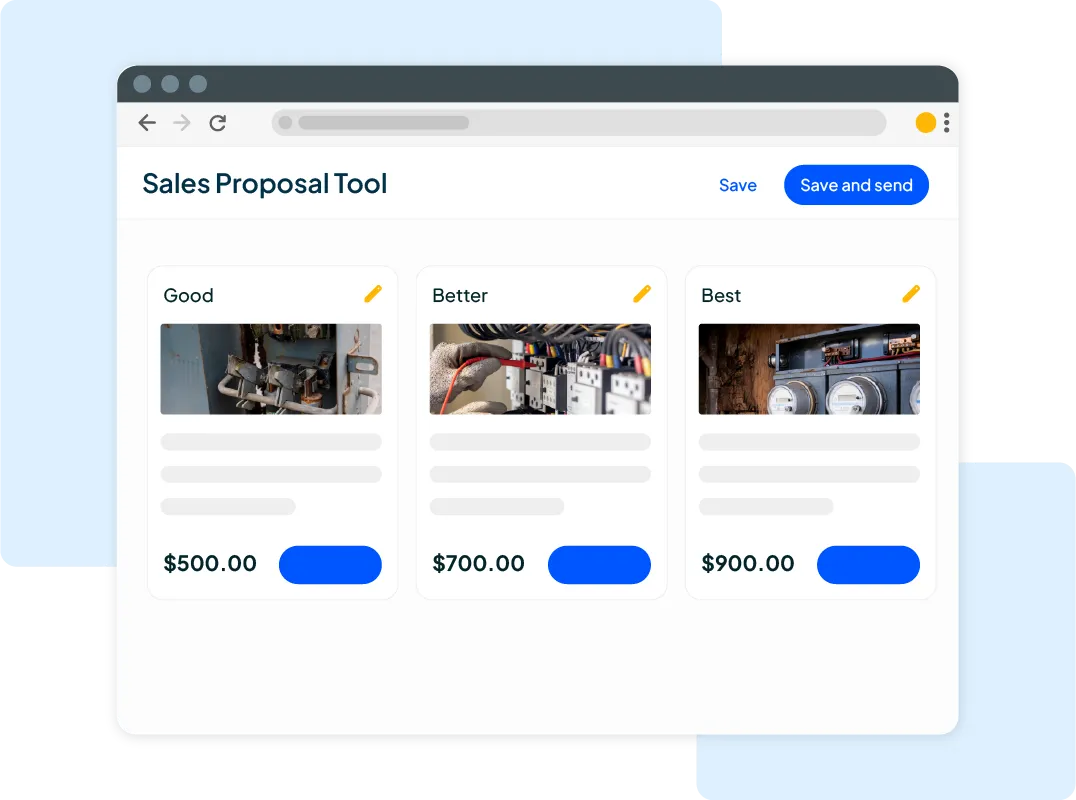
- Strengthening pricing and quoting processes
- Increasing technician productivity as teams complete more service calls
- Implementing operational systems that support growing, multi-tech teams
HVAC contractors who adjust staffing, pricing, and workflow systems to reflect rising repair demand will be best positioned to maintain margins and grow revenue.
Learn more: For tips on scaling your operation and adapting to these trends, see our guide to growing your HVAC business.
Get In Touch: 858-842-5746
Let us earn your trust
On average, Pros increase monthly revenue generated through Housecall Pro by more than 35% after their first year.
See plan options and feature breakdown on our pricing page.
Methodology
This HVAC industry trends analysis draws on aggregated, anonymized data from HVAC (Heating & Air Conditioning) businesses using the Housecall Pro platform. The analysis focuses on jobs where job-type tags explicitly indicate repair or install work, representing approximately 11% of total HVAC job volume (about 2 million jobs). Jobs without explicit job-type tagging are excluded. While this creates a filtered sample, consistent tagging behavior across quarters supports reliable trend analysis over time.
Job types are classified using a deterministic mapping system applied to normalized job labels. A precedence hierarchy ensures each job is assigned to a single category: install-directional labels take precedence over maintenance, which takes precedence over repair/service. Maintenance and checkups are included within the repair category for revenue-share reporting.
Metrics examined include repair revenue share (repair revenue / total revenue), repairs per organization per year, average repair revenue per job, and average repair cost per job. Revenue and cost figures are evaluated in nominal and inflation-adjusted terms where noted.
The analysis relies on a consistent cohort of active businesses with completed jobs and positive revenue to ensure comparability across periods. Findings reflect directional patterns within this subset and should not be interpreted as representative of all HVAC activity on the platform or as benchmarks for individual businesses.
External market indicators, including HVAC wholesale pricing and producer price indexes, are referenced for context only and are not incorporated into Housecall Pro’s calculations.
More to come: The Trades Pulse
Home service businesses sit on the front lines of the economy. When conditions shift, Pros feel it first. This HVAC report kicks off Housecall Pro’s quarterly Trades Pulse, drawing on aggregated, anonymized platform data to track how the trades are performing, what’s driving change, and what it means for home service Pros.