FREE DUCTULATOR TOOL
HVAC Duct Size Calculator
QUICK ANSWER
Size every duct run right, from the main trunk to the last register.
- Enter the duct shape, airflow (CFM), and max velocity (FPM).
- Get the duct area and dimensions for round, rectangular, or square duct.
- Use it before you install to avoid weak airflow and callbacks.
Take this duct calculator on every job
Get our free HVAC duct calculator and size every run in seconds — no slide rule, no chart-flipping, no math errors. Built for residential and light-commercial techs who’d rather quote the job than calculate it.
This HVAC duct size calculator, also called a ductulator, helps you determine duct dimensions based on airflow rate and maximum air velocity. Download a copy of our free calculator and use it on the go to size ducts accurately.
What is an HVAC duct size calculator?
An HVAC duct size calculator — also called a ductulator — is a tool that determines the correct duct dimensions for an HVAC system based on airflow (CFM), velocity, friction rate, and duct shape. Contractors use it to size every supply and return run on a project, avoiding the energy loss, hot and cold spots, and noisy operation that come from undersized or oversized ductwork.
This free calculator works for round metal, rectangular sheet metal, and flexible duct, with built-in conversions between shapes and outputs in both imperial and metric units.
How to calculate HVAC duct size
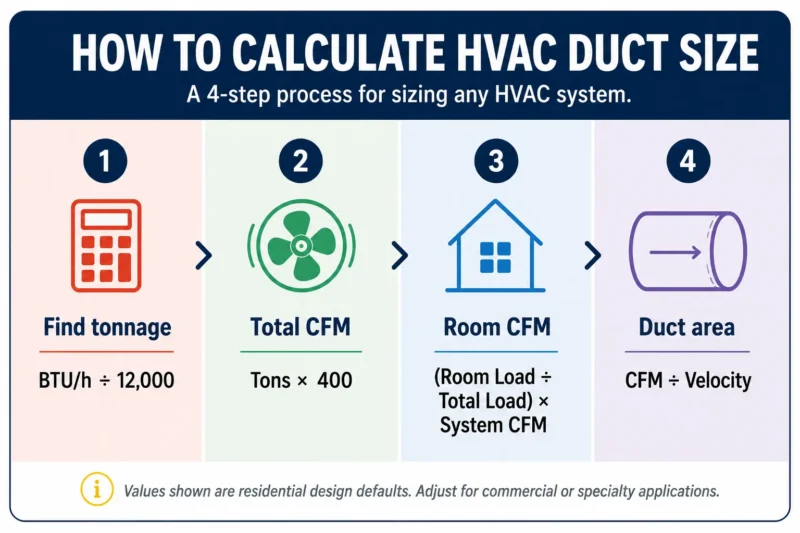
To calculate HVAC duct size, follow four steps: find the total HVAC equipment size in tons, calculate total system airflow in CFM, calculate room-by-room CFM based on each room’s load, then size each duct run by CFM, velocity, and friction rate.
Step 1: Find your HVAC system size in tons
Every duct calculation starts with the total heating and cooling load for the building, converted into equipment tonnage. One ton of HVAC capacity equals 12,000 BTUs per hour, so divide your total load by 12,000 to find the system size in tons.
Tons = Total BTU/h ÷ 12,000
Example: a home with a 24,000 BTU/h load needs a 2-ton system. Round up for uneven results — a 28,000 BTU/h load needs a 2.5-ton unit, since 2.33-ton units don’t exist.
If you haven’t run a load calculation yet, start with our free HVAC Load Calculator to get BTU/h for the whole house and each room.
Step 2: Calculate total system airflow in CFM
Once you know the equipment tonnage, calculate the total airflow the system needs to deliver, measured in cubic feet per minute (CFM). The industry standard for cooling is 400 CFM per ton of capacity.
Total System CFM = Tons × 400
Example: a 2-ton HVAC system delivers 800 CFM total. A 5-ton system delivers 2,000 CFM. Some high-efficiency or high-humidity systems are designed at 350 CFM per ton to improve dehumidification; older systems may run at 450 CFM per ton.
Heating typically requires about 65% of the cooling airflow, so when designing for both, always size ductwork to the cooling demand — that’s the higher number, and it guarantees the system has capacity year-round.
Step 3: Calculate room-by-room CFM
Each room needs its share of the total system airflow, proportional to its individual heating and cooling load.
Room CFM = (Room Load ÷ Total House Load) × Total System CFM
Example: in a 24,000 BTU/h home with 800 total CFM, a bedroom with a 2,000 BTU/h load needs:
Room CFM = (2,000 ÷ 24,000) × 800 = 66.7 CFM
As a quick rule of thumb, plan on roughly 1 CFM per 1 to 1.25 square feet of floor area. Rooms with large windows, direct sun exposure, or high occupancy may need closer to 2 CFM per square foot.
Step 4: Size each duct run by CFM, velocity, and friction rate
With CFM in hand for each run, calculate the required cross-sectional duct area using the formula:
Duct Area = CFM ÷ Velocity
Where velocity is typically 600–900 FPM for residential supply trunks. The calculator converts that area into a round duct diameter or rectangular dimensions automatically, based on your target friction rate (default 0.10″ wc per 100 ft) and duct shape.
Friction rate is the most common input for residential ductwork:
Friction Rate = (Available Static Pressure × 100) ÷ Total Effective Length
The default friction rate for most residential HVAC systems is 0.10″ wc per 100 feet. Total Effective Length (TEL) includes the longest straight duct run plus the equivalent length of every fitting, bend, register, and grille along that run.
Once you enter CFM plus friction rate or velocity, the ductulator returns the round duct diameter or rectangular dimensions needed for the required airflow.
HVAC duct sizing methods
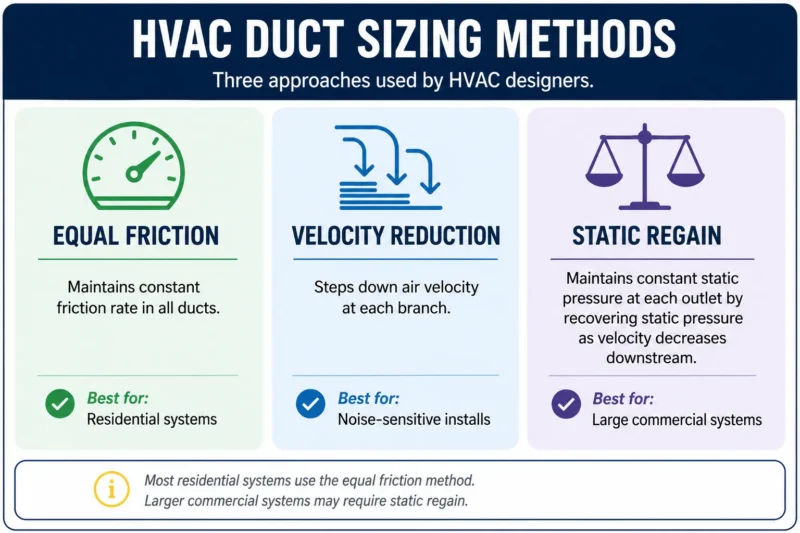
There are three main duct sizing methods used by HVAC designers, each best suited to different system types.
Equal Friction Method
Sizes every duct run to the same friction loss per linear foot — typically 0.08–0.10″ wc per 100 feet for residential. It’s the most widely used method for residential and small commercial systems because it’s straightforward and produces balanced airflow with minimal calculation overhead.
Velocity Reduction Method
Starts with a high air velocity at the main trunk near the air handler and progressively reduces velocity as the duct branches outward. Useful when noise control matters at the registers (lower velocity = quieter delivery), but more design-intensive than equal friction.
Static Regain Method
Designed for large, complex commercial duct systems with long trunk lines and multiple branches. Sizes each section so the static pressure regained from velocity decrease offsets the friction loss in the next section, producing nearly equal static pressure at every outlet. Most accurate, but requires specialized software or experienced design.
Duct size CFM chart
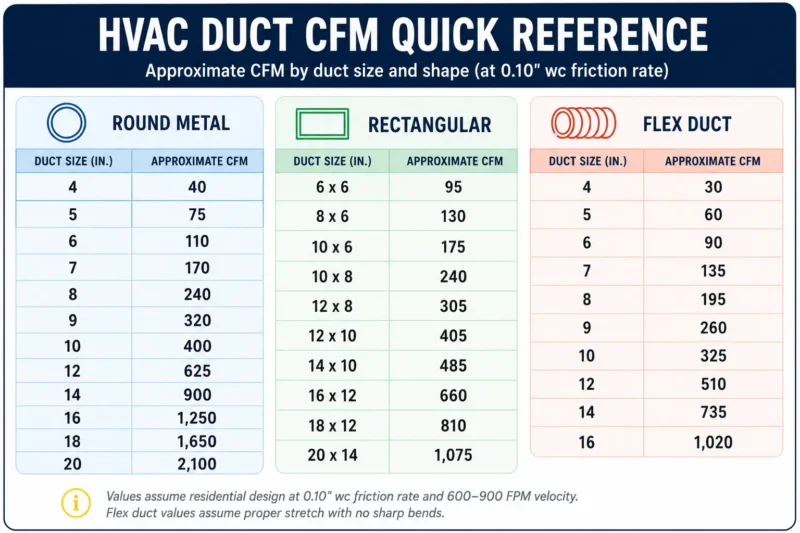
Use these quick-reference charts to look up airflow capacity for common duct sizes at a standard residential friction rate of 0.10″ wc per 100 feet.
Round metal duct CFM chart
| Round Duct Size | Approximate CFM |
|---|---|
| 4″ | 35–50 CFM |
| 5″ | 60–80 CFM |
| 6″ | 100–125 CFM |
| 7″ | 150–175 CFM |
| 8″ | 200–250 CFM |
| 9″ | 270–325 CFM |
| 10″ | 350–400 CFM |
| 12″ | 525–700 CFM |
| 14″ | 770–950 CFM |
| 16″ | 1,100–1,300 CFM |
| 18″ | 1,400–1,700 CFM |
| 20″ | 1,750–2,000 CFM |
Rectangular duct CFM chart
| Rectangular Duct Size | Approximate CFM |
|---|---|
| 6 × 6 | 80–110 CFM |
| 8 × 6 | 110–150 CFM |
| 10 × 6 | 150–200 CFM |
| 8 × 8 | 160–215 CFM |
| 10 × 8 | 215–270 CFM |
| 12 × 8 | 270–340 CFM |
| 12 × 10 | 360–450 CFM |
| 12 × 12 | 460–600 CFM |
| 14 × 10 | 430–540 CFM |
| 16 × 10 | 500–625 CFM |
| 18 × 12 | 720–900 CFM |
| 20 × 14 | 950–1,200 CFM |
Flexible duct CFM chart
Flex duct carries about 10–20% less airflow than rigid metal at the same diameter due to higher friction loss and inevitable sag and bend losses. Upsize flex by one nominal size if the run has multiple bends.
| Flex Duct Size | Approximate CFM |
|---|---|
| 4″ | 25–40 CFM |
| 5″ | 50–70 CFM |
| 6″ | 75–110 CFM |
| 7″ | 110–150 CFM |
| 8″ | 150–200 CFM |
| 9″ | 220–280 CFM |
| 10″ | 300–360 CFM |
| 12″ | 450–600 CFM |
| 14″ | 650–850 CFM |
| 16″ | 950–1,200 CFM |
All ranges assume design velocities of 600–900 FPM (typical for residential supply trunks) at 0.10″ wc friction rate.
Round vs. rectangular vs. flexible ductwork
The four main types of HVAC ductwork are round metal, rectangular metal, flexible duct, and fiberglass duct board. Most residential systems combine round or rectangular sheet metal trunks with flex duct branches.
| Duct Type | Best For | Pros | Cons |
|---|---|---|---|
| Round metal | Trunk lines, main runs | Lowest friction loss, durable, energy-efficient | Hard to route through joist bays |
| Rectangular metal | Tight spaces, retrofits | Fits framing cavities, customizable | Higher friction loss than round |
| Flexible (flex) | Branch runs to registers | Low cost, fast install, fits tight spots | High friction, easy to crush or kink |
| Fiberglass duct board | Insulation-sensitive runs | Built-in insulation, quiet | Lower durability, harder to clean |
Use round metal when efficiency and longevity matter, rectangular when you need to fit framing cavities, and flex for short branch runs only.
Common HVAC duct sizing rules of thumb
These quick rules don’t replace a full calculation, but they’re useful for sanity-checking results in the field.
The 2-foot rule:
Keep at least 2 feet of straight duct between any takeoff, fitting, or register and the next bend or transition. Stacking fittings too close together creates turbulence, pressure loss, and register noise.
The 20% rule:
Return ductwork should be sized for roughly 20% more airflow than supply to prevent negative pressure and air starvation.
400 CFM per ton:
Baseline cooling airflow per ton of capacity. Drop to 350 CFM/ton for high-humidity climates to improve dehumidification.
1 CFM per 1–1.25 sq ft:
Rough room-level airflow target. Rooms with heavy sun exposure or high occupancy may need up to 2 CFM per sq ft.
0.10″ wc per 100 ft:
The default friction rate for most residential duct designs. Use lower friction rates for longer or more complex systems.
HVAC Duct Size Calculator : FAQs
How do you calculate HVAC duct size?
To calculate HVAC duct size, first find your total system airflow in CFM (tons × 400), then calculate each room’s share of that airflow using the formula Room CFM = (Room Load ÷ Total Load) × System CFM. Finally, size each duct using a ductulator or duct sizing chart based on CFM, velocity (typically 600–900 FPM for residential supply), and friction rate (default 0.10″ wc per 100 feet).
How many CFM is a 12×12 duct?
A 12×12 rectangular duct carries approximately 460–600 CFM at a standard residential friction rate of 0.10″ wc per 100 feet. The exact figure depends on velocity — 700 FPM gives the low end, 900 FPM the high end. Its round equivalent is roughly a 13-inch diameter duct.
How many CFM is 1 ton of HVAC?
One ton of HVAC capacity requires approximately 400 CFM of airflow as a baseline. Some high-efficiency or high-humidity systems are designed at 350 CFM per ton to improve dehumidification, while older systems may run as high as 450 CFM per ton. A 2-ton system delivers around 800 CFM; a 5-ton system delivers 2,000 CFM.
How many CFM is a 4-inch duct?
A 4-inch round metal duct carries approximately 35–50 CFM at a standard 0.10″ wc friction rate. A 4-inch flex duct carries less — roughly 25–40 CFM — because of higher friction loss. Four-inch ducts are typically used for small bathroom exhausts or single-register branches, not main supply runs.
What is the 2-foot rule for ducts?
The 2-foot rule states there should be at least 2 feet of straight duct between any takeoff, transition, register, or bend and the next fitting. Stacking fittings too close together increases turbulence and pressure loss, reducing airflow to downstream registers and producing whistling or rumbling noise at registers.
What are the 4 types of HVAC ductwork?
The four main types of HVAC ductwork are round metal (rigid sheet metal trunks and runs), rectangular metal (sheet metal sized to fit framing cavities), flexible duct or “flex” (insulated branch runs), and fiberglass duct board (rigid fiberglass with foil backing, mostly used in older or specialty installations). Most residential systems combine round or rectangular trunks with flex branches.
What is the formula for duct sizing?
The two core duct sizing formulas are: Room CFM = (Room Load ÷ Total Load) × Total System CFM for airflow distribution, and Friction Rate = (Available Static Pressure × 100) ÷ Total Effective Length for sizing each duct run. Once you have CFM and friction rate, the duct dimension is read from a ductulator or duct sizing calculator.
Can flexible duct carry the same CFM as rigid duct?
No. Flexible duct carries approximately 10–20% less CFM than rigid metal duct of the same diameter at the same friction rate, because flex has higher internal surface friction and inevitable sag, kinks, and bends. Always upsize flex by one nominal size if the run has multiple bends or extends past 25 feet.
What’s the difference between equal friction and velocity reduction sizing?
The equal friction method sizes every duct run to the same friction loss per foot — typically 0.10″ wc per 100 ft for residential — and is the standard for most residential work. The velocity reduction method starts with high velocity at the trunk and steps down at each branch, useful for noise-sensitive installs but more design-intensive than equal friction.
How is this calculator different from a full Manual D calculation?
This calculator gives fast, accurate duct sizes for common installs and field estimates, working within 5–10% of full ACCA Manual D results for standard residential layouts. For new construction permits, code submissions, or complex multi-zone systems, run a full Manual D. Pair this calculator with our HVAC Load Calculator for fast Manual J + Manual D estimates on every quote.
Try out some more of our HVAC calculators!
-


Profit Margin Calculator
Discover what to charge and find your profit margin based on your markup percentage.
-


Load Calculator
Calculate the HVAC system size in BTUs & tons for any residential or commercial space.
-


Markup Calculator
Discover what to charge and find your markup percentage based on your target profit margin.
-


Labor Cost Calculator
Find the total and hourly labor cost with total labor burden for any project.