FREE SAVINGS CALCULATOR
HVAC Energy Savings Calculator
QUICK ANSWER
Estimate a customer’s energy savings from a system upgrade.
- Enter the old and new system’s efficiency ratings and usage.
- Get the projected annual savings in dollars.
- Use it to show customers the real payoff of an upgrade.
Show customers their savings on every quote
Get our free HVAC energy savings calculator and close more high-efficiency upgrades. Show customers exactly what a higher-SEER system saves them per year and over its lifetime — and watch the price objections fade.
This calculator allows you to estimate potential energy and cost savings by upgrading to more energy-efficient HVAC systems. Download a copy of our free calculator and use it on the go!
What is an HVAC cooling energy savings calculator?
An HVAC cooling energy savings calculator is a tool used to estimate potential energy and cost savings by upgrading to a more energy-efficient HVAC system. The calculator looks at factors like the current HVAC system’s efficiency, the efficiency of the new system being considered, the size of the HVAC unit, the climate zone, and the energy costs in the local area.
Who uses an HVAC cooling energy savings calculator?
HVAC cooling energy savings calculators can be used by anyone—HVAC organizations, technicians, and property owners. The calculator helps estimate savings from reduced energy consumption and associated costs. These details help technicians and property owners to make informed decisions based on the results.
How accurate are the results?
Whether or not the results are accurate depends on input details and the assumptions made by the calculator. But other factors can affect the recommendations too. In order to get the best results, you should consult with a licensed engineer.
How do you calculate HVAC cooling energy savings?
To calculate HVAC cooling energy savings, add the details about the HVAC usage for cooling, including current and new SEER ratings.
You’ll have to include:
- Avg. Usage per Day
- Location
- AC capacity (in BTU)
- Current SEER
- New SEER
Once the information is entered into the calculator, you’ll get an estimate of the potential HVAC cooling energy savings.
What is the HVAC cooling energy savings calculation formula?
The formula used to estimate base HVAC cooling energy savings is:
- Usage per Month (in hours) = Avg. Usage per Day (in hours) * 30
Current SEER:
- Current Energy Consumption per Day (in watts) = AC Capacity (in BTU)/Current SEER Rating
- Consumption per Month (in kilowatts) = (Energy Consumption per Day (in watts) * Usage per Month)/1000
- Current Cooling Cost per Month = (Consumption per Month * Average Cost of Electricity (per Kwh))
New SEER:
- New Energy Consumption per Day (in watts) = AC Capacity/New SEER Rating
- Consumption/Month (in kilowatts) = (Energy Consumption per Day (in watts) * Usage per Month)/1000
- New Cooling Cost per Month = Consumption per Month * Average Cost of Electricity (per Kwh)
Savings:
- Savings per Month = Current Cooling Cost per Month – New Cooling Cost per Month
- Savings per Year = (Savings per Month * 12)
- Savings % = (Savings per Month/Current Cooling Cost per Month) * 100
Disclaimer Statement
The recommended energy savings provided are estimated in good faith and are solely meant for general informational purposes. We do not guarantee the accuracy of these estimates. Please note that other external factors may affect or falsify the recommended savings. For accurate values, consult a licensed engineer.
HVAC Energy Savings Calculator: FAQs
How much can I save by upgrading to a higher SEER air conditioner?
Upgrading from an old 10 SEER unit to a modern 16 SEER2 unit typically saves $190–$500 per year on cooling costs, depending on climate, usage hours, unit size, and local electricity rates. Hot climates with long cooling seasons (Texas, Arizona, Florida) land at the higher end. Over a 15-year system life, that adds up to $3,000–$7,000+, often enough to offset much of the upgrade cost.
What is the payback period for a new HVAC system?
The payback period for a new high-efficiency HVAC system is typically 5 to 12 years, calculated by dividing the upfront cost by the annual energy savings. A $4,000 upgrade saving $450 a year pays back in about 9 years. Cold climates with high heating bills often see faster furnace payback (under 7 years), while mild climates with low usage take longer. Rebates and tax credits shorten the payback period significantly.
What is the difference between SEER and SEER2?
SEER and SEER2 both measure an air conditioner’s cooling efficiency over a season — higher numbers mean lower operating costs. SEER2 is the updated standard adopted in 2023, using more realistic testing conditions (higher external static pressure) that better reflect real-world performance. A SEER2 rating is roughly 4.5% lower than the equivalent old SEER number, so a 15 SEER unit is about 14.3 SEER2. Always compare like-for-like when shopping.
Is it worth upgrading to a higher SEER unit?
Upgrading to a higher SEER unit is usually worth it if your current system is 10–13 SEER, more than 10–12 years old, or facing a major repair. The energy savings, improved comfort, better humidity control, and available rebates often justify the investment — especially in hot climates with high usage. If your system is already 14+ SEER and running well, the savings from a marginal efficiency bump rarely justify the replacement cost on their own.
How much does SEER actually affect my energy bill?
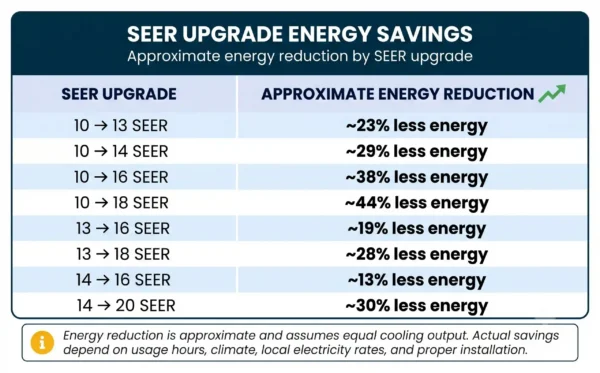
SEER has a major effect on cooling costs because the relationship is proportional: a 20 SEER unit uses about 50% less energy than a 10 SEER unit for the same cooling output. Moving from 13 to 16 SEER cuts cooling energy use by roughly 19%; 13 to 18 SEER cuts it by about 28%. The dollar impact depends on how many hours you run cooling and your local electricity rate — both of which this calculator factors in.
What's the difference between SEER, HSPF, EER, and AFUE?
These are all HVAC efficiency ratings for different functions. SEER/SEER2 measures seasonal cooling efficiency; EER measures cooling efficiency at peak conditions; HSPF/HSPF2 measures heat pump heating efficiency over a season; and AFUE measures furnace heating efficiency as the percentage of fuel converted to usable heat. When estimating energy savings, match the right rating to the equipment — SEER for AC, AFUE for furnaces, HSPF for heat pumps.
Are there rebates or tax credits for high-efficiency HVAC systems?
Yes. Many homeowners qualify for federal tax credits, utility rebates, and manufacturer incentives when installing high-efficiency HVAC equipment. Federal credits often apply to qualifying heat pumps and high-AFUE furnaces, while local utilities offer rebates for ENERGY STAR–certified systems. These incentives can shave hundreds to thousands of dollars off the upfront cost and meaningfully shorten the payback period. Always check current federal programs and your local utility, since amounts change year to year.
How can HVAC contractors use an energy savings calculator to close more sales?
An energy savings calculator is one of the strongest sales tools in HVAC. Showing a customer the concrete annual and lifetime savings of a higher-efficiency system turns an abstract price tag into a clear return on investment. Pairing projected savings with the payback period and available rebates helps customers justify the upgrade — and often moves them toward a higher-SEER, higher-margin unit. Print or email the results as part of your proposal to reinforce the value.
Try out some more of our HVAC calculators!
-


Profit Margin Calculator
Discover what to charge and find your profit margin based on your markup percentage.
-


Duct Size Calculator
Calculate the right duct diameter, dimensions, and airflow capacity for residential and commercial HVAC ductwork.
-


Markup Calculator
Discover what to charge and find your markup percentage based on your target profit margin.
-


Labor Cost Calculator
Find the total and hourly labor cost with total labor burden for any project.