FREE ESTIMATING TOOL
HVAC Bid Calculator
QUICK ANSWER
Build accurate HVAC bids from your real labor and equipment cost.
- Enter the job type: repair, tune-up, or full system install.
- Get a bid price that covers your costs and hits your target margin.
- Use it before you quote so you’re not underbidding a long job.
Take this HVAC bid calculator on every estimate
Get our free HVAC bid calculator and lock in profitable margins on every quote. Build accurate, defensible bids in minutes — without spreadsheets, sticky notes, or back-of-the-napkin math.
This calculator helps you accurately estimate HVAC job costs by factoring in labor, materials, and equipment expenses. Download a copy of our free calculator to create precise bids and quotes anytime, anywhere.
What is an HVAC bid calculator?
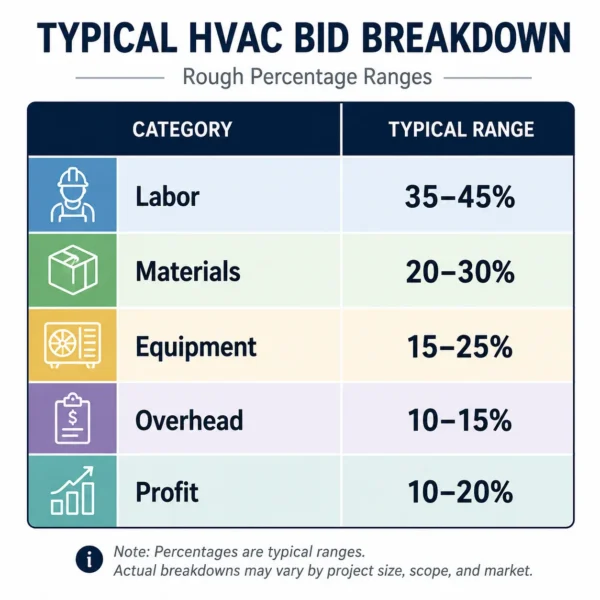
An HVAC bid calculator helps techs and contractors estimate the overall cost of an HVAC project down to the dollar. It decreases the possibility of human error (no offense) and can save you a ton of time. The calculator creates a detailed cost estimate by letting users enter a variety of information, like labor rates, projected labor hours, material costs, equipment charges, travel costs, and permission fees. HVAC bid calculators can be customized to fit the specific requirements of all kinds of projects, making them essential for presenting competitive and realistic bids.
How do you determine the labor rate for my project?
The labor rate is the hourly wage you pay your techs, including additional benefits, taxes, and overhead costs. It can also include a profit margin. Research local industry standards to set a competitive rate.
What should you include in the material costs input?
Material costs are all the supplies and components needed for the project. Think wires, outlets, switches, circuit breakers, tools, and other HVAC materials. Be sure to include taxes, shipping fees, and any discounts received.
How do you calculate markup percentage?
The markup percentage is calculated based on your company’s overhead costs and desired profit margin. Overhead may include administrative expenses, insurance, and utilities. A common markup range is 10% to 20%, but this can vary based on your specific business needs.
Can I use the calculator for different types of HVAC projects?
Yes. The calculator can be used for all kinds of HVAC projects from a small home install to a massive industrial complex. Simply adjust the input fields to reflect the specific requirements and costs associated with each type of project.
What every HVAC bid should include
Before you run the math, make sure you’ve captured every category of cost. Missing one of these is the most common reason HVAC contractors underbid jobs and watch margins disappear after the install.
- Direct labor — Fully loaded hourly cost for every technician on the job: wages, payroll taxes, benefits, workers’ comp, and vehicle/tool allocations. Not just the tech’s hourly wage.
- Materials and consumables — Refrigerant, line sets, fittings, condensate pumps, electrical wire, fasteners, sealants, drip pans, vibration pads, and anything else used up or installed.
- Equipment — Condensers, air handlers, furnaces, package units, thermostats, controls, and any specialty equipment in the scope.
- Permits and inspections — Local mechanical, electrical, and building permits plus inspection fees charged by the authority having jurisdiction.
- Travel and fuel — Round-trip drive time, fuel, and tolls — especially for jobs outside your normal service radius.
- Subcontractors — Electricians, crane operators, roofers, sheet-metal fabricators, or any trade outside your scope.
- Disposal and recycling — Old equipment haul-away, refrigerant recovery, and dump fees.
- Warranty and callback reserve — A 2–5% reserve built into your markup to cover post-install issues without eating profit.
- Overhead allocation — This job’s share of office, software, insurance, marketing, and admin costs.
- Profit margin — What you actually take home after every cost above is covered.
How do you calculate an HVAC bid? (With an example)
Formulas used to calculate an HVAC bid:
Total Labor Cost = Labor Rate per Hour × Estimated Hours
Total Direct Costs = Material Costs + Equipment Costs + Travel Costs + Permit Fees
Indirect Costs = (Total Direct Costs + Total Labor Cost) × (Markup Percentage/100)
Project Cost = Total Direct Costs + Total Indirect Costs + Total Labor Cost
Example:
Labor Rate per hour = $50
Estimated Hours = 100 hours
Material Costs = $2,000
Equipment Costs = $500
Travel Costs = $200
Permit Fees = $100
Markup Percentage = 15%
Calculator total labor cost:
Total Labor Cost = $50 × 100 = $5,000
Calculate total direct costs:
Total Direct Costs = $2,000 + $500 + $200 + $100 = $2,800
Calculate total indirect costs:
Total Indirect Costs = ($2,800 + $5,000) × (15/100) = $1,170
Calculate total project cost:
Total Project Cost = $2,800 + $1,170 + $5,000 = $8,970
This example demonstrates how the calculator aggregates various costs and applies a markup to provide a comprehensive project bid.
HVAC Bid Calculator: FAQs
What's the difference between an HVAC bid and an HVAC estimate?
An HVAC bid is a firm, contractual price commitment to complete a defined scope of work — typically used for new construction, commercial projects, or formal procurement. An HVAC estimate is a non-binding approximation, used more commonly for residential service calls and replacements. Bids include precise material and labor breakdowns and are legally enforceable once accepted; estimates are flexible and can change as project conditions are uncovered.
What profit margin should HVAC contractors aim for?
Most successful HVAC contractors target a net profit margin of 10–20%, with gross margins on installs typically falling between 30% and 50%. New construction and commercial bids usually run lower margins (10–15%) due to competitive pressure, while service replacements and emergency work can support significantly higher margins. The exact number depends on overhead, market competition, job mix, and operational efficiency.
What's a typical hourly labor rate for HVAC technicians?
HVAC labor rates billed to customers typically range from $75 to $200 per hour in the U.S., with most contractors landing between $100 and $150. Rates vary by region (urban metros run higher), technician experience, job type (service vs. install vs. emergency), and whether the rate covers one tech or a two-person team. Always price off fully loaded labor cost — wages, payroll taxes, benefits, insurance, vehicle, and overhead — before adding profit, not just the wage you pay.
How do you bid on a commercial HVAC job?
Commercial HVAC bidding starts with reviewing the project’s mechanical drawings, Division 23 specifications, and equipment schedules. Perform a detailed takeoff covering equipment, ductwork, refrigerant line sets, controls, drains, and electrical hookups. Add labor hours by trade, factor in subs and permits, apply your markup, and present the bid with clearly itemized inclusions, exclusions, and alternates. Commercial bids are more rigorous than residential and often require formal proposal documents, bonding, and insurance certificates.
What causes HVAC contractors to underbid jobs?
The most common causes are: pricing off raw wages instead of fully loaded labor cost, missing scope items during the site walk, using outdated material prices, forgetting to reserve for warranty and callbacks, copying last year’s pricing without adjusting for inflation, and applying markup to direct costs only instead of total cost. A bid calculator helps eliminate most of these by forcing you to enter every cost category before pricing the job.
How long should an HVAC bid stay valid?
Most HVAC bids are valid for 30 days, though some contractors shorten validity to 14 or 21 days when equipment prices are volatile. Always include an explicit expiration date and a clause noting that pricing is subject to change if material costs shift before acceptance. For longer commercial projects, use a 60–90 day window with a built-in price-escalation clause in the contract.
Should I include warranty and callback costs in my HVAC bid?
Yes. Every HVAC bid should reserve a percentage of the job — typically 2–5% of total project cost — to cover warranty work, callbacks, and minor scope creep. This reserve protects your margin when a fitting leaks two weeks after install or a customer reports a thermostat issue you didn’t catch on the walk. Build this reserve into your markup percentage rather than treating it as a surprise expense.
Try out some more of our HVAC calculators!
-


Profit Margin Calculator
Discover what to charge and find your profit margin based on your markup percentage.
-


Duct Size Calculator
Calculate the right duct diameter, dimensions, and airflow capacity for residential and commercial HVAC ductwork.
-


Markup Calculator
Discover what to charge and find your markup percentage based on your target profit margin.
-


Labor Cost Calculator
Find the total and hourly labor cost with total labor burden for any project.