Construction Measurements
Square Footage Calculator
This square footage calculator allows you to find the total square footage of a square, rectangular, circular, or triangular area using basic dimensions in feet. Download a copy of our free calculator for contractors and use it on the go!
How to calculate square footage of an area?
By all accounts, square footage is the most common measurement used to define the size of an area within residential construction projects in North America and beyond. It will often be described as, the house has 2,500 finished square feet, or the master bedroom is 200 square feet. In a square or rectangle area, the square footage is determined by simply multiplying the length by the width in feet. A single unit in square footage is 1 square foot, which is a square area measuring 1 foot in length by 1 foot in width.
The shape of the area in which you’re measuring will determine which of the following formulas you should use to calculate the total square feet.
Square or Rectangle Area
Length (ft) x Width (ft) = Total Square Feet
Circular Area
3.14 x (Diameter (ft)/2)^2 = Total Square Feet
Triangular Area
1/2 x Length of Side 1 (ft) * Length of Side 2 (ft) = Total Square Feet
How to measure the square footage of a house?
Most often you’ll hear the size of a home be described in finished square feet. This simply means that this is the total area of the completed portions of a home. For example, if a home includes a basement that hasn’t been completed, the area of that basement would not be included as part of the finished square feet.
To find the square footage of a home, first determine if you’d like to find the finished square feet or the total square feet.
Once you’ve decided which measurement you’re after, you’ll want to break down your home by rooms/areas to make the calculations of each area easier to manage. i.e. Bedroom 1, Bedroom 2, Living Room, etc.
For each room, you’ll need to measure the width and length in feet, including any closet space, nooks, entry ways, etc. The simplest way to accomplish this is to break down each room/area into smaller areas in regular shapes. For example, measure the closet separately from the main area of a bedroom. When each of these smaller areas within a room are measured, you’ll calculate the square footage of each and add them all together to get the total square footage of the bedroom.
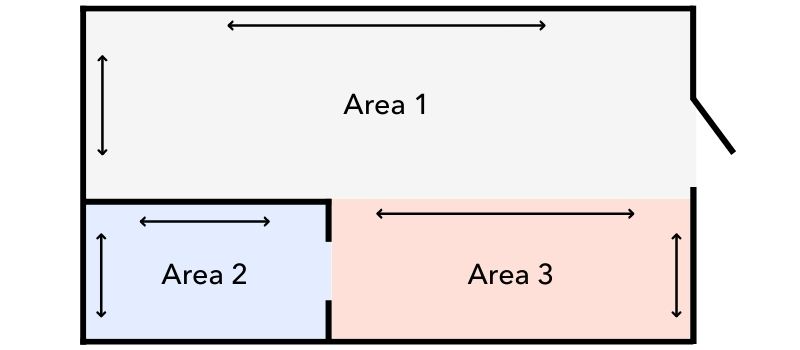
Break down your room into smaller areas in regular shapes to make it easier to calculate the square footage
Once you’ve completed determining the square footage of each of the individual rooms/areas, you’ll add them all together to determine the square footage of the home.
How to calculate the cost per square footage of a construction project
If you’ve ever bought or purchased a home, you may have heard the cost of a home being measured by the its cost per square foot compared to the cost per square foot of other homes in the area. In a similar way, you may want to determine the cost of a construction project based the cost per square foot.
Calculating this figure is actually quite simple as long as you know both the total cost and total square footage of the project. The formula is as follows:
Total Cost of Construction / Total Square Feet = Construction Cost Per Square Foot
Get the Free Square Footage Calculator for Your Next Job
Skip the manual math on every project. Download the free calculator to use on-site, in estimates, or share with your crew — get instant area calculations, room totals, and shape-specific measurements built for contractors who’d rather be measuring jobs than crunching numbers.
Square footage calculator: frequently asked questions
How do you calculate square footage for an irregular shape?
To calculate square footage for an irregular shape, break it into smaller regular shapes — rectangles, triangles, or circles — calculate each one separately, then add the totals together. For an L-shaped room, divide it into two rectangles. For a room with an angled corner, split it into a rectangle plus a triangle. This method works for any complex floor plan, no matter how irregular. The accuracy depends on how precisely you define the boundaries between sub-shapes, so use straight reference lines wherever possible.
How many square feet are in an acre?
One acre equals 43,560 square feet. To convert acres to square feet, multiply the number of acres by 43,560. To go the other way, divide your square footage by 43,560 to get acres. For quick reference: a half-acre is 21,780 square feet, a quarter-acre is 10,890 square feet, and a typical residential lot in most US suburbs runs 0.15–0.30 acres (6,500–13,000 square feet).
Do closets count in square footage?
Yes, closets count in finished square footage as long as they’re part of a heated, finished living space. The American National Standards Institute (ANSI Z765) standard — which most US appraisers and real estate listings follow — includes closets, hallways, stairs, and any enclosed area with a finished floor, walls, and ceiling that meets minimum height requirements (typically 7 feet). Unfinished closets, storage areas under stairs, and crawl spaces are excluded.
What is the standard ceiling height required to count as square footage?
Most square footage standards require a minimum ceiling height of 7 feet for an area to count as finished living space, with at least 50% of the room reaching that height. Areas with sloped ceilings (under attics or stairs) only count where the ceiling is 5 feet or higher, and only if the average room height meets the 7-foot threshold. This rule is why finished attic and bonus room square footage often differs between appraisers and real estate listings — the calculation method matters.
Does a garage count as square footage?
No, a garage typically does not count toward the finished square footage of a home, even if it’s attached and insulated. Garages are considered unfinished space because they don’t meet the standard requirements (heated, finished walls and ceiling, suitable for year-round living). Converted garages can count as finished square footage if they meet building code for habitable space — proper insulation, heat, finished floors and ceilings, and required egress. Always disclose garage conversions to appraisers, as some lenders require permits to count converted space.
How do you measure square footage of a basement?
Finished basements count as square footage only when they meet ANSI standards: heated, finished walls and ceiling, minimum 7-foot ceiling height, and proper egress. Even when finished, many appraisers and MLS listings report basement square footage separately from above-grade finished square footage because below-grade space typically appraises at 50–70% of above-grade value. Unfinished basements never count as finished square footage. To measure, calculate the area the same way as any other floor — but report it as a separate line item in listings or appraisals.
How accurate is square footage from listings or tax records?
Square footage from real estate listings and tax records is often inaccurate, with discrepancies of 5–20% common. Tax records may not reflect additions, conversions, or remodels. MLS listings depend on the source — appraisal-based listings tend to be most accurate, while owner-reported figures vary widely. For any project where square footage matters (renovations, additions, flooring estimates), measure it yourself or hire an appraiser. Trusting public records can mean ordering 10–20% more or less material than you actually need.
Try out some more of our construction calculators!
-


Profit Margin Calculator
Discover what to charge and find your profit margin based on your markup percentage.
-


Concrete Calculator
Calculate the amount of concrete needed in cubic feet, yards, and bags for a concrete slab.
-


Markup Calculator
Discover what to charge and find your markup percentage based on your target profit margin.
-


Labor Cost Calculator
Find the total and hourly labor cost with total labor burden for any project.