Want to win more jobs with less effort?
Grow your business and send quick quotes with our home service software.

Want to see your potential revenue?
See what businesses like yours earn with Housecall Pro in 1 - 2 minutes.

Accurate estimating is the foundation of every profitable electrical business. Whether you’re bidding residential service calls or large-scale commercial projects, the key to success is knowing exactly how to estimate electrical jobs—from materials and labor to overhead and profit.
This 2026 guide breaks down the electrical estimating process step-by-step so you can price jobs confidently, avoid underbidding, and win more contracts. You’ll learn proven estimating techniques, see how to calculate true job costs, and discover how tools like Housecall Pro’s electrical estimating software make quoting faster and more precise.
→ Want to create estimates faster? Download our free electrician estimate template to create accurate, mobile-friendly estimates in minutes—perfect for responding quickly to bid requests.

Rate checker
Stop second-guessing your bids. Check your rates against market averages and get a clear picture of what you should be charging today.
Key takeaways
Follow these steps for accurate electrical estimating:
Follow a step-by-step process: Choose the right jobs, review specs, analyze drawings, perform takeoffs, and check pricing.
Calculate costs precisely: Factor in labor, materials, overhead, and desired profit to ensure competitive and profitable bids.
Build professional proposals: Use clear formats like lump-sum, time and materials, cost-plus, or unit pricing tailored to client needs.
Review and track results: Double-check estimates, submit bids accurately, and track outcomes to refine future estimating accuracy.
Jump ahead
- What is an electrical estimate?
- How to estimate electrical work accurately
- Step-by-step electrical estimating process
- 1. Choose and bid on the right electrical jobs
- 2. Review the project specifications (Division 01 & Division 26)
- 3. Analyze electrical drawings and blueprints
- 4. Perform a quantity takeoff
- 5. Get updated material and supplier pricing
- 6. Calculate labor costs accurately
- 7. Add overhead costs and profit margin
- Example: calculating your electrical job estimate
- 8. Build a format a professional electrical proposal
- 9. Double-check takeoff quantities & estimate
- 10. Submit your electrical bid
- 11. Review the results
- Common electrical estimating mistakes to avoid
What is an electrical estimate?
Electrical estimating is the process electricians use to calculate the total cost of completing a job while maintaining a healthy profit margin. It combines materials, equipment, labor, subcontractors, and overhead into one clear number that represents what it will actually take to complete the work.
In simple terms, an electrical estimate is the result of that process—the detailed cost breakdown or proposal you present to a client. Estimating is the method; the estimate is the document. Together, they ensure your bids are accurate, competitive, and profitable.
Accurate estimating is one of the most valuable skills an electrician can develop. It builds trust with general contractors, helps you forecast costs more reliably, and protects your business from costly underbids or razor-thin margins.
How to estimate electrical work accurately
Accurate electrical estimating starts with a clear understanding of your job scope, materials, and labor costs. Whether you’re bidding a small residential project or a large commercial installation, the goal is to calculate a price that covers all expenses while maintaining a healthy profit margin.
At its core, estimating electrical work means breaking down every phase of a project into measurable units—each with an associated labor rate, material cost, and overhead factor. By following a consistent estimating process, you can quote faster, avoid underbidding, and increase your win rate.
Here’s what accurate electrical estimating typically includes:
- Labor costs: Time required to install, wire, and test each component.
- Material costs: Conduits, panels, fixtures, fittings, and supplies based on takeoffs.
- Equipment and subcontractors: Rentals, lifts, or specialty work.
- Overhead and profit: Insurance, fuel, marketing, office expenses, and your margin.
Pro tip: Even seasoned electricians use electrical estimating software to stay competitive. Automation tools like Housecall Pro can calculate totals, generate professional proposals, and store cost data to reduce errors and improve turnaround time.

Step-by-step electrical estimating process
Whether you’re estimating a single-room rewiring or a large-scale commercial installation, accuracy comes from a repeatable system. The following electrical estimating steps outline a proven process professional contractors use to prepare precise, profitable bids every time.
1. Choose and bid on the right electrical jobs
The first step in accurate electrical estimating is knowing which jobs to bid on—and where to find them. Not every opportunity is worth your time or resources, so focus on projects that match your experience, crew size, and capabilities.
You can find electrical jobs to bid on in several ways:
- Online bid boards and lead platforms like PlanHub, ConstructConnect, BidClerk, and The Blue Book Network regularly post new electrical projects.
- Local builder exchanges and trade associations often provide member-only access to active bids. National Electrical Contractors Association (NECA) chapters are a good place to start.
- Public procurement websites list open government and municipal projects in your region.
- Networking with general contractors, property managers, and other trades (like HVAC or plumbing pros) frequently leads to subcontracting opportunities.
Once you’ve identified potential projects, vet them carefully:
- Are they within your technical scope?
- Do you have the right labor, equipment, and time availability?
- Are the project documents (plans, specs, RFP) complete and clear?
Avoid bidding on jobs that fall far outside your comfort zone—such as large industrial projects if you typically do residential work—until you’ve built the team and resources to take them on. Specializing first helps you quote faster and more accurately, and it also build trust with clients.
“Clients tend to engage more positively with contractors that only take on their types of work because they associate that type of contractor with fewer mistakes and quicker outcomes,” says Caspar Matthews, Director of Electcomm Group Electrical & Data. That perception is what drives references.”
2. Review the project specifications (Division 01 & Division 26)
Before touching your calculator, carefully read the project specifications provided in the bid package. These documents define the materials, methods, and standards you’ll be held to if awarded the job.
Division 01 (general requirements) usually includes:
- Contractor qualifications and bonding requirements
- Insurance and safety compliance details
Payment schedules and retention terms - Warranty obligations
Division 26 (electrical requirements) typically covers:
- Approved wiring methods and material grades
- Installation procedures
- Scope boundaries (who provides fire alarms, comms, or HVAC hookups)
Misreading or overlooking specs can destroy your profit margin. Always confirm that you meet the legal and technical qualifications to bid before investing time in an estimate.
3. Analyze electrical drawings and blueprints
Blueprints reveal the real-world complexity of a project. Begin with a broad review—look at architectural and electrical drawings to understand the building layout, ceiling heights, access points, and potential obstacles.
Then, zoom in. Compare the drawings against Division 26 specs to ensure everything aligns. Look for inconsistencies or missing details, like panel schedules that don’t match the load calculations.
If anything seems unclear, issue a Request for Information (RFI) before you finalize your bid. A small clarification now can prevent expensive rework later.
4. Perform a quantity takeoff
A quantity takeoff involves counting and measuring every component you’ll need for an electrical job: conduits, fixtures, panels, wire runs, devices, and terminations.
If you’re using electrical estimating software, digital takeoff tools can automatically detect and count symbols from blueprints—saving hours of manual work. For manual takeoffs, print drawings at scale, grab your highlighters, and go sheet by sheet.
A typical manual takeoff process looks like this:
- Select one material category (for example, light fixtures).
- Count each item and write the total on that sheet.
- Record those totals on your master takeoff log.
- Repeat for the next material type (switches, panels, receptacles, etc.).
Always double-check your counts. Human error is common here, and small mistakes multiply quickly.
5. Get updated material and supplier pricing
Electrical material prices can change weekly, especially for copper, steel conduit, or LED lighting. Relying on outdated cost data can undercut your profitability.
Build relationships with at least two local suppliers or lighting reps. When you have a good rapport, you’ll receive faster, more accurate quotes (and possibly better discounts).
For lighting takeoffs, note the fixture designations from the drawings (A1, B2, etc.) and send them to your supplier for a lump-sum quote. Always cross-check quotes from different vendors before finalizing your cost.
→ See average 2026 pricing in our plumbing pricing guide.
6. Calculate labor costs accurately
Labor usually represents 40%–60% of an electrical job’s total cost. Estimating it correctly is crucial.
Start with unit-based labor rates. For example, the time it takes to install one outlet, run 10 feet of conduit, or set a light fixture. The NECA Manual of Labor Units is an excellent reference for standard rates.
Then, adjust those rates for real-world conditions:
- Tight or high-access workspaces may double installation time.
- Weather delays, shift work, or occupied facilities can affect productivity.
- Union vs. non-union labor rates vary widely by region.
Example formula:
Labor Hours per Unit × Hourly Rate × Quantity = Total Labor Cost
Add indirect labor costs like setup, travel, cleanup, and supervision time.
Pro tip: Rather than guessing or relying on your own speed, price based on real-world performance. As he scaled, Matthew Hirthe of JaxPowerPro says he had to stop pricing jobs based on how fast he could do them and instead build estimates around the average time it would take his techs. That’s how you avoid underbidding and protect your profit.
7. Add overhead costs and profit margin
Your bid isn’t complete until you account for overhead, which is the cost of running your business beyond direct labor and materials. This includes your office lease, fuel, insurance, software, tools, marketing, and taxes.
To find your overhead rate:
- Add up your total annual overhead costs.
- Divide that by your annual revenue.
- Apply that percentage to each job you bid.
Overhead rate formula:
Overhead Rate (%) = (Total Annual Revenue ÷ Total Annual Overhead Costs) ×100
Finally, add your desired profit margin—usually 10%–20%, depending on competition and risk.
Profit margin formula:
Profit Margin (%) = (Total Revenue ÷ Net Profit) ×100
Final price formula:
Final Price = Total Job Cost × (1+ Overhead % + Profit Margin %)
Example: calculating your electrical job estimate
Let’s use all the pieces together for a commercial rewiring job.
Step 1: Direct costs
- Labor: $1,980
- Materials: $6,020
Total job cost: 1,980 + 6,020 = 8,000
Step 2: Overhead
Annual overhead: $120,000
Annual revenue: $1,200,000
(120,000 ÷ 1,200,000) × 100 = 10%
Overhead applied to job:
8,000 × 0.10 = 800
Step 3: Profit
Desired profit margin: 15%
8,000 × 0.15 = 1,200
Step 4: Final price
8,000 × (1+0.10+0.15) = 8,000 × 1.25 = 10,000
Final bid price: $10,000
This covers your labor, materials, overhead, and profit, ensuring every bid is accurate, competitive, and profitable.
→ Skip the math with Housecall Pro’s estimating software. It automatically applies your labor rates, overhead, and profit so you can create accurate bids in minutes.
Get In Touch: 858-842-5746
Let us earn your trust
On average, Pros increase monthly revenue generated through Housecall Pro by 35% after their first year.
See plan options and feature breakdown on our pricing page.
8. Build a format a professional electrical proposal
Most general contractors prefer lump-sum bids, where you provide one fixed total price for the entire job. This makes budgeting easier for the client but requires precise estimates; if you go over the cost, it’ll come out of your profit. Be sure to detail all costs and specify what’s included in your service and what’s not.
Alternatives include:
- Time and materials (T&M): You bill for actual labor hours, materials, and markup as the project progresses. This is common when the scope isn’t fully defined.
- Cost-plus: The client pays the actual job cost plus an agreed-upon percentage or fee for your overhead and profit. It offers flexibility but less price certainty for the customer.
- Unit pricing: You quote a set price per measurable unit (e.g., per outlet or fixture). Useful for large or repetitive projects where quantities may change.
Whichever format you choose, make sure your proposal looks professional and includes clear terms.
9. Double-check takeoff quantities & estimate
Before submitting, take one final pass through your estimate. Verify quantities, supplier quotes, and any assumptions you made along the way.
If possible, have a second estimator or team member review your bid with fresh eyes—they may catch missing items or math errors.
Keep a bid log for every project that includes:
- Project type and client
- Bid amount and result (won/lost)
- Profit margin achieved
- Lessons learned
This log is invaluable for refining your estimating accuracy over time.
10. Submit your electrical bid
Follow the submission instructions exactly as outlined in the Request for Proposal (RFP). Some bids require submission through an online portal; others may need emailed PDFs or printed forms.
Pay attention to format, naming conventions, and submission deadlines. Even small mistakes—like omitting a required signature—can disqualify your bid.
Always confirm receipt with the general contractor and keep a timestamped copy for your records.
→ Want to streamline your bidding process? Download Housecall Pro’s free Electrical Bid Template to create professional, accurate bids in minutes.
11. Review the results
Once results are in, don’t just move on—review them. Whether you win or lose, understanding why is the key to improvement.
Ask general contractors for feedback on how your pricing compares. Note whether your bid was too high, too low, or simply outside their preferred vendor list.
Track these details in your estimating system to identify patterns. If your bids are consistently 10% higher than the average, you may need to revisit your labor or material assumptions.
Even winning bids can reveal lessons—especially if your profit margin ends up tighter than expected.
Pro tip: Create a simple “Bid Tracker” spreadsheet or use Housecall Pro’s CRM tools to log every opportunity. Track bid source, project type, due date, and status so you can focus on the jobs most likely to win.
Common electrical estimating mistakes to avoid
Even seasoned contractors lose money from avoidable estimating errors. Here are the most common pitfalls:
- Bidding on jobs outside your expertise or capacity
- Ignoring Division 26 specifications or scope exclusions
- Using outdated material or labor pricing
- Forgetting overhead or equipment rentals
- Relying on “rule-of-thumb” bids instead of documented data
Electrical estimating mistakes can be costly, but they’re completely fixable. The trick is to pair a disciplined process with accurate data and the right tools. Every time you review a lost bid, update your cost log, or double-check a specification, you’re getting smarter and faster.
Use an electrical estimate template
An electrical estimate template is the foundation of an efficient estimating process. It standardizes how you price jobs, ensuring consistency from quote to quote—no matter how big or complex the project.
At Housecall Pro, our free electrical estimate template was built with real contractors in mind. It’s customizable, easy to use, and eliminates the clutter that slows most spreadsheet-based systems.
Because it’s web-based, you can create or update estimates anywhere—right from your phone, tablet, or laptop. That means no more waiting until you’re back in the office to calculate pricing or send a proposal.
With Housecall Pro, you can:
- Personalize your template by adding your logo, branding, and customer information
- Focus less on paperwork with our electronic system. It’s easy to use: simply fill in the blanks with the right information, and a quote is automatically generated
- Download, print, and share your professional quote
- Create estimates anywhere, anytime, as long as you have an internet connection or data
Use Housecall Pro’s electrical estimating software
Housecall Pro’s electrical estimating software is built for contractors who want to quote faster and win more jobs without sacrificing accuracy. Our cloud-based system includes everything you need to estimate, follow up, and convert leads—right from your dashboard.
With Housecall Pro, you can:
- Perform on-screen takeoffs: Count and measure items directly from blueprints.
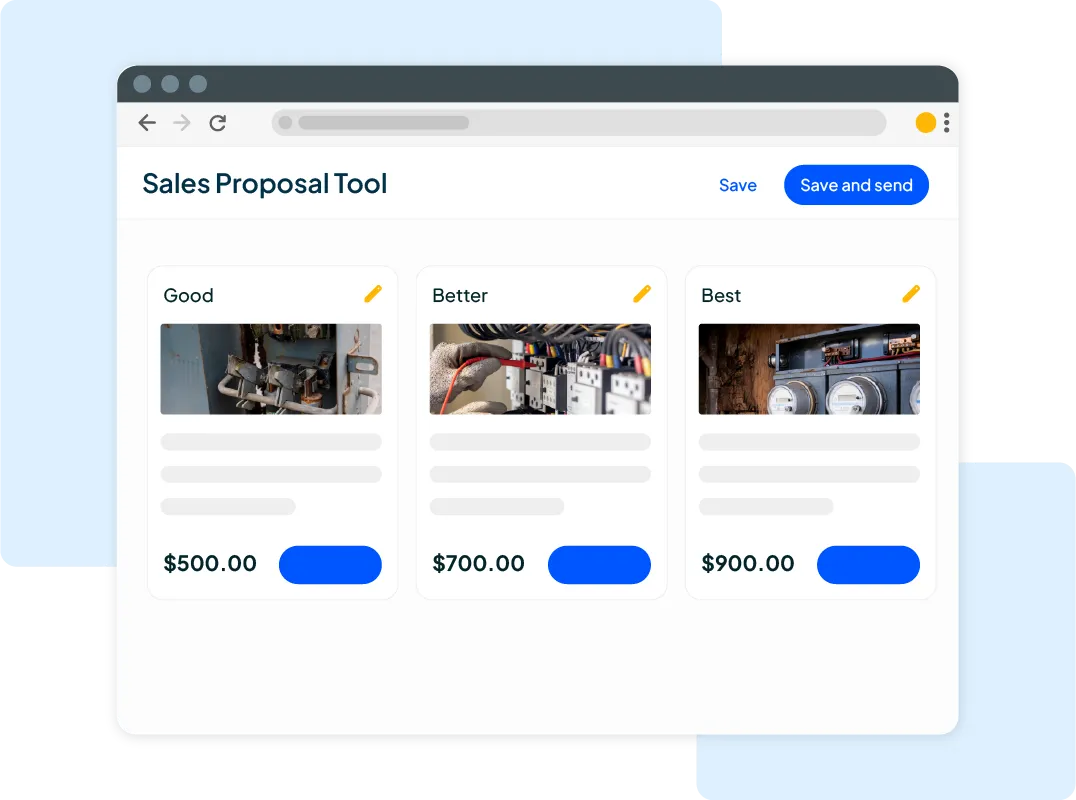
Generate branded proposals: Use customizable templates for different job types, including “good, better, best” pricing options. - Convert estimates to invoices: Turn approved bids into jobs with one click.
Offer financing options: Provide instant estimates with payment plans between $500 and $25,000. - Automate follow-ups: Use our Pipeline module to remind customers about pending quotes.
- Track profitability: See real-time job costing and gross profit to measure performance.
→ Start a free 14-day trial today to see how Housecall Pro can help grow your business.
Electrical Estimating FAQ
Why is an electrical estimate important?
An electrical estimate is important because it determines whether a job will be profitable or not. A detailed estimate ensures you’re covering materials, labor, and overhead costs while including a fair profit margin. It also provides transparency for clients, helping them understand what they’re paying for and why. Without accurate estimates, electricians risk underbidding projects, losing money, or damaging client trust.
How do I find electrical jobs to bid on?
To find electrical jobs to bid on, start by checking local bid boards, construction lead services, and general contractor networks. Websites like BidClerk, ConstructConnect, PlanHub, and GovernmentBids.com list open projects for both residential and commercial electrical work. You can also join local trade associations or builder exchanges, which often share exclusive bid opportunities with members.
Don’t overlook your own network—builders, property managers, and HVAC or plumbing contractors frequently subcontract electrical work to trusted partners.
How do you bid electrical work?
To bid electrical work, start by reviewing the project’s drawings and Division 26 specifications. Next, perform a thorough quantity takeoff to count materials—like fixtures, panels, and conduits—and determine required labor hours. Once you know your direct costs, add overhead, equipment rentals, and a profit margin.
Submitting your bid on time, in the required format, and with clear inclusions or exclusions makes your proposal stand out. Many contractors use electrical estimating software like Housecall Pro to automate this process and create professional, accurate bids faster.
How should I price electrical work?
To price electrical work correctly, start by calculating direct costs (labor and materials), then add indirect costs (overhead) and your target profit margin. Most electricians aim for a 10%–20% profit margin, depending on job type and competition.
Use real data from past projects to adjust your pricing for accuracy. Industry resources like the NECA Manual of Labor Units can also help you estimate labor hours per task, which you can then tailor to your own crew’s productivity.